Singapore, China launch talks on FTA upgrade as PM Wong meets Xi - The Straits Times
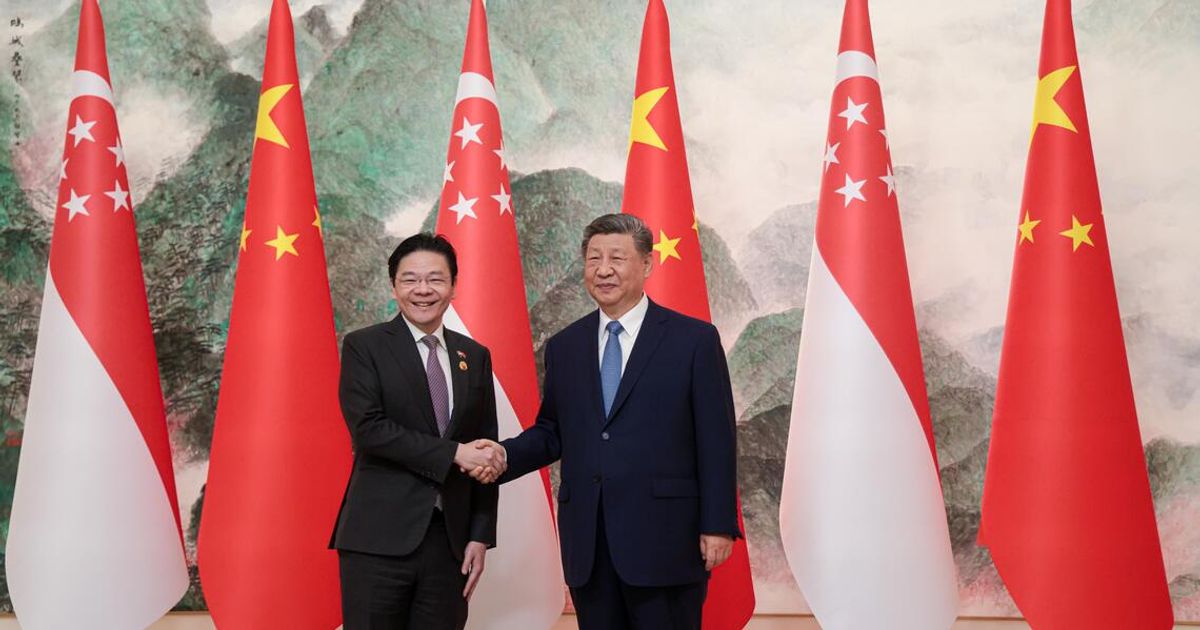
Prime Minister Lawrence Wong (left) meeting Chinese President Xi Jinping at Kylin Villa in Shenzhen on Nov 20.
SHENZHEN – Singapore and China have launched negotiations to upgrade their free trade agreement, as Prime Minister Lawrence Wong and Chinese President Xi Jinping called for closer bilateral cooperation amid growing global uncertainty when they met on Nov 20.
“Between our two countries, we have enjoyed a longstanding friendship and close partnership, and the relationship has deepened even as the international environment has become more complex,” said PM Wong during their meeting held at lakeside state guesthouse Kylin Villa in Shenzhen.
Xi said China and Singapore should strengthen strategic communication and cooperation as the world undergoes profound changes and technological advances reshape industries.
“We can make a positive contribution to international and regional prosperity and stability,” he said.
Both leaders welcomed the launch of negotiations for the China-Singapore Free Trade Agreement (CSFTA) 4.0 upgrade, which will explore greater cooperation in areas such as the digital economy and government procurement, Singapore’s Ministry of Foreign Affairs (MFA) said in a statement on Nov 20.
The proposed upgrade aims to open up new market opportunities and make it easier for Singapore companies to do business in China, said the Ministry of Energy, Trade and Industry (METI).
A memorandum of understanding to launch the negotiations was signed by Singapore Deputy Prime Minister Gan Kim Yong and Chinese Commerce Minister Wang Wentao, METI said.
The CSFTA, which took effect in 2009, was China’s first comprehensive bilateral free trade agreement with an Asian country. It has undergone several upgrades, with the latest taking effect in 2024.
The agreement is a key pillar of the economic relationship between the two countries.
China was Singapore’s largest merchandise trading partner from 2013 to 2024. Bilateral merchandise trade reached $162.9 billion in 2025, accounting for 11.7% of Singapore’s total merchandise trade.
Singapore has also been China’s largest source of foreign direct investment by annual flows since 2013.
Beyond the FTA, Xi called for deeper cooperation under the Belt and Road Initiative, better implementation of major bilateral projects and new initiatives in areas such as digital economy, green development and artificial intelligence, according to Chinese state news agency Xinhua.
These efforts would help make bilateral cooperation more innovative, technology-driven and environmentally sustainable, he said.
Xi also urged both countries to deepen political trust, respect each other’s development paths and strengthen exchanges on governance and between their political parties, Xinhua reported.
Singapore and China established diplomatic ties in 1990 and upgraded their relationship to an All-Round High-Quality Future-Oriented Partnership in 2023.
Their economic ties are underpinned by three longstanding government-to-government projects: the Suzhou Industrial Park, Tianjin Eco-City and Chongqing Connectivity Initiative.
The two countries also have cooperation platforms at the provincial and city levels.
The 25-minute session at Kylin Villa marked the third bilateral summit between the two leaders since PM Wong took office in May 2024.
PM Wong congratulated Xi on China’s successful hosting of the Asia-Pacific Economic Cooperation (APEC) summit, where leaders of 21 economies discussed ways to deepen regional economic integration, harness innovation and promote sustainable and inclusive growth.
“Our discussions were timely, especially China’s emphasis on openness, innovation and cooperation,” he said.
At the APEC summit, PM Wong had warned against allowing the Asia-Pacific to split into competing economic blocs and made a case for pragmatic economic cooperation in a region increasingly divided by strategic rivalry.
During his meeting with Xi, he welcomed China’s contributions to addressing global challenges and expressed support for its broad vision of building a “community with a shared future”, MFA said.
Singapore is already a member of the Group of Friends on China’s Global Development Initiative and will join the Group of Friends for its Global Governance Initiative (GGI), MFA added.
The GGI, proposed by Xi in 2025, seeks to reform international governance, including by giving developing countries a greater voice and strengthening the role of the United Nations.
It emphasises respect for national sovereignty, international law and multilateralism, reflecting China’s ambition to play a bigger role in shaping global rules and institutions.
PM Wong also congratulated Xi on the historic trilateral summit between China, the US and Russia.
“Such dialogue is especially valuable as it contributes to greater understanding, peace and stability for the entire world,” he said.
The two leaders also discussed developments across the Taiwan Strait.
PM Wong reiterated Singapore’s longstanding and consistent “One China” policy, and conveyed its opposition to Taiwan independence and any unilateral moves to change the status quo, MFA said.
Singapore will continue to support the peaceful development of cross-strait relations, the ministry added.
Turning to regional affairs, PM Wong updated Xi on Singapore’s priorities as ASEAN chair in 2027, including strengthening regional integration and supply chain resilience.
He looked forward to deepening ASEAN-China cooperation in tackling common challenges, such as improving regional energy security through the ASEAN Power Grid, an initiative to connect electricity networks across South-east Asia, MFA said.
Xi also called for closer coordination between Singapore and China in multilateral forums, including APEC and ASEAN-China mechanisms, to maintain regional peace and stability, Xinhua reported.
Xi noted it was PM Wong’s second visit to China in 2026, a frequency that “demonstrates the high importance you attach to China-Singapore relations”. He said he was delighted that exchanges and cooperation between the two countries over the past year had produced tangible benefits for their people.
Prime Minister Lawrence Wong (second from left) and Chinese President Xi Jinping (third from right) meeting in Shenzhen on Nov 20. The two leaders have also called for closer cooperation amid global uncertainty.
The bilateral discussions came ahead of the 22nd meeting of the Joint Council for Bilateral Cooperation (JCBC), expected to be held in Singapore later in November.
The JCBC is the highest-level bilateral mechanism for reviewing cooperation and setting the strategic direction of ties between the two countries.
PM Wong left Shenzhen for Beijing on Nov 20.
Yew Lun Tian is an Assistant Foreign Editor at The Straits Times.