Singapore exploring Canada as potential energy source, anticipates further fuel disruptions from Middle East: Vivian Balakrishnan - CNA
Speaking after his visit to Ottawa, Dr Balakrishnan described Canada as an energy "superpower" in both fossil fuels and renewable energy.
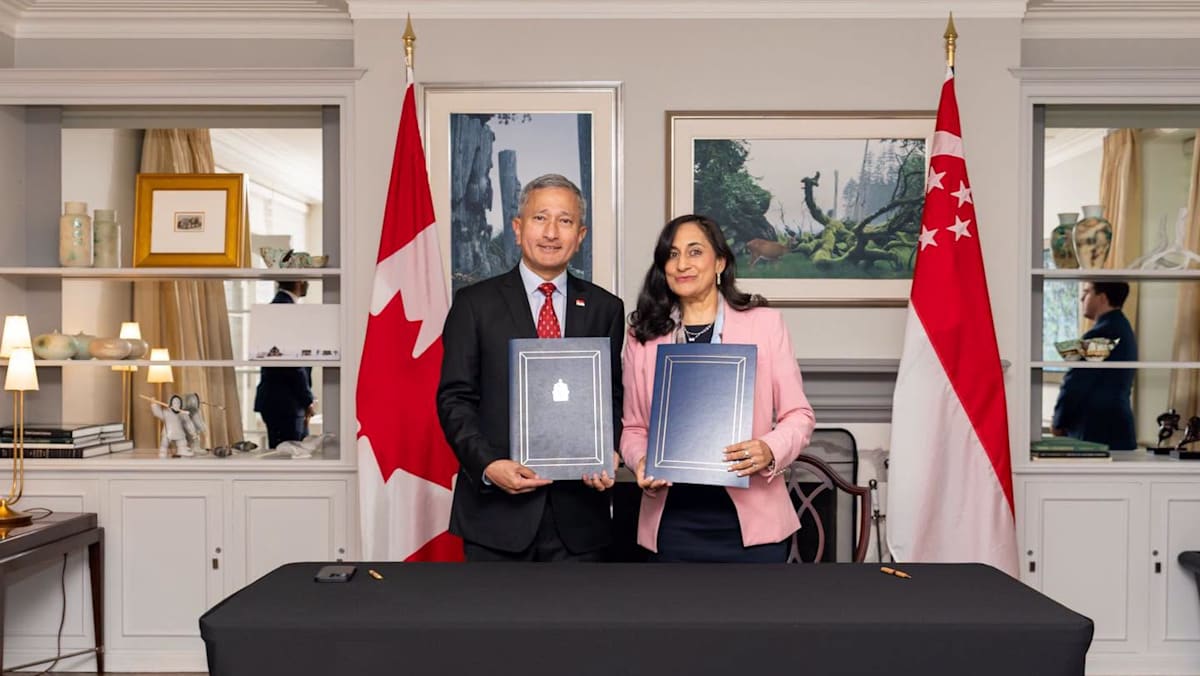
Singapore Foreign Affairs Minister Vivian Balakrishnan and Canadian Foreign Minister Anita Anand at the signing of a joint statement for the Singapore–Canada Economic Partnership Framework. (Photo: Facebook/Vivian Balakrishnan)
This audio is generated by an AI tool.
Vanessa Lim 19 Sep 2026 09:53AM (Updated: 19 Sep 2026 09:57AM) Bookmark Bookmark Share WhatsApp Telegram Facebook Twitter Email LinkedIn Set CNA as your preferred source on Google Add CNA as a trusted source to help Google better understand and surface our content in search results. Read a summary of this article on FAST. Get bite-sized news via a newcards interface. Give it a try. Click here to return to FAST Tap here to return to FAST FAST SINGAPORE: Singapore should anticipate further disruptions to energy supplies from the Middle East with the conflict affecting key shipping routes, Foreign Affairs Minister Vivian Balakrishnan said on Saturday (Sep 19).
Speaking to reporters at the end of visits to Doha and Ottawa, Dr Balakrishnan said Singapore is also looking at Canada as a potential source of energy and food.
He said the closure of the Strait of Hormuz has been a “major, major impediment” to liquefied natural gas (LNG) exports from Qatar, a major supplier to Singapore.
Singapore has so far been able to cope because it has diversified sources, he added.
CNA Games Guess Word Crack the word, one row at a time Buzzword Create words using the given letters Mini Sudoku Tiny puzzle, mighty brain teaser Mini Crossword Small grid, big challenge Word Search Spot as many words as you can Show More Show Less He pointed to problems around the Bab el-Mandeb strait, which could affect exports from Saudi Arabia, as another warning of possible disruptions ahead.
“We have to anticipate further disruptions to fuel supply from the Middle East in general,” he said.
Singapore will continue to monitor the situation closely and work with its partners, Dr Balakrishnan said.
During his stop in Qatar, Dr Balakrishnan said it was important to express Singapore’s solidarity and to explore “preliminary ideas on resilience for the future”.
Qatar and Singapore continue to insist on freedom of navigation, particularly in straits used for international navigation, such as the Strait of Hormuz, he said.
Describing Canada as an energy “superpower” in both fossil fuels and renewable energy, Dr Balakrishnan said Singapore is looking at the country as a potential source of energy and food.
Singapore is also looking at the possibility of having more formal arrangements for trade in essential supplies with Canada.
The two countries are exploring opportunities in artificial intelligence, the digital economy and digital payments.
"All these again are preliminary, but we hope that within the next two to three months, we will have some agreements ripe and ready for signature," he said.
During his visit, Dr Balakrishnan and Canadian Foreign Minister Anita Anand signed a joint declaration that would lead to the establishment of an economic partnership framework.
“We hope to get this ready within the next couple of months, and we were really looking for complementarities between Canada and Singapore and I think this will give us many opportunities, including for Singaporean companies who want to invest in Canada or who want to take advantage of the complementarities in our economy,” he said.
“For Canada, the Pacific, the Asia Pacific, offer many opportunities. It's complementary to the Canadian economy and vast markets in Asia, which will be available to Canada.”
Dr Balakrishnan’s visit to Ottawa was the first visit by a Singapore foreign affairs minister to Canada since 2013, according to Global Affairs Canada.
It followed Ms Anand’s visit to Singapore in October last year, when the countries marked 60 years of diplomatic relations, as well as Canadian Prime Minister Mark Carney’s visit to Singapore that same month.
Amid trade tensions with the United States, Canada has been looking to expand its economic opportunities across both the Atlantic and Pacific, said Dr Balakrishnan.
He noted that Canada and the US have a “special relationship” and remain tightly integrated economically, politically and at the people-to-people level.
He said that it was not Singapore’s role to become directly involved in the “to-ing and fro-ing” between the two neighbours.
“Having said that, I think it is a path of no regret for Canada to explore opportunities across both the Atlantic and the Pacific, because Canada does have goods and services and products and resources which are in demand all over the world, and Canada should maximise its opportunities for trade and investment across the Asia Pacific and in Europe,” he said.
“So, what is happening now, and the fact that Canadian bandwidth is now allocated across a much broader spectrum of the world, is an opportunity, and it's an opportunity for us in Asia, and in particular for Singapore.”
Dr Balakrishnan said he hoped to see a “significant breakthrough” in negotiations for an ASEAN-Canada free trade agreement. Singapore takes over the ASEAN chairmanship from the Philippines on Jan 1, 2027.
“Canada is now looking for opportunities ... on a global level, as I said, across the Pacific and across the Atlantic, and the fact that Canada is now focused on doing this is an opportunity, especially for us in the Asia Pacific, where we see Canada as another like-minded partner.
“We believe in globalisation, rules-based, liberal, free and fair trade. It's a source of investment, a source of technology, a source of energy. So it's a complementary relationship, which I would say is overdue.
“But now that the stars are aligned, we should maximise the opportunities in this relationship,” he said.