
SIR row: What changed in Form 6, and why did 2 Election Commissioners object?
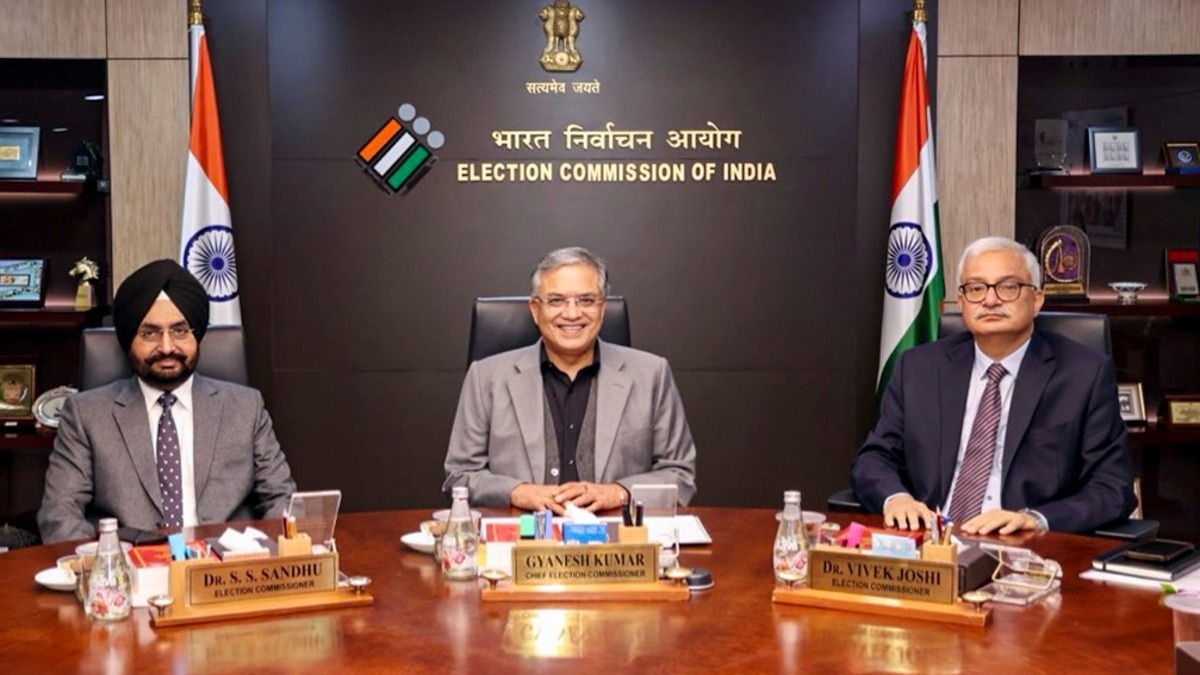
A serious controversy has erupted over changes made to ECINet, the online version of Form 6 used by the Election Commission for the registration of new voters.
The controversy intensified after reports emerged of objections and differences of opinion between two of the three Election Commissioners, Sukhbir Singh Sandhu and Vivek Joshi. Following the revelation, the changes are being described as “illegal” and “unauthorised.”
The main objections were related to changes made to Form 6, which is filled out to register a name in the electoral roll. A new declaration section linked to the Special Intensive Revision (SIR) was added to the Form 6 available on the portal.
Under the new change, particularly first-time voters and new applicants were asked three questions related to the names of their parents or grandparents in the electoral rolls. They were asked to select one of the options.
The first question was whether their own name appeared in the electoral roll during the SIR conducted in the early 2000s.
The second was whether the names of their parents or grandparents appeared in that old list.
The third asked what would happen if neither their name nor that of their parents appeared in that list.
Although this question was marked as “Non-Mandatory”, the form could not be submitted on the portal without answering the declaration.
Both Election Commissioners reportedly raised several legal objections and expressed their disagreement over these changes. Former Chief Election Commissioner OP Rawat and former Election Commissioner Ashok Lavasa also supported the objections.
The legal and practical objections described the change as a violation of the prescribed legal process and termed it an unauthorised alteration.
The Election Commissioners argued that Form 6 is a statutory form prescribed under the Registration of Electors Rules, 1960. Any change to the rules or the form requires a notification from the Ministry of Law and a formal amendment. The Commission cannot alter it merely by issuing an order or guideline at its own level.
In his dissent note, Election Commissioner Sukhbir Singh Sandhu warned that adding such incomplete and unauthorised declarations could create difficulties for young people and first-time voters. They could even be deprived of their right to vote.
Former CEC OP Rawat also said that the SIR process had created a sense of fear among voters, which was unfortunate for democracy.
The change affects new voters in several ways. Those whose families were left out of the electoral rolls or whose names were removed for some reason during the 2002 revision could face a generational problem.
Apart from Form 6, the Election Commissioners also objected to the control of the country’s digital electoral databases, ECINet and ERONet, being concentrated at the Delhi headquarters.
They argued that this was preventing ground-level officials, or Electoral Registration Officers (EROs), from getting full access and freedom to carry out their work.
In this entire matter, the two Election Commissioners had reportedly recorded at least 14 written objections on record over the past 10 months.
The Election Commission, however, has rejected reports of internal differences, saying that it is a multi-member institution where differences of opinion, internal comments and suggestions are a normal part of the process. It also said that all decisions related to electoral revision were taken unanimously.
Political parties have also become vocal over the changes made to Form 6.
The Congress said that following the revelation, the Chief Election Commissioner had no right to remain in office even for a second and should resign immediately.
The Congress alleged that the BJP had opened an office for the “murder of democracy” and that the government was running a “double-bulldozer.”
Condemning what it described as the Chief Election Commissioner’s dictatorial style of functioning, the party said he had held the constitutional institution hostage.
A Congress spokesperson, citing a Supreme Court judgment, said that the Chief Election Commissioner is not the supreme authority but is instead “first among equals”.
Congress MP and spokesperson, senior advocate Abhishek Manu Singhvi, said that dissent protects democracy and that disagreement is not an obstruction. He praised the dissent recorded by the two Election Commissioners.
The Congress leader demanded transparency and said all written dissent notes should be made public. “This is extremely important to fix accountability,” Singhvi said.
Singhvi said the developments pointed to just one thing: the ruling party’s obsession with winning elections by “saam-daam-dand-bhed” -- by any means possible.
He further alleged that the BJP also wanted no trace of the Opposition to remain wherever it had won. He said it would be a unique case in the world if the “formal Opposition” in West Bengal was supporting the government.
Citing the large-scale deletion of voters’ names, Dr Singhvi said 7.8 crore voters -- 13 per cent of the previous electoral roll -- had been removed during the first and second phases of the SIR. He said that in the next phase, currently underway in 16 states and three Union Territories, 6.18 crore names had been removed, amounting to 17 per cent.
He added that 5.43 crore voters had been declared doubtful and served notices to submit additional documents. He expressed apprehension that the total number of names removed could reach 15 crore once the SIR process is completed.- EndsPublished By: Sayan GangulyPublished On: Sep 23, 2026 20:35 IST

