Smit Machchhar’s heroism forces a rethink of cockpit safety - The Indian Express
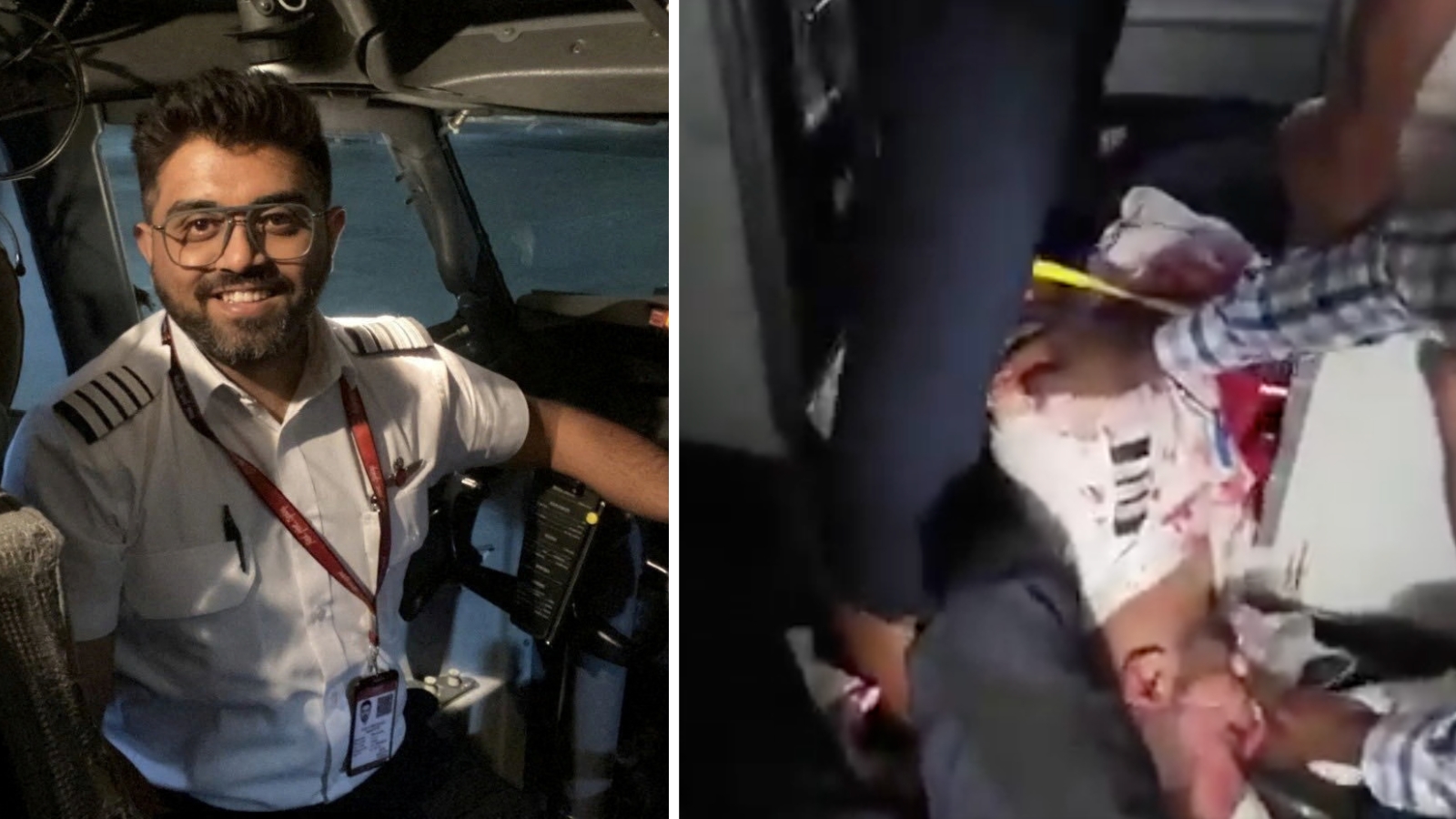
On Wednesday, a Flydubai flight from Dubai to Tel Aviv dropped 14,000 feet in 29 seconds. With 174 people on board, the reason it landed at all was its Indian captain, Smit Machchhar, a pilot who was attacked by his own co-pilot, severely injured, and yet managed to unlock the flight deck door. Today, the entire country stands proud, and both the Indian and Israeli prime ministers have commended Machchhar for his valour. The commendations are well deserved but they also reopen questions of safety and technology, which are once again staring the aviation sector in the face.
On this flight, nothing mechanical on the aircraft malfunctioned. The human element failed. Forty years of aircraft design has focused on engineering out human error — the incorrect altitude, the incorrect setting, or an exceedingly sharp angle of descent. The engineering, by its very nature, has to first reduce error to a statistical problem and then apply automation. But malice and intent to kill are not an error and rarely revealed in numbers. It is a judgement, and a decision. And the 9/11 terrorist attack, in which aircraft were used as missiles, has already shown what horrific outcomes can come of this.
Airlines and airports and regulators are not naive about this, and the safety architecture in aviation is more serious than most passengers realise. In addition to airport security protocols, most airlines run a psychological assessment of every pilot before they are released to line flying, run support programmes for all crew members, and conduct random testing for psychoactive substances. Airports also employ behaviour detection officers and technology, both of which will now likely also focus on airline crew behaviour. On several flights, air marshals are present. But by the very nature of the programme, their identity and pattern are secret. As is any coordination with intelligence agencies.
Even so, what the safety system actually measures is fairly narrow. A psychological assessment at the start of employment is a snapshot in time. The Class 1 medical test that pilots have to clear at regular intervals is built to catch physiology, not psychology. And psychometrics usually screen for instability, not for ideology or malintent.
Once the aircraft is in the air, the cockpit has been the last line of defence. The captain commanding the aircraft is given full authority for the flight, and automation has always held that there be an override in the cockpit whereby the aircraft can be taken over manually. This is even though a ground-initiated override — via a protected uplink allowing a certified authority to take an aircraft — exists. In fact, the technology is actually almost two decades old. But it has never been used on a commercial aircraft because, among other considerations, no regulator has been willing to answer the question of who will hold the key.
But at a time when Artificial Intelligence is working wonders, and where autonomous vehicles — be it on the ground or in the air — are a reality, this likely will reignite the debate. Autonomous vehicles already exist, and millions of passengers board automated people movers across airports across the globe. Many cities in the US now have driverless cabs. And autonomous drones are ubiquitous. Autonomous aircraft are the next step in this evolution, and the stepping stone is likely the ground-initiated override. But automation cannot remove the error of human misjudgment. More importantly, it cannot assume responsibility. And accountability is not a capability that can be specified, procured or certified.
A link that can take an aircraft from a hostile pilot is also a link that can take an aircraft from a competent one. Centralising control substitutes a human-trust problem with another human-trust problem. Ironically, while creating a safety net, it paradoxically also creates a new way to attack an aircraft.
The choice, as such, is binary, and that is the complication. Either the aircraft becomes genuinely autonomous with no pilot, no override, nobody on board or on the ground with the capability to use it as a missile. Or it keeps a human at the controls, in which case it must keep a second human for checks and balances. Every architecture in between concentrates authority in one pair of hands. Until there are no pilots in cockpits, there will have to be two in them. Captain Smit Machchhar has strengthened this for several years to come. He should not have had to.