Smuggling suspected as more rare animals seen in India
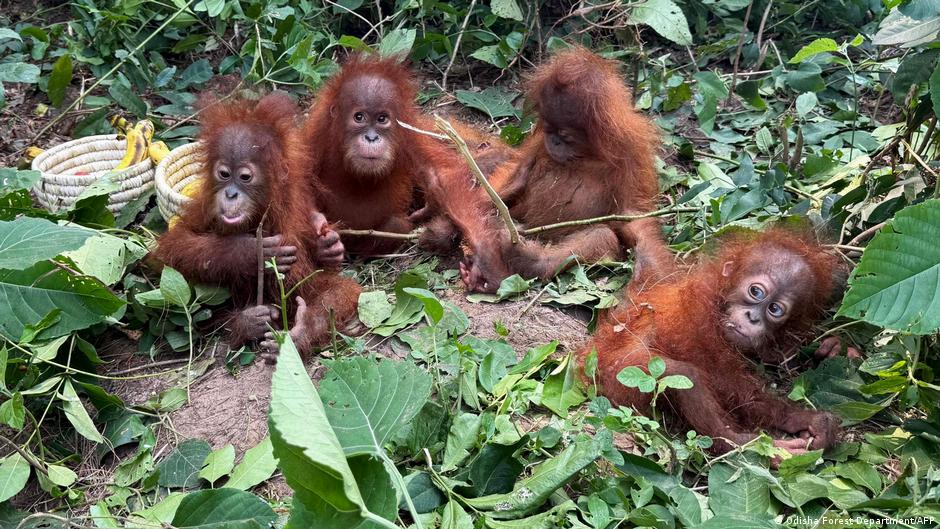
Orangutans in the wild are native only to Indonesia's Sumatra island and Borneo. These young ones were found in a forest in IndiaImage: Odisha Forest Department/AFPAdvertisementFive infant orangutans, a species found only on the Indonesian island of Sumatra and on Borneo, were found in a forest by rangers patrolling in the Balasore district of India's eastern Odisha state last week.
Indonesia's Forestry Ministry has asked India to establish the origin of the abandoned orangutans, known for their shaggy red fur, and return them if they are found to have come from their usual habitat abroad.
The rescue of the rare apes has raised fresh questions about how exotic animals enter India and how the country is used in the illegal wildlife trade.
"The discovery on the eastern coast of India is a bit mind-boggling. It's like that time a few years ago when live kangaroos were found wandering along the highways of West Bengal," Kanitha Krishnasamy, Southeast Asia director at wildlife trade monitoring network TRAFFIC, told DW.
"What are orangutans doing in India? Were they smuggled from their native Malaysia or Indonesia or did they come from a facility?" she asked.
The Odisha government has asked the Wildlife Crime Control Bureau to investigate how the critically endangered animals reached the state.
"These animals are not found in India and are mostly seen in the rainforests of Malaysia, Indonesia, Borneo and Sumatra in Southeast Asia," said Odisha's Forest and Environment Minister Ganesh Ram Singh Khuntia.
"We suspect that they might have been released in the Balasore district forest… by an international wildlife smuggling racket."
The orangutans are the latest in a series of exotic wildlife being seized in India.
In November 2024, authorities in the Indian city of Bengaluru seized 40 rare animals arriving from the Malaysian capital, Kuala Lumpur, including Aldabra giant tortoises, gibbons, American alligators and iguanas.
In June 2025, Mumbai Customs seized 284 exotic animals arriving in four consignments from the Thai capital, Bangkok, including snakes and tortoises.
In July 2025, customs officials in the Indian city of Pune intercepted 20 exotic animals from passengers arriving from Bangkok. They included 14 green tree pythons, four double-eyed fig parrots and two Sumatran striped rabbits.
According to figures from TRAFFIC, 7,272 individual animals, alive and dead, were seized from passenger baggage in smuggling attempts between Thailand and India between January 2022 and May 2025, with more than 80% of interceptions taking place in India.
The animals included reptiles, birds and mammals — many apparently destined for the exotic pet trade.
"We have found hundreds of species and thousands of individuals being trafficked into India through air and land routes. This changed drastically from around 2020," conservation researcher and practitioner Uttara Mendiratta told DW.
"Both the volume of this trafficking, and the number of species involved, many of which are endangered, have been shocking."
TRAFFIC says India and Malaysia were the countries most implicated in an illegal gibbon trade chain identified in 2025, with gibbons being moved from Malaysia to India.
Trishala Ashok, a conservation filmmaker and science communicator, says the scale of the trade remains difficult to establish.
"Our enforcement systems haven't evolved at the same speed as the trade," Ashok told DW. "We are still reacting to individual seizures rather than mapping the networks, financiers, suppliers and buyers behind them."
Tito Joseph of the Wildlife Protection Society of India says the situation is escalating.
"Smuggling of exotic species was always there in India," Joseph told DW.
At the same time, he noted that it has increased significantly since 2018.
He identifies routes running from Myanmar through northeast India into other parts of the country, as well as movement from Bangladesh into India. By air, Thailand and Malaysia are important sources of trafficked wildlife.
The routes into India also extend beyond airports. Exotic animals are also reaching India through its northeastern land borders.
"What is new is the large volume of incoming live wildlife. There are indications that some of the traders who were involved in smuggling live animals like star tortoises out are now also involved in sourcing [other] exotic wildlife," said Mendiratta, the conservation researcher.
Demand is being fueled by growing ownership of exotic pets and unregulated digital marketplaces, according to a June 2026 analysis of India's exotic pet trade by Humane World for Animals India, an NGO that works to tackle the root causes of animal cruelty.
"Internationally, social media platforms have aided and abetted the growth of illegal trade in wild animals by providing a platform for people to display and boast about the animals they collect," wildlife biologist and conservation scientist Ravi Chellam told DW. "These platforms are also serving as an online marketplace for the illegal trade to flourish."
"The problem is exacerbated by the senseless and obscenely huge personal collections of animals from around the world by the rich and the famous," Chellam noted.
Establishing where an animal came from can become particularly difficult once it has crossed several borders.
"A seizure cannot be the end of the investigation. It should be the beginning," said Ashok, the conservation filmmaker.
"Who supplied the animals? Who arranged the movement? Who paid? Who was waiting for them?" she asks. "Until we start following those links, we will keep catching consignments without dismantling the networks behind them."