Sold nostalgia for former East Germany... Ulrich Siegmund behind the AfD surge [See-through People] - 경향신문
![Sold nostalgia for former East Germany... Ulrich Siegmund behind the AfD surge [See-through People] - 경향신문](https://img.khan.co.kr/news/2026/09/07/rcv.YNA.20260907.PEP20260907032201009_P1.jpg)
This article was translated by an AI tool. Feedback Here.
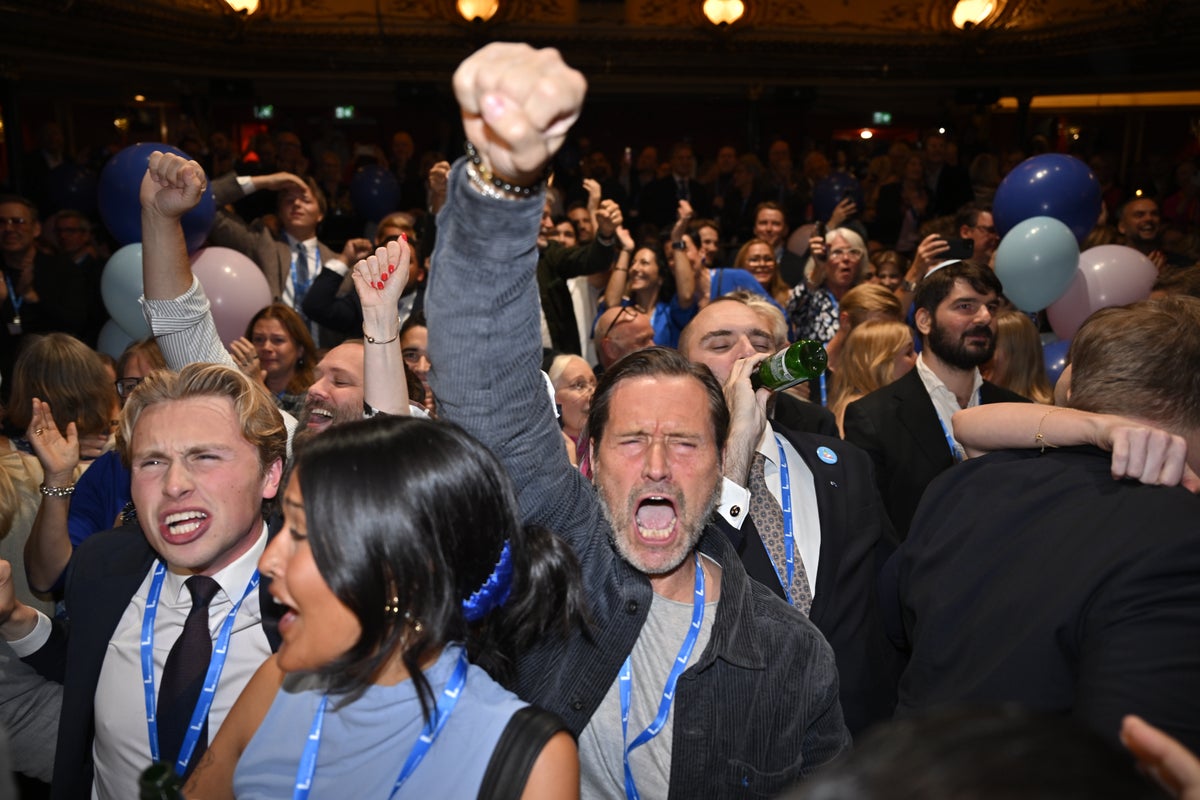
Ulrich Siegmund, Alternative for Germany (AfD) candidate for Saxony-Anhalt state premier, leaves after voting on the 6th (local time) at a polling station in Tangermuende, riding a Simson Schwalbe moped. EPA Yonhap News
At an AfD rally held in Quedlinburg, Saxony-Anhalt, in eastern Germany, someone arrived cutting through the crowd on a blue Simson motorcycle. It was Ulrich Siegmund, the AfD nominee for state premier.
The event, which drew about 5,000 people by AfD estimates, was steeped in nostalgia for the East German era. Most participants, residents of the area, came in Trabant cars, once dubbed the national car of East Germany, and on Simson motorcycles, the national bike. They carried flags of the former East Germany and the Free German Youth (FDJ), wore T-shirts bearing the hammer and sickle, and donned helmets emblazoned with the word East Germany. They then rode through the Harz Mountains with Siegmund.
How did a group deemed a threat to democracy create a surge?
The domestic intelligence service officially classified the AfD Saxony-Anhalt branch last year as an extremist organization that threatens democracy. This extremist group, which had maintained consistently high support, won at least 44% in the Saxony-Anhalt state election held on the 6th (local time), proving its surge.
Observers say the background is a strategy by Siegmund and AfD that used a friendly image to stir the nostalgia of voters in the former East. Ahead of this election, Siegmund stopped his earlier aggressive messaging and began to speak the language of hope. Although hardline deportations and migration policies of AfD still lay behind it, the new face of AfD felt fresh to many residents.
David Begrich, director of the Institute for Research on Right-Wing Extremism under the pro-democracy civic group Miteinander, told public broadcaster ZDF that the Siegmund camp are people politically socialized within a far-right milieu.
Born in 1990, Siegmund is 36. He hails from Tangermuende, a small town on the Elbe River in northern Saxony-Anhalt. This rural area became more than his hometown; it became the reference point for his politics. He has described his hometown as a place where children could play outside in the evening without worry and has argued that all of Saxony-Anhalt should be such an ideal world (heile Welt).
He was not a so-called political elite. After earning a qualification for a university of applied sciences during his school years, he finished Gymnasium and went straight into vocational training. He worked as a salesperson for electrical goods and also at an eye clinic. He later studied industrial and organizational psychology and ran a fragrance sales business. In this campaign, he highlighted past experiences such as sweeping warehouse floors and dealing directly with customers. Local media reported that, thanks to his sales career, Siegmund could leave a good impression even in brief encounters.
In his early political career, he was not as far-right as now. At 18, he joined the center-right Christian Democratic Union (CDU). Around 2013, opposing the eurozone bailout policies of former Chancellor Angela Merkel, he moved to AfD. In 2016, in his twenties, he entered the Saxony-Anhalt state parliament. During the Covid-19 period, he gained visibility by strongly criticizing the government response to the pandemic, and in 2022 he became co-leader in the legislature, rapidly emerging as the next candidate for state premier.
About a year before the election, his message, once similar to that of other AfD politicians, began to change. He dropped invective and agitation and adopted a warm, upbeat tone. He used positive slogans such as Everything is possible and Let us rebuild the country. He also amped up approachability: rather than speaking in a suit from a podium, he wore a sweater and communicated by smartphone from his car or while walking. Public broadcaster ARD described him as a shrewd salesman of ideology.
Yet, contrary to the gentle image, his pledges and the people around him make AfD radicalism unmistakable. Immigration law experts at Martin Luther Halle-Wittenberg University wrote in the legal outlet Verfassungsblog that most pledges from the Siegmund camp appear to be unlawful. Key ideas include holding people slated for deportation in ordinary prisons, concluding repatriation agreements with foreign countries, and reducing support for asylum applicants, which they say run counter to current law or the constitution.
Associates with records linked to Nazism have also become an issue. Patrick Harr, head of the AfD Saxony-Anhalt campaign, is known to have belonged to HDJ, a now-banned neo-Nazi group that taught subjects such as race studies. Members of Filmkunstkollektiv, which produced campaign materials, also belong to organizations the Federal Office for the Protection of the Constitution classifies as extremist. Siegmund has praised them as an excellent team.
Criticism focuses on this duality. Although Siegmund has emphasized defending the free democratic basic order, Begrich argued this effectively uses criminal punishability as the sole criterion. In other words, he does not distance himself politically from extreme or radical forces or positions and treats anything that is not punishable as unproblematic.
Furthermore, ZDF reported that, even within AfD, there are claims that the actual political stance of Siegmund remains unclear.
Far-right rule becomes real... What kind of Germany under AfD?
Some say Siegmund is merely a puppet of the AfD central party. Whatever the case, his desire to take power looks unmistakable. Even without an absolute majority to form a single-party government, he is sticking to taking power while ruling out coalitions with other parties.
AfD is a party that defines reflection on the Nazi era as the perpetuation of a guilt complex and has insisted that all Syrians living in Germany be returned.
ZDF noted that it is unknown what changes might come to Saxony-Anhalt under Siegmund and AfD. It then pointed again to the words on his election poster, Everything is possible.