Some Democrats don’t expect to fill a Supreme Court vacancy under Trump
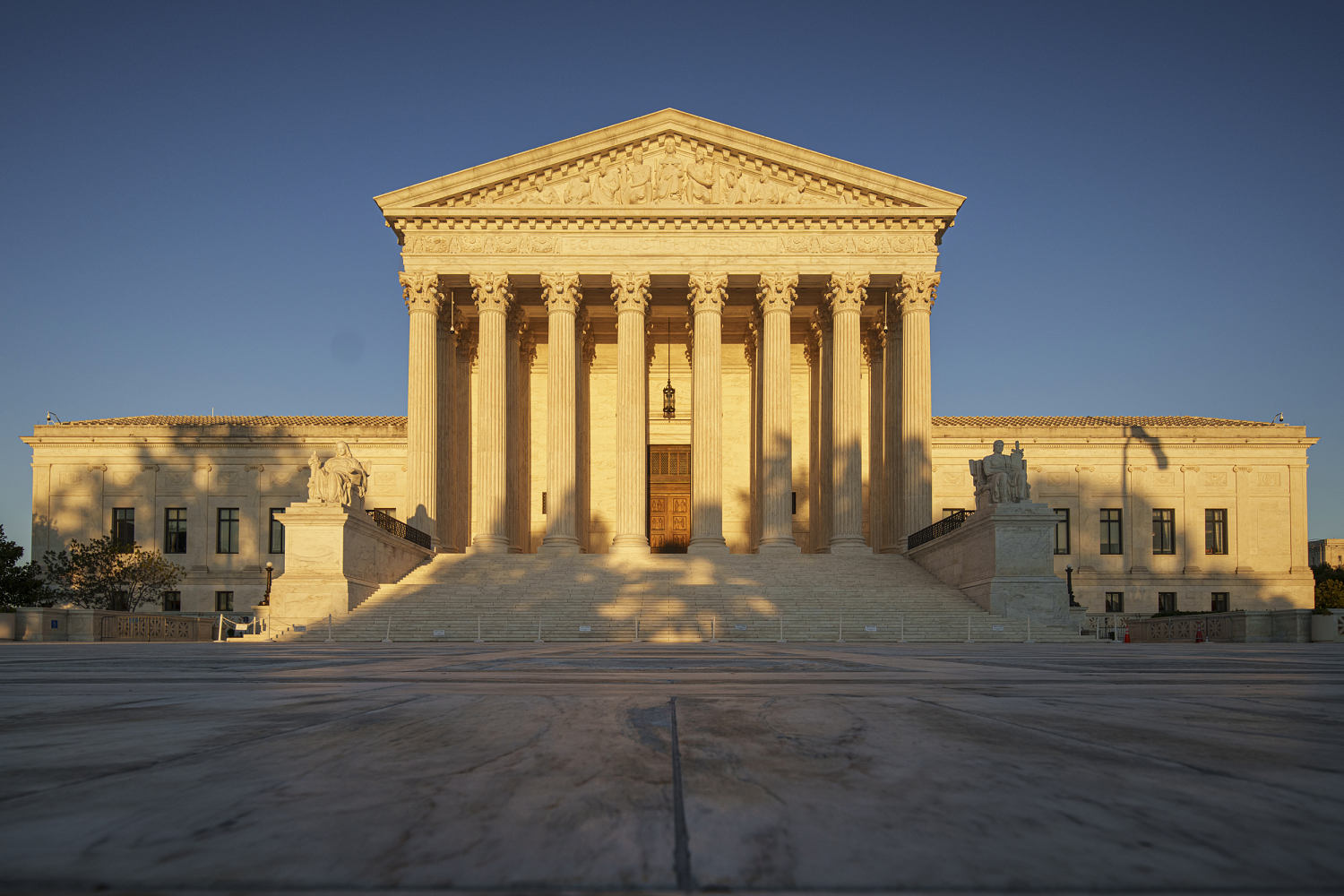
Some Democrats say they should take the same approach then-GOP leader Mitch McConnell did and refuse to seat another Trump appointee to the Supreme Court.J. David Ake / GettyShareAdd NBC News to GoogleOct. 5, 2026, 12:21 PM EDT / Updated Oct. 5, 2026, 12:55 PM EDTBy Sahil KapurWASHINGTON — Senate Minority Leader Chuck Schumer, D-N.Y., is putting President Donald Trump on notice: If Democrats win control, they don’t intend to put “MAGA” judges on the courts.
“The bottom line is: One of the reasons we want to do everything we can to take back the Senate is not let Trump put such horrible justices — MAGA justices — on the Supreme Court and the lower courts,” Schumer said in response to a question from NBC News about a potential high court vacancy if Democrats win in 2026.
Sen. Richard Blumenthal, D-Conn., a senior member of the Judiciary Committee, said he doesn’t think a Democratic-led Senate would confirm a Trump pick for the Supreme Court either.
“Well, given the history of Trump nominees, I think it is slim to none that we would support a nominee from this administration,” Blumenthal said in an interview. “Because we’ve seen this movie, we know how it ends, which is a politician in robes who is following Trump’s orders on most major questions.”
Add to GoogleSupreme Court kicks off term with major climate change case04:53The remarks highlight the high stakes of the 2026 election for Trump’s final two years when it comes to judicial nominees, especially for the Supreme Court if there’s a vacancy. None of the nine justices have signaled plans to retire, but speculation has centered on how long the two oldest justices — conservatives Clarence Thomas, 78, and Samuel Alito, 76 — will stay on the court. Justice Sonia Sotomayor and Chief Justice John Roberts are the next oldest justices, at 72 and 71, respectively.
Alito told CBS News in a recent interview that he considered retirement earlier this year, but ultimately decided against it.
“It’s something I think that somebody at my age has to think about every term,” Alito said, while adding: “It’s too hard to predict what the political situation will be, and what any president might do with respect to a replacement.”
If Democrats win control of the Senate, they would have the power to determine which of Trump’s nominees for federal judicial postings get hearings and votes, including for a hypothetical Supreme Court vacancy.
But if Republicans keep control, the president will maintain his glide path to fill vacancies with his preferred nominees — adding to his nearly six-year total of 290 federal judges, including three Supreme Court justices during his first term. All of those judges have been confirmed under GOP Senate control.
Some Democrats say there should be no question of confirming a Trump pick after former Senate Majority Leader Mitch McConnell, R-Ky., held a seat open for 10 months under President Barack Obama to let a Republican president fill it instead. (Justice Neil Gorsuch ultimately filled that vacancy).
“No, we’ve got to do exactly what McConnell did to us,” Sen. Ruben Gallego, D-Ariz., said.
Gallego said he doesn’t want it to become a rule that no president can get a nominee confirmed by a Senate run by the opposing party. But at minimum, he wants Democrats to “even the scales.”
Beyond that, “I don’t think you know you want to go down that road,” the first-term Arizona Democrat said. “But clearly you know McConnell and Trump used, I would say, their power, whatever you want to call it, to change the makeup of the courts. And I think we have to start moving it back.”
Sen. John Kennedy, R-La., who sits on the Judiciary Committee, said he wouldn’t count on Trump getting any Supreme Court nominee through a Democratic-led Senate.
“I don’t think it would be impossible. You know, there’s a slim possibility, very slim possibility,” Kennedy said. “But there’s a possibility that somebody would confuse me with Brad Pitt. I mean, it’s possible, but it’s not likely.”
Kennedy, like most U.S. senators quoted in this article, spoke before Alito’s comments to CBS News were published.
Sen. Darline Graham, R-S.C., who took her late brother Lindsey Graham’s seat on the Judiciary Committee when she was appointed to the Senate, reacted directly to Alito’s remarks and connected it to her 2026 campaign for a six-year term.
“Should Justice Alito choose to retire next year, a Republican-majority Senate will be needed to vote and hopefully confirm a Supreme Court nominee from President Trump,” Graham wrote on X. “If Democrats control the Senate, they will not even allow a vote. And if they allow a vote, they will defeat a Trump-nominated candidate regardless of their qualifications.”
FOR SUBSCRIBERSDOJ moves to revoke U.S. citizenship for 40 foreign-born AmericansFOR SUBSCRIBERSThe U.S., Denmark, and Greenland reached a security deal. Here’s what to know.FOR SUBSCRIBERSFamily of Epstein victim appears in campaign attack ad in ColoradoFOR SUBSCRIBERSFlying through ‘fire clouds’: A NASA project is studying the weather wildfires createFOR SUBSCRIBERSSusan Collins and Troy Jackson brace for debate gantlet in close, pivotal Maine Senate raceFOR SUBSCRIBERSIs ‘bad’ cholesterol actually good? Cardiologists set the record straightFOR SUBSCRIBERSIn early clinical trial, people with Type 1 diabetes are able to go off insulinFOR SUBSCRIBERS‘Daddy, we don’t want to die’: Daughters’ words pushed Flydubai passenger to confront attackerFOR SUBSCRIBERSPoll: The Latino vote isn’t a monolith. Here’s how it breaks down by gender, generation and more.FOR SUBSCRIBERSWhy 7 million fewer working women get paid time off than menFOR SUBSCRIBERSTaiwan reckons with the prospect of fending for itself as Trump pivots on ChinaFOR SUBSCRIBERSHow Trump’s strikes against Houthis foreshadowed struggles in Iran warFOR SUBSCRIBERSWalmart’s quest for market share expands with a new bohemian fashion brandFOR SUBSCRIBERSDating under fire: With a shrinking population, Ukraine faces a demographic crisisFOR SUBSCRIBERSHigh-profile special prosecutor takes over Cornell investigationAnother open question is how a Democratic majority would approach Trump judicial nominees for the lower courts.
FOR SUBSCRIBERSDOJ moves to revoke U.S. citizenship for 40 foreign-born AmericansFOR SUBSCRIBERSThe U.S., Denmark, and Greenland reached a security deal. Here’s what to know.FOR SUBSCRIBERSFamily of Epstein victim appears in campaign attack ad in ColoradoFOR SUBSCRIBERSFlying through ‘fire clouds’: A NASA project is studying the weather wildfires createFOR SUBSCRIBERSSusan Collins and Troy Jackson brace for debate gantlet in close, pivotal Maine Senate raceFOR SUBSCRIBERSIs ‘bad’ cholesterol actually good? Cardiologists set the record straightFOR SUBSCRIBERSIn early clinical trial, people with Type 1 diabetes are able to go off insulinFOR SUBSCRIBERS‘Daddy, we don’t want to die’: Daughters’ words pushed Flydubai passenger to confront attackerFOR SUBSCRIBERSPoll: The Latino vote isn’t a monolith. Here’s how it breaks down by gender, generation and more.FOR SUBSCRIBERSWhy 7 million fewer working women get paid time off than menFOR SUBSCRIBERSTaiwan reckons with the prospect of fending for itself as Trump pivots on ChinaFOR SUBSCRIBERSHow Trump’s strikes against Houthis foreshadowed struggles in Iran warFOR SUBSCRIBERSWalmart’s quest for market share expands with a new bohemian fashion brandFOR SUBSCRIBERSDating under fire: With a shrinking population, Ukraine faces a demographic crisisFOR SUBSCRIBERSHigh-profile special prosecutor takes over Cornell investigationBlumenthal said that one of his litmus tests for Trump judicial nominees up and down the courts is that they must be able to correctly answer who won the 2020 election, a question that various Trump nominees have refused to engage on as the president persists with false claims that it was stolen from him.
“We’ll stop a lot of these totally unqualified, ideologically right-wing nominees who won’t answer the question of who won the 2020 election,” Blumenthal said. “Among other questions.”
Some Democrats with a long memory haven’t forgotten that McConnell slowed nearly all judicial nominations to a crawl in Obama’s last two years, when the Kentucky Republican first took charge as Senate majority leader. McConnell saw it as payback for Democrats abolishing the 60-vote threshold for lower court judges in 2013, which at the time was part of a rapidly escalating judicial war between the parties.
Still, not all Democrats are willing to speculate on how they would deal with Trump’s judicial nominees.
Sen. Mazie Hirono, D-Hawaii, another member of the Judiciary Committee, paused and chuckled when asked if Democrats would confirm a Trump-nominated justice to the Supreme Court.
“Well, I don’t know. I can’t speak for my colleagues,” she said. “Let us just say that I would be very much for Supreme Court reform. ... One that allows every president to nominate two Supreme Court justices, and then they move on” to senior status.
Sen. Dick Durbin, D-Ill., the current ranking member of the Judiciary Committee, is retiring after this Congress. Next in line to chair the panel, should Democrats capture the Senate, would be Sen. Sheldon Whitehouse, D-R.I.
Whitehouse declined to engage when asked what the dynamic of judicial nominations would be if he becomes chairman.
Josh Orton, the president of the progressive judicial group Demand Justice, said his organization is “prepared to oppose any Trump nominee, regardless of when the vacancy happens.”
“On moral and political grounds, I don’t see any reason for Democrats to consider a Trump Supreme Court nomination,” Orton said, adding that Trump wants judges to be personally loyal to him, and would select them on that basis. “Any casual observer knows that Trump sees the Supreme Court generally as a political extension of himself — or that it should be.”
Just last month, Trump issued a lengthy criticism of the Supreme Court on Truth Social for ruling against him on mail-in ballots, tariffs and birthright citizenship. “The Supreme Court has really let our Country down. ... These are not the people I interviewed to serve on the United States Supreme Court,” he wrote. “They are merely a shell of their original selves.”
CORRECTION (Oct. 5, 2026, 12:55 p.m. ET): Due to an editing error, a previous version of this article misstated who ultimately filled the Supreme Court vacancy that arose at the end of President Barack Obama’s term. It was Justice Neil Gorsuch, not Brett Kavanaugh.
Sahil KapurSahil Kapur is a senior national political reporter for NBC News.