
Sooryavanshi can't learn while warming the bench. Is Gautam Gambhir listening?
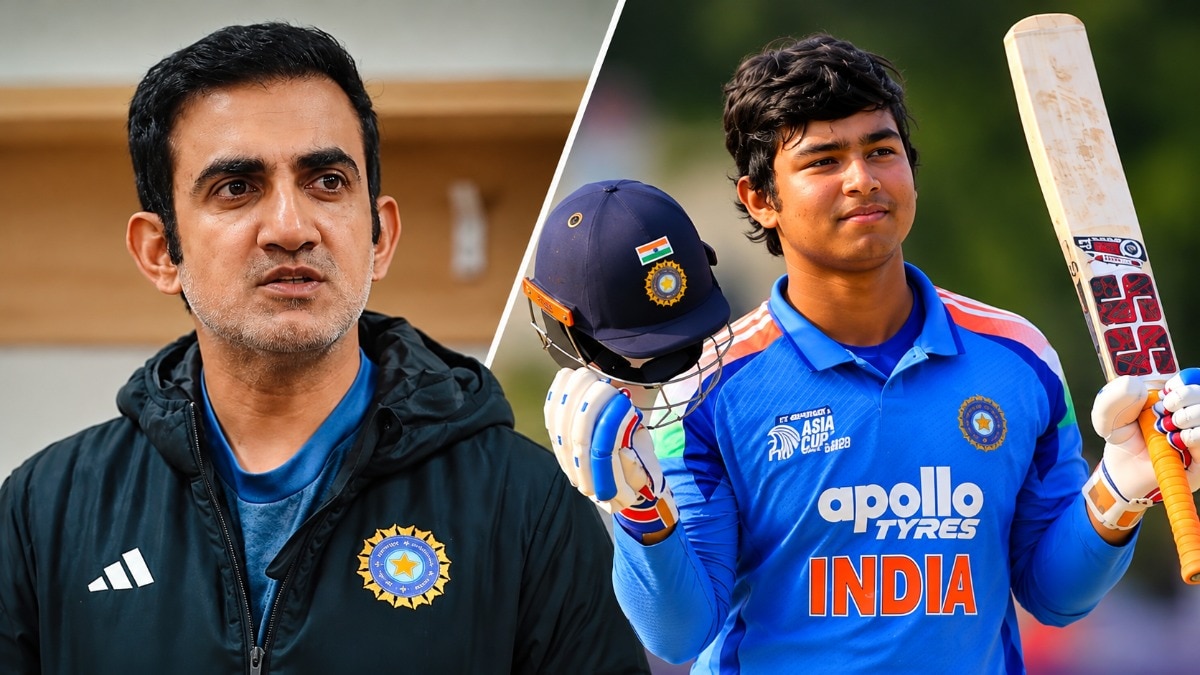
Gautam Gambhir has often maintained that his job is to take the right decisions, not the popular ones. But every time Vaibhav Sooryavanshi walks out to bat and produces something extraordinary, a question that India's head coach might prefer to avoid comes back into focus: is the teenager being given enough opportunities to show what he can do?
On Tuesday, Sooryavanshi produced an innings that left the cricket world scrambling for superlatives. Chasing 250 against the UAE, an Associate team, in the Rising Stars Asia Cup, the 15-year-old smashed 204 off just 53 balls. He hit 28 sixes, brought up his hundred in 28 deliveries and reached his double century in just 52 balls. The previous record for the fastest double hundred in List A cricket was 103 balls. Sooryavanshi bettered it by a staggering 51 deliveries.
It was the sort of innings that seemed more suited to a video game than a real cricket match. Even those who have followed his remarkable rise were left in awe. The opposition's standing in world cricket might invite a degree of context, but it does little to diminish the audacity of what Sooryavanshi achieved. Very few batters have even come close to producing such an assault in 50-over cricket.
And yet, amid the celebration of another record-breaking performance, the conversation inevitably returned to his place in the senior Indian team. How does a talent capable of such extraordinary feats continue to find himself waiting for opportunities in the T20I side?
His childhood coach, Manish Ojha, believes the answer lies in changing India's approach to managing the teenager. He has a particularly pointed message for the team management.
"Vaibhav played today's match and delivered this performance because he was on the field. He did not do it while sitting on the bench," Ojha told IndiaToday.in.
"A player learns by stepping onto the field, facing situations, dealing with challenges and overcoming them. That is how experience develops. Nobody has ever developed experience by sitting on the bench, and nobody ever will. No player has become a better cricketer simply by remaining on the sidelines."10 MATCHES IN 26: A STOP-START CAREER
At 15, Sooryavanshi broke the selection door down. After a record-breaking IPL season, he was picked for T20Is in June for a tour of Ireland. But, Sooryavanshi did not get a game in Ireland, with many feeling he missed out on a relatively easy induction to international cricket. Since making his T20I debut against England in July, Sooryavanshi has been part of India's playing XI in only 11 of the 26 completed matches in the period under consideration. The sequence tells its own story.
Sooryavanshi was named in India's squad for the two-match tour of Ireland in June but did not feature. He made his debut in the second T20I against England in July and played the second, third and fourth matches of that five-game series. He then enjoyed a full run in Zimbabwe, featuring in all three matches and winning the Player of the Series award after scoring 151 runs at a strike rate of 196.10.
Despite his performances in Zimbabwe, Sooryavanshi did not get a game in the three-match home series against Afghanistan in September. He was also left out of the one-off T20I against Japan before featuring in India's Asian Games campaign, where he played both completed matches.
The five-match series against the West Indies brought another prolonged spell on the sidelines. Sooryavanshi did not feature in any of the games. In New Zealand, he was given opportunities in the second and third T20Is but missed the first, fourth and fifth matches.
For a batter who has already demonstrated his ability to make an impact at the highest level, the lack of continuity is difficult to ignore.advertisementA THREE- WAY RACE The numbers from the three opening options also make for an interesting comparison.
Abhishek Sharma has scored 830 runs in 26 matches at an average of 31.92 and a strike rate of 207.50. Sanju Samson has made 416 runs in 17 matches at 24.47 and a strike rate of 169.10. Sooryavanshi, meanwhile, has scored 291 runs in nine innings at an average of 32.33 and a strike rate of 192.71.
Abhishek's numbers underline why the team management has been reluctant to disturb the combination. He has been India's most productive opener in this period, scoring two centuries and four half-centuries. Samson, too, has had his moments.
But Sooryavanshi's numbers raise a legitimate question. He has the highest average among the three and has scored at a strike rate close to 193. He has not looked out of place when given an opportunity. Why, then, has it been so difficult to give him a sustained run?
There is also a larger selection question: why can't India find a way to accommodate all three in the playing XI? It would require some flexibility in the batting order, particularly from Samson, but is that possibility worth exploring rather than repeatedly asking a 15-year-old to wait for his turn?advertisementWHAT IS GAMBHIR'S ARGUMENT?Gambhir has not hidden his reasoning. Ahead of the Afghanistan series in September, he said Sooryavanshi would have to wait because established players who had performed over a longer period deserved to remain ahead in the pecking order.
The head coach also revealed that he had personally spoken to the teenager about the situation.
"Sometimes, because of the players who have done well for a long time, he will have to wait for his opportunity," Gambhir said in October.
His argument is not without merit. India cannot be expected to discard players who have delivered consistently simply because a younger batter has produced extraordinary performances. International selection is not a reward for potential, and the management has a responsibility to maintain stability in a team that has enjoyed considerable success.
Shreyas Iyer, who captained India in the New Zealand T20I series, echoed that position. He pointed to the consistency of Abhishek and Samson, reminding Sooryavanshi that he was only 15 and had several years ahead of him to earn opportunities.
But that is precisely where the debate becomes interesting. How much patience should a young player be expected to show, and how much of that patience should the team management demand when the player has already demonstrated that he can, leave alone compete, but dominate?
Sooryavanshi was given just two opportunities in New Zealand. He responded with a quickfire 45 in the third T20I after making four in his first appearance. Yet, with the series already decided at 3-1, he was left out of the final match. Gambhir defended the decision, saying his responsibility was to make the right calls rather than popular ones.
But is backing the same combination always the right decision, particularly when there is an opportunity to test a young player without necessarily abandoning the established options?DOESN'T NEED GROOMING
Former India batter Mohammed Kaif has also questioned the emphasis on grooming Sooryavanshi, arguing that his achievements already offer enough evidence of his readiness.
"Vaibhav Sooryavanshi is not getting opportunities in the Indian team. They say he is only 15, very young, and that he is being groomed. But let me tell you what this boy has already achieved. He is a record-breaker," Kaif said.
There is a distinction worth making here. Nobody is suggesting that Sooryavanshi should be guaranteed a place in India's XI irrespective of his performances. Nor should Abhishek or Samson be dropped simply to accommodate a teenager. Their contributions deserve recognition, and the competition for places is healthy.
But competition should also mean that a player gets a fair opportunity to challenge the established order. It cannot become a situation where the same combination is protected indefinitely while a promising alternative is asked to wait.
Coach Manish Ojha, for his part, is not demanding that Sooryavanshi play every match. He wants the team management to give the youngster a proper run rather than judge him on isolated appearances.
"India have been doing very well in the recent past, and I acknowledge that. But Vaibhav should be given opportunities in a five-match series. He should play at least two or three matches. And if he performs well in an innings, he should certainly get another opportunity in the next match," he said.
"He should not be viewed as a substitute player. Look at his batting and his performances. He is a strike player for the team. On days when he plays, the opposition can be reduced to its knees."
The team combination cannot be Sooryavanshi's burden to carry. He cannot be expected to wait indefinitely because the established openers are performing well. At 15, he has time on his side, but India must give him a genuine run against international attacks, allowing him to learn from failure as well as success. He need not be guaranteed a place, but he deserves more than the occasional opportunity. As Ojha put it, nobody develops experience by sitting on the bench.- Ends
Chennai guy who is making money out of watching and writing on sports from New Delhi. Ex-Engineer who loves going that extra mile for keeping people informed. My girlfriend tells me that I keep watching cricket a bit too much. I have fallen in love with racquet sports as well.
