South Africa’s Indian community has waited 15 years for a direct India flight - IOL
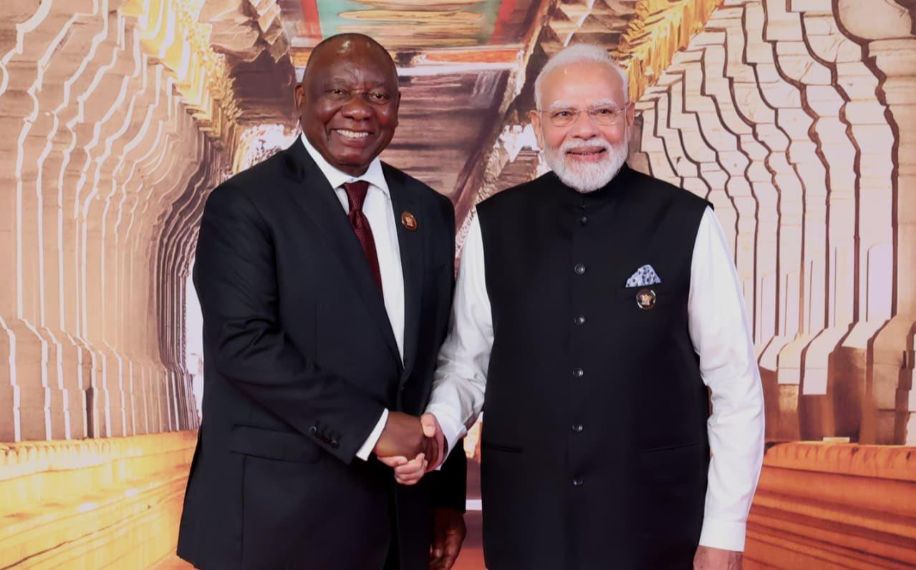
President Cyril Ramaphosa with Indian Prme Minister, Narendra Modi, at the India-South Africa Business Leaders' Roundtable at the 18th BRICS Leaders’ Summit held at Bharat Mandapam in New Delhi, India.
FOR most South Africans, the absence of a direct flight to Mumbai is an inconvenience. For the Indian community, it reads as something closer to an insult. A family in Durban wanting to attend a funeral in Gujarat, or take children to a wedding in Chennai, does not experience "no direct flight" as a logistics problem. It experiences it as a 15-year-old promise, repeated by three ministers, that nobody in government has yet been made to keep.
Money spent on an expensive stopover ticket can, in principle, be earned back. Time cannot. When South African Airways operated its direct Johannesburg–Mumbai service, the flight took roughly nine hours (FlightGlobal, 2015).
Today the same journey via Doha or Dubai takes 14 to 16 hours door-to-door once layovers are included, longer still via Addis Ababa on a poor connection (Flightroutes, 2026; Prokerala, 2026).
That is not an inconvenience measured in rand. It is five to seven extra hours taken from every passenger, every trip, in both directions - hours a grieving family does not get to spend with a dying parent before flying home, hours a working parent does not get back with a child. A country can refund a ticket. No president, minister or airline can refund a life's worth of stolen hours.
South Africa's Indian community is not an ordinary diaspora with a passing interest in one air route. The first indentured labourers landed in Durban in November 1860 (Desai & Vahed, 2010); more than 165 years later, an estimated 1.8 million South Africans trace their ancestry to that arrival, the largest population of Indian descent outside India itself (Statistics South Africa, 2022; World Economic Forum, 2015).
KwaZulu-Natal alone is home to roughly one million Indian South Africans (Durban Direct, 2025) — citizens with parents to bury and pilgrimages to make.
President Cyril Ramaphosa acknowledged in 2019 that Indian business leaders had long complained about how "cumbersome" travel between the two countries had become and conceded that the Gupta family's influence lay behind the 2015 closure of the route - an account corroborated in detail before the Zondo Commission into state capture (News24, 2019; Judicial Commission of Inquiry into State Capture, 2018).
Tourism Minister Patricia de Lille has since restated the same commitment in December 2024, late 2025, and again in August 2026, each time citing engagement with Air India, IndiGo and SpiceJet and, latterly, the 2027 Cricket World Cup as the new deadline (Tourism Update, 2024; BusinessTech, 2026).
Indian arrivals nonetheless remain a fraction of what the scale of ties would predict - 69,680 in 2025, against South Africa's 10.48 million total arrivals that year (ATTA, 2026) - a gap the department attributes chiefly to the absence of direct flights and slow visa processing (Tourism Update, 2024).
What compounds the community's frustration is not delay the alone but its fragmentation. Durban Direct has pursued IndiGo and Air India independently (Durban Direct, 2025); a separate Cape Town delegation held its own talks with Air India in Bengaluru; Gauteng, custodian of OR Tambo and the bulk of historical Mumbai traffic, has offered no comparable public initiative.
Three spheres of government are conducting three separate conversations toward one shared goal, while bilateral trade is already close to $19 billion a year and more than 150 Indian companies employing thousands of South Africans generate exactly the travel volumes that would justify one coordinated national position (IOL/Pretoria News, 2026; BusinessTech, 2026).
There is, however, an encouraging precedent worth building on.
In July 2026, the Consulate General of India in Johannesburg, Shri S Koventhan, met SAA's acting group chief executive, Matshela Seshibe (who is now on special leave), to press the case for direct connectivity as a "strategic necessity"; Seshibe undertook that SAA would fast-track the proposal (IOL/Pretoria News, 2026).
By all accounts, the office of India's High Commissioner to South Africa, currently held by Shri Prabhat Kumar in Pretoria, is eager to see this succeed and has signalled it will assist. However, it can help realise what is, for many South Africans and Indians alike, a long-deferred dream - a notably approachable office, well placed to help carry Koventhan's groundwork the rest of the way.
Equally, South Africa's High Commissioner to India, Professor Anil Sooklal, has already been reported engaging India's business sector on the president's behalf (BusinessTech, 2026); his role as a BRICS Sherpa gives him direct access in Delhi that could turn goodwill among Indian carriers into a signed commitment sooner rather than later.
This matters beyond scheduling, because the community's frustration is ultimately about recognition. South African Indians spent a century contesting the Group Areas Act and forced removals to establish that they belong here fully, not provisionally. To watch their most basic link to ancestral family and culture treated as a low priority, while ministers travel to Delhi for photographs, revives the disregard history was meant to have closed.
None of this requires a new inquiry. The route, the airlines and the demand have already been identified, repeatedly, on the record, by the Tourism Minister's own department. What is missing is coordination: a single national negotiating position, led jointly by the two high commissioners and backed publicly by the Presidency, rather than three provinces, a ministry and two consulates pursuing separate conversations toward the same end.
President Ramaphosa has, over this first term, shown a marked fondness for commissions of inquiry - into state capture, into whatever crisis needs to be seen to be taken seriously. That same instinct could be put to more modest, achievable use: task a small, time-bound team drawn from Tourism, Transport, DIRCO and both high commissions to establish exactly what is still blocking this route, and report back with a signed agreement before the year is out, not filed away for 2027.
He is, after all, the president who inherited a mess his predecessor's administration made of this very route in 2015, by his own admission on record; finishing the repair is not a favour to the Indian community; it is completing work his own government has already conceded needs doing.
There is a smaller, more personal test he has already set for himself. At the same BRICS summit where he again promised a direct flight, President Ramaphosa told Prime Minister Narendra Modi, on camera, that he had bought books in India and paid in rupees, watching the transaction settle in rand - proof, he said, that local-currency trade between BRICS partners already worked (PTI, 2026; Newswire, 2026).
If that is true at a bookshop till in Delhi, there is no reason South Africans should not pay in rupees here, and Indian visitors pay in rand there, as ordinary commerce rather than a presidential anecdote. That, too, is what BRICS is meant to deliver: not only summits and photographs, but a payments system and a flight path ordinary citizens can actually use.
The president does not need another roundtable in New Delhi to tell South Africans that a flight is imminent. The undertaking has been made, publicly, more than once. What remains is for those who already hold the authority - the Presidency, Tourism, Transport, and the two high commissioners in Pretoria and New Delhi - to finish what one consulate meeting in Johannesburg has already started, this year, not next.
Money spent on stopovers can be repaid; hours already lost in transit lounges cannot. For a community that has waited fifteen years to fly to their ancestral home without three stopovers, words have stopped being enough. Give us back our time, Mr President. Walk the talk and land the plane.
Sanjith Hannuman is a director at AVIB and an employee benefits consultant who holds an MBA from UKZN, is an FSA of the Financial Planning Institute of South Africa, a Human Values Practitioner, and a Behavioural Life Coach who believes in the betterment of life for all.
** The views expressed do not necessarily reflect the views of IOL or post.co.za