South-east speakers seek regional legislative collaboration, harmonisation - Premium Times Nigeria
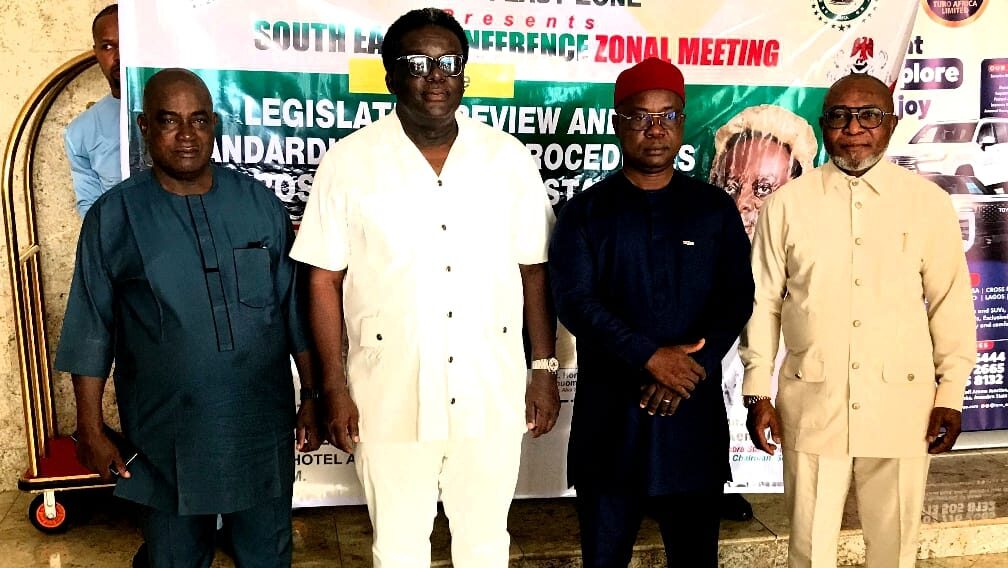
South-east Houses of Assembly speakers, (from left) Moses Odunwa, Ebonyi; Somtochukwu Udeze, Anambra; Uche Ugwu, Enugu, and Emmanuel Emeruwa, Abia, in Awka on Saturday after a one-day conference.
House of Assembly speakers from the South-east have sought collaboration and the harmonisation of laws in the concerned states to ensure effective service delivery across the board.
The speakers expressed the need for collaboration and harmony at the zonal meeting of the Conference of Speakers of State Legislatures of Nigeria, South-east zone, held in Awka on Saturday.
The conference, hosted by the Anambra State House of Assembly, was themed “Legislative Review and Standardisation of Procedures Across South-East States: The Need to Redefine a Better Relationship”.
The Speaker of the Anambra State House of Assembly, Somtochukwu Udeze, said the collaboration would enable state legislatures in the region to share and promote best practices at the regional level.
Mr Udeze, also the zonal vice chairman of the conference, said that legislative cooperation in the region should move beyond periodic consultations to structured institutional synergy.
“This is capable of facilitating comparative review of laws, legislative research, development of model bills and joint consideration of issues that have regional implications.
“We need to redefine the relationship among the five South-east states from one of periodic political consultation to one of structured institutional cooperation.”
The speaker further said that the synergy should establish minimum professional standards that would not undermine the constitutional autonomy of cooperating legislatures.
“It may not mean outright uniformity; it means to agree on a minimum professional standard below which none of our legislatures should operate.”
According to him, differences in laws across the states should not unnecessarily impede businesses, traders, and residents operating across the region.
“A trader moving from Aba to Onitsha should not encounter five completely different regulatory standards simply because they have crossed a state boundary.”
Mr Udeze said that environmental regulation, transportation, trade, investment, digital governance, waste management and emergency response required greater legislative coordination.
He also called for stronger post-enactment review of laws to assess their potency and ability to achieve intended objectives.
“Our responsibility is not simply to make laws. It is to make laws that can stand the test of constitutional scrutiny, administrative reality, and time,” he said.
In his presentation, Pius Udoh, former clerk of the Anambra State House of Assembly, urged South-east lawmakers to play an active role in the discussion on state policing and constitutional reforms.
In a paper titled, “Security Challenges, Constitutional Review, and State Policing in Nigeria: The Role of State Legislatures”, Mr Udoh described insecurity as a major threat to lives, property, and economic development.
He identified terrorism, kidnapping, banditry, farmer-herder conflicts, communal conflicts, cybercrime, armed robbery and human trafficking as some of the security challenges confronting the country.
Mr Udoh said that state policing could improve intelligence gathering and responses to security threats because personnel would have better knowledge of local communities, languages, customs, and geography.
He identified political interference, human rights abuses, inadequate funding, and potential conflicts between federal and state police as concerns requiring careful navigation.
He urged lawmakers to promote strong legislative oversight, merit-based recruitment, professional training, and political neutrality when formulating state policing frameworks.
According to him, sustainable security requires a combination of effective policing, good governance, economic opportunities, justice and strong institutions.