South-South: Incumbents, heavyweights in make or mar gov battles - Vanguard News
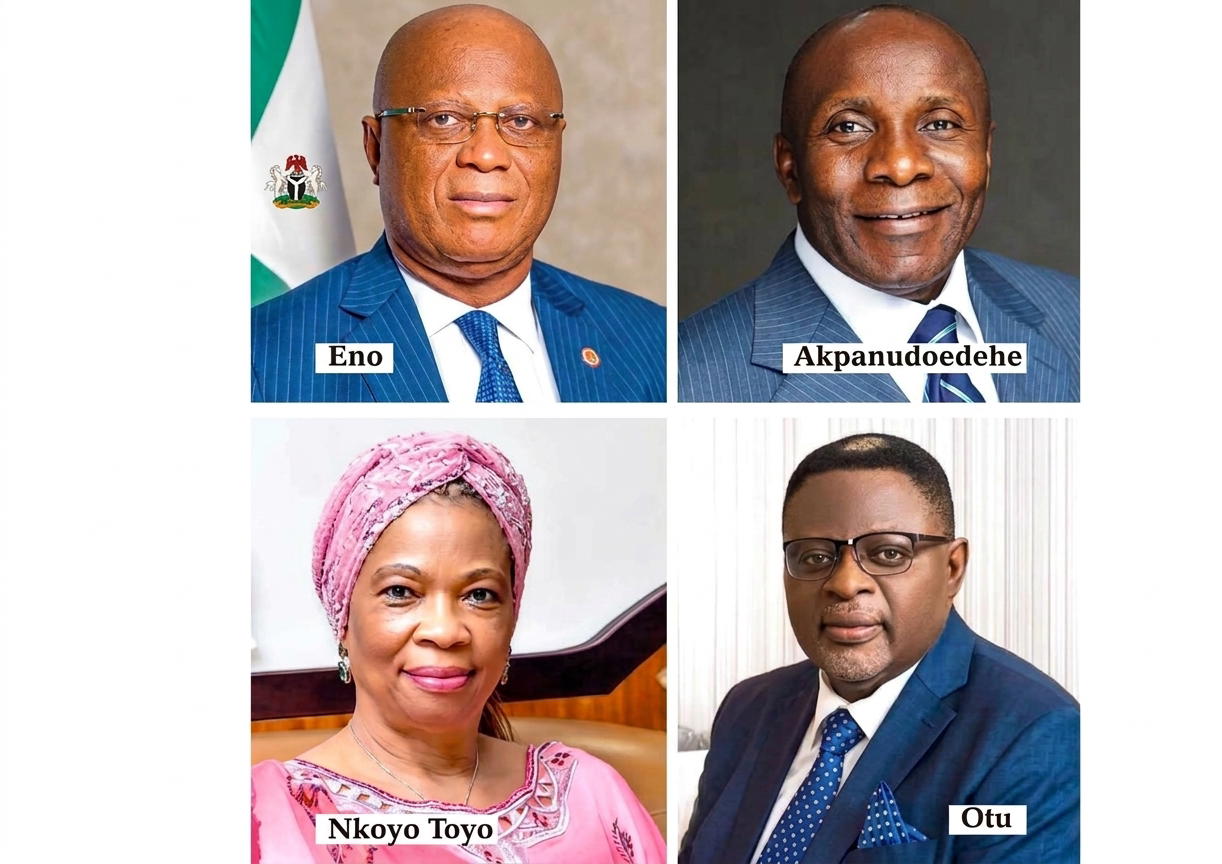
WITH the 2027 general elections approaching, the battle for four governorship seats across the South-South is gathering momentum, with incumbents, political heavyweights and emerging contenders positioning themselves for control of the region’s political landscape.
In Akwa Ibom, Governor Umo Eno is banking on his performance, incumbency and the mass defection of Peoples Democratic Party, PDP, members to the All Progressives Congress, APC, to secure a second term.
In Cross River, Governor Bassey Otu enjoys the advantages of incumbency, federal backing and expanding political alliances, but faces a determined challenge from PDP’s Arthur Jarvis Archibong.
Rivers presents a more complicated contest, with the influence of FCT Minister Nyesom Wike, the political grievances arising from the protracted power struggle in the state and the growing appeal of opposition parties shaping the calculations.
In Delta, Governor Sheriff Oborevwori appears to enjoy an advantageous position following his defection to the APC and the support of influential political leaders, while opposition candidates seek to exploit the changing political alignments.
Across the four states, the contests will test the strength of incumbency, party structures, political alliances, grassroots mobilisation and the capacity of opposition candidates to convert public support into electoral victories. There will be no governorship polls in Bayelsa and Edo.
Governor Umo Eno of the APC appears to have the upper hand in the battle for Akwa Ibom Government House, facing former senator and minister, John Akpanudoedehe of the African Democratic Congress, ADC, and former House of Representatives member, Michael Enyong of the Nigeria Democratic Congress, NDC.
Eno, who hails from Akwa Ibom North-East Senatorial District, Uyo, enjoys the advantage of incumbency and the political boost arising from the defection of several PDP members to the APC.
His performance in office over the last three and a half years is also being projected as a major selling point as he seeks another four years.
Although Akpanudoedehe commands considerable political recognition in the state, and Enyong brings legislative experience to the contest, observers believe the incumbent’s political machinery and expanding support base could prove difficult to dislodge.
A public affairs analyst, Mr Ben Ikoriko, believes Eno’s empowerment programmes, particularly for people at the lower end of the state’s economy, could secure him substantial electoral support.
He said: “Umo Eno will win. Yes, there are two other contenders; Akpanudoedehe and Enyong, the governor has done well and deserves a second term. Again, the PDP crossed to the APC. I can tell you that 80 per cent of the people are with Umo Eno.”
Ikoriko said the governor had empowered beneficiaries with cash, sewing machines, fishing equipment and other tools to establish businesses.
“My in-law, wife and mother benefitted from the largesse. People were given cash, sewing machines and many other things, including modern fishing equipment for fishermen,” he added.
Another public affairs stakeholder, Andy Eyo, also predicted Eno’s victory, arguing that zoning considerations and the governor’s political acceptance were working in his favour.
However, the NDC has dismissed the argument that incumbency gives Eno an insurmountable advantage.
The party’s State Publicity Secretary, Edidiong Umoetor, expressed confidence that Enyong would defeat the governor, citing his legislative experience and capacity to deliver good governance.
He said: “When you have a good candidate, the party sells beyond expectation. At the national level, we have Peter Obi, who even the blind, the deaf know about him. Then coming to Akwa Ibom State, we are not afraid of the power of incumbency.”
Describing Enyong as an experienced legislator, Umoetor said: “Enyong is a two-time representative of his constituency in the National Assembly. He was chairman of the Committee on Mining and Mineral Resources twice. So, the experience and capacity are there.”
He added: “We are 100 per cent sure of winning. Our strategies are with us and we are moving forward by God’s grace.”
The APC, however, insists that Eno’s achievements have put him in a commanding position.
Its spokesman, Chief Patryk Edeke, said the administration had paid more than N91 billion out of over N120 billion in inherited gratuity arrears.
He also cited the provision of ambulances to all 31 local government areas, improvements in primary healthcare, compassionate homes for vulnerable people and the construction of about 1,550 kilometres of roads.
According to him, these projects have strengthened public confidence in the administration.
With the incumbent’s political structure, performance claims and the opposition’s determination to make an impact, Akwa Ibom’s contest promises to be a test of whether Eno’s popularity can withstand a coordinated challenge.
In Cross River, the central question is whether Governor Bassey Otu can consolidate his political advantage or whether the opposition can mobilise enough support to dislodge him in the February 6, 2027 governorship election.
Four major contenders dominate the race: Otu of the APC, Sir Arthur Jarvis Archibong of the PDP, Ambassador Nkoyo Toyo of the ADC and John Odey Jr. of the NDC.
Otu appears to be the frontrunner, buoyed by incumbency, party machinery, political alliances and federal backing.
He emerged as the APC’s sole aspirant and secured the party’s ticket, with 160,038 votes reportedly recorded across the state’s 18 local government areas.
His position has been strengthened by defections from opposition parties, endorsements by traditional rulers, religious organisations and support groups, as well as political engagements across the state.
Federal backing is another advantage. Vice-President Kashim Shettima, representing President Bola Tinubu at the groundbreaking ceremony of the Bakassi Deep Seaport, urged Cross River residents to support the governor for continuity.
Otu’s supporters also point to his agricultural initiatives and economic programmes, including the payment of the first N10 billion tranche of retirees’ gratuities.
However, critics argue that increased Federation Account Allocation Committee, FAAC, inflows and internally generated revenue have not translated into commensurate visible infrastructure and development.
Some also contend that his political advantage rests more on incumbency than widespread public enthusiasm.
Archibong, proprietor of Arthur Jarvis University, has emerged as Otu’s most visible challenger.
The PDP candidate has reportedly toured all 18 local government areas, consulting political stakeholders and community leaders. His rallies and town hall meetings have also attracted sizeable crowds.
His challenge to Otu to participate in a public debate is part of an effort to project himself as accessible and ready to subject his ideas to public scrutiny.
Archibong is also believed to enjoy some goodwill from FCT Minister Nyesom Wike through Prof. Sandy Onor, who reportedly led PDP candidates to Abuja to meet the minister.
However, his lack of experience in public office could become a campaign issue. His opposition to the ‘Back to South’ arrangement, despite supporting Onor in 2023, has also attracted criticism.
The PDP’s internal difficulties constitute another challenge. The resignation and defection of former state chairman, Venatius Ikem, to the APC weakened the party’s structure. His replacement, Chief Francis Bullem, faces the task of rebuilding the party and restoring confidence.
For Archibong, the challenge is not merely attracting crowds but converting enthusiasm into votes through effective polling-unit mobilisation.
Toyo, a lawyer and former member of the House of Representatives representing Calabar Municipality/Odukpani Federal Constituency, brings considerable political experience to the contest.
She is arguably the most politically experienced among the opposition challengers. Her candidacy offers voters an alternative to the dominant APC and PDP.
Toyo and her running mate, Dr Dino Magam, are on INEC’s final list. She was also scheduled to unveil her manifesto and launch her campaign fund on November 16.
Her major disadvantage, however, is the late start to the campaign. Archibong has already established considerable visibility, while ADC’s organisational reach remains limited compared with the APC and PDP.
Reported defections from the ADC, including a chieftain who launched a movement supporting Otu’s re-election, further expose its difficulties.
For Odey, the NDC candidate, the challenge is more fundamental: establishing a visible campaign structure.
There have been few indications of statewide consultations, rallies or grassroots mobilisation. His deputy, Stella Archibong, has reportedly withdrawn from the ticket and aligned with the Otu administration, dealing another blow to his ambition.
Unless he changes strategy and intensifies mobilisation, Odey risks remaining a distant contender.
Ultimately, Otu’s political alliances and federal backing give him a commanding advantage, but Cross River’s electoral history suggests that the opposition should not be written off.
The Rivers governorship contest presents one of the most intriguing political battles in the South-South, with four candidates positioning themselves to control the state’s political machinery.
The candidates are Hon. Kingsley Chinda of the APC, Dumo Lulu-Briggs of the NDC, Dr Gabriel Pidomson of the ADC and Pastor Nature Dumale Kieghe of the Peoples Redemption Party, PRP.
Chinda’s greatest advantage is his position as candidate of the ruling APC and his membership of the Rainbow Coalition, a political group with influence across the state’s 23 local government areas.
More significantly, he enjoys the backing of Wike, who has considerable influence in the state’s political calculations and enjoys the support of President Bola Tinubu.
Chinda is also reportedly the preferred successor of Governor Siminalayi Fubara, who has been effectively shut out of seeking a second term. Fubara has pledged to ensure that Chinda succeeds him in 2027.
The candidate is therefore expected to benefit from considerable political and financial resources, as well as the backing of influential political actors at the state and federal levels.
But these advantages could also become his biggest liability.
Wike’s role in the political crisis that engulfed Rivers, culminating in President Tinubu’s declaration of a state of emergency in March 2025, remains a contentious issue.
Many Rivers people, particularly in the Ijaw-speaking areas, remain aggrieved over the treatment of Fubara. Some view the political developments as denying the Ijaw ethnic nationality the opportunity to govern the state for eight years, as other groups had done in the past.
Consequently, Chinda could face a protest vote from voters opposed to Wike’s influence and the political circumstances surrounding Fubara’s exit.
He also has to contend with a legal challenge instituted by one of the governorship candidates over the implication of the recent Supreme Court judgment for his defection from the PDP to the APC.
For NDC’s Dumo Lulu-Briggs, the greatest attraction is the political appeal of the party’s presidential candidate, Peter Obi, whose support cuts across party, ethnic and religious boundaries.
A wealthy businessman, Dumo also has the financial capacity to fund his campaign without depending entirely on party resources.
His Ijaw and riverine roots could further attract support from voters opposed to Wike’s political influence, particularly those sympathetic to Fubara.
However, questions have been raised about his commitment and campaign energy. Some political observers regard him as a perennial governorship contestant whose repeated appearances in the race have yet to translate into a decisive political breakthrough.
ADC’s Pidomson has a different advantage. He belongs to the same party as former Rivers Governor Rotimi Amaechi, who is Atiku Abubakar’s running mate in the 2027 presidential contest.
The Atiku-Amaechi ticket could provide a national political platform and visibility for Pidomson, particularly if the opposition makes significant electoral gains.
His major weakness, however, is inadequate funding. Politics in Rivers requires substantial financial resources, and Pidomson is not believed to enjoy the financial muscle available to some of his rivals.
The internal divisions within Ogoni land, particularly disagreements over resumption of oil exploration and the agitation for Bori State, could also complicate his political calculations.
Kieghe of the PRP is perhaps the least established of the four contenders.
His supporters could market him as a fresh face without the baggage of previous political office. His religious background may also provide a limited support base.
However, he lacks the financial resources, political experience, popularity and organisational structure required to mount a formidable statewide campaign.
The Rivers contest is therefore likely to revolve around the Wike factor, the political grievances surrounding Fubara, the appeal of Obi and the ability of opposition candidates to translate sympathy into votes.
As it is, Wike’s backing gives Chinda a formidable structure, but resentment over Fubara’s political ordeal could fuel a protest vote for Dumo and other opposition candidates.
In Delta State, Governor Sheriff Oborevwori appears to enjoy a significant political advantage following his defection from the PDP to the APC and the support of influential political figures across the state.
All four major governorship candidates hail from Delta Central Senatorial District, reflecting the state’s established zoning arrangement.
They are Oborevwori of the APC, Peter Mrakpor of the PDP, Deacon Chris Iyovwaye of the NDC and Chief Great Ogboru of the ADC.
Oborevwori’s strongest asset is his expanding political coalition and grassroots support base.
His defection to the APC has strengthened the party’s presence across the state’s wards, local government areas and senatorial districts.
He also enjoys the backing of influential political leaders, including former governors James Ibori and Ifeanyi Okowa, Minister of Aviation and Aerospace Development, Festus Keyamo, Senators Ede Dafinone and Joel-Onowakpo Thomas, and former Senator James Manager.
The support cuts across different political tendencies and is expected to strengthen the governor’s re-election machinery.
The state’s zoning arrangement may also work in his favour. With Delta Central currently occupying the governorship, the understanding that Delta South would have its turn after the Central’s tenure expires in 2031, followed by Delta North in 2039, could discourage serious opposition from those districts against another Central candidate in 2027.
These factors place Oborevwori in an advantageous position, although his eventual victory will depend on the electorate.
NDC’s Iyovwaye, who also hails from Okpe Local Government Area, is hoping to benefit from the growing national profile of Peter Obi and the party’s increasing visibility.
The NDC is gradually attracting political attention in Delta, with its mobilisation efforts making inroads into Delta Central and Delta North.
Iyovwaye also enjoys the backing of prominent political figures, including former Deputy President of the Senate, Senator Ovie Omo-Agege, and former Speaker of the Delta State House of Assembly, Rt. Hon. Victor Ochei.
Both men are pursuing senatorial ambitions in Delta Central and Delta North respectively. Their political structures, established followership and grassroots networks could provide the NDC with a platform to expand its influence.
However, Iyovwaye’s prospects will depend on how effectively he can harness these alliances, strengthen the party’s structures and convert growing visibility into votes.
For ADC’s Great Ogboru, the 2027 contest represents another attempt to capture the state’s top political office.
Popularly known as the People’s General, Ogboru is one of Delta’s most familiar opposition figures. An indigene of Ethiope East Local Government Area, he has contested the governorship in successive election cycles since 2007 under different political platforms.
His political persistence and loyal followership remain important assets. His personal popularity also gives him an identity that transcends party affiliations.
However, the ADC is facing organisational challenges ahead of the election.
The Obedient Movement, which previously provided considerable support to the party, has shifted allegiance to the NDC, where Obi is pursuing his presidential ambition.
Leadership disputes and court cases surrounding the ADC’s national leadership have also raised questions about its internal stability.
At the grassroots, the party is yet to demonstrate a formidable presence across the state’s wards and local government areas.
Ogboru will therefore have to rely heavily on his personal political profile to overcome ADC’s structural weaknesses.
PDP’s Mrakpor, a former Attorney-General and Commissioner for Justice in the state, is seeking to revive the party’s fortunes after its major political setback.
His experience in public service and familiarity with Delta’s political landscape are among his strongest assets.
However, the defection of Oborevwori to the APC on April 28, 2025, dealt a major blow to the PDP, triggering a significant realignment of political forces.
The party has also been weakened by prolonged leadership disputes at the national level, internal divisions and multiple litigations, all of which have complicated efforts to rebuild its structures.
Nevertheless, the PDP retains a longstanding political identity and grassroots presence in Delta, having governed the state for several years.
Mrakpor hopes to leverage that legacy, his experience in government and the party’s remaining support base to mount a credible challenge.
With Oborevwori’s political coalition, zoning considerations and APC’s expanding structure, the governor appears to have the advantage. But the opposition candidates will be seeking to exploit any cracks in the ruling party’s alliance.
Across the South-South, the 2027 governorship contests are shaping up as battles between incumbency and opposition mobilisation, established political structures and emerging alliances.
Eno, Otu and Oborevwori appear to enjoy varying degrees of political advantage, while Rivers presents a more complicated contest in which Wike’s influence and the political fallout from the Fubara crisis could prove decisive.
For the opposition, the challenge is to move beyond endorsements, political alliances and campaign rallies to establish effective grassroots structures capable of delivering votes.
Ultimately, political influence, money, party organisation, candidate credibility and the electorate’s assessment of government performance will determine who occupies the four Government Houses after the 2027 elections.
Egufe Yafugborhi, Ochuko Akuopha, Dan Abia, Chidi Ndaa, Ike Uchechukwu & Emmanuel Una also contributed to this report.
Comments expressed here do not reflect the opinions of Vanguard newspapers or any employee thereof.