
Southeast Asia's haze crisis: Have lessons been learned?
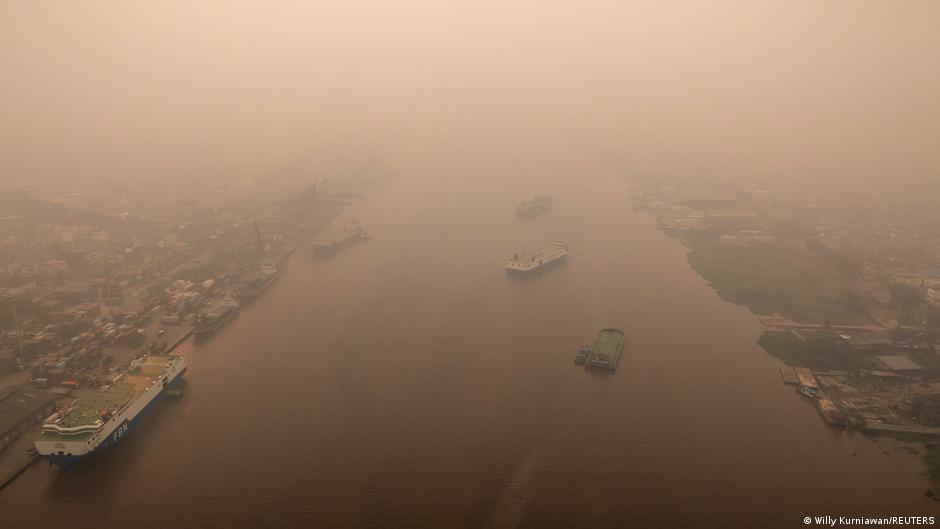
Indonesia's long 2026 dry season, coupled with this year's El Nino, has worsened what has become an almost annual crisisImage: Willy Kurniawan/REUTERSAdvertisementIndonesia's worst wildfire season in more than a decade is exposing how much, and how little, Southeast Asia's response to haze has changed since 2015.
Forest and land fires have burned across parts of the Indonesian islands of Sumatra, Borneo and Papua for weeks, sending smoke across large areas of the country and into neighboring Malaysia and Singapore.
Indonesia's long 2026 dry season, coupled with this year's El Nino, has worsened what has become an almost annual crisis, exposing millions of people to hazardous smoke containing harmful microscopic particles.
More than 170,000 cases of acute respiratory infection were recorded in haze-affected areas of Indonesia between August and mid-September, according to the country's Health Ministry, including more than 40,000 cases involving young children.
The haze has forced hundreds of schools to close in Malaysia and pushed more than 1.4 million Indonesian students into remote learning, although the full economic cost is not yet known.
This year's severe weather is only part of the explanation. Fire has long been used as a cheap way to clear land for agriculture in Southeast Asia, while the expansion of palm oil and pulpwood plantations has drained and degraded large areas of peatland.
The echoes of 2015 are hard to ignore. That year's fires burned roughly 2.6 million hectares of land, produced months of severe haze across Southeast Asia and cost Indonesia an estimated $16 billion (€14.2 billion) in economic losses, according to the World Bank.
The risk is growing that severe haze will become more frequent as climate conditions worsen, Paruedee Nguitragool, an associate professor at Chiang Mai University in Thailand, told DW.
"Haze, which used to be mainly a problem in maritime Southeast Asia, has become a concern for most countries in the region," she added.
Governments within the Association of Southeast Asian Nations (ASEAN), the regional bloc, "need to be more open to one another and work closely together."
"Farmers and companies need alternative methods of land clearing and incentives to adopt them, while land and forest rehabilitation must also be implemented," Nguitragool said.
"At the same time, consumers need to be more aware of whether the products they buy come from sustainable practices and whether burning was involved in their production," she added.
The 2015 disaster triggered major policy changes. Indonesia strengthened peatland restoration, fire monitoring, enforcement and firefighting, while ASEAN expanded regional cooperation, David Mark Taylor, a professor of tropical environmental change at the National University of Singapore, told DW.
Indonesia established the Peatland Restoration Agency in 2016 to restore millions of hectares of degraded peat. Its mandate was later expanded to mangrove rehabilitation, with the agency renamed the Peatland and Mangrove Restoration Agency.
A permanent moratorium on new concessions in primary forests and peatlands also restricted further development in some vulnerable areas.
Authorities have also increasingly pursued companies in court. Last year, an appeals court ordered palm oil company PT Banyu Kahuripan Indonesia to pay around €14 million in environmental damages over fires covering more than 3,300 hectares of its concession. Other companies have faced much tougher restoration orders.
At the regional level, ASEAN adopted a new Peatland Management Strategy and a second Haze-Free Roadmap for 2023-2030, and the long-awaited ASEAN Coordinating Center for Transboundary Haze Pollution Control opened its secretariat in Jakarta in April, more than two decades after the 2002 ASEAN Agreement on Transboundary Haze Pollution.
"But the underlying problem hasn't gone away, and neither has the driver," said Taylor.
Extensive areas of peat remain drained or degraded, including cleared land that has yet to be put into productive use. Such poorly managed or "idle" peatlands can become highly combustible during prolonged drought, Taylor noted.
There is also disagreement over how much restoration Indonesia has actually achieved.
The Peatland and Mangrove Restoration Agency ceased operating at the end of 2024, with its responsibilities returned to other government ministries and institutions, raising questions among environmentalists about whether they can maintain the same institutional focus.
ASEAN faces its own limitations. Its 2002 haze agreement is legally binding, but many targets and implementation plans depend on national governments acting on them. The regional bloc has few mechanisms to compel governments to meet those targets or punish failure.
But the ultimate driver for all of this "is the global demand for cheap, plantation-grown commodities, such as palm oil and pulp and paper, which most of us are responsible for," said Taylor.
"So long as that demand persists, so too will the pressure to convert peatlands and forests to plantations," he added.
This year's fires have turned attention from creating new agreements to how Southeast Asian governments can make existing mechanisms work.
"To prevent this from worsening further, there needs to be a real pooling of capacity among ASEAN. Indonesia, for all its efforts, does not have the capacity to manage it alone," Helena Varkkey, an associate professor at Universiti Malaya, told DW.
The existing ASEAN mechanisms for joint emergency response should be operationalized, she added, but this should have been arranged before the start of the haze season, as meteorological reports made it clear that a "Super El Nino" was comingearlier this year.
"Southeast Asian governments need to work together to prevent biomass-burning episodes by implementing stringent laws to stop peat and forest fires. They need to use all available technologies together to prepare for dry conditions," Mohd Talib Latif, a professor at Universiti Kebangsaan Malaysia, told DW.
"Haze needs to be considered a disaster for this region," he added.

