SpaceX launches Starship's 1st orbital flight test
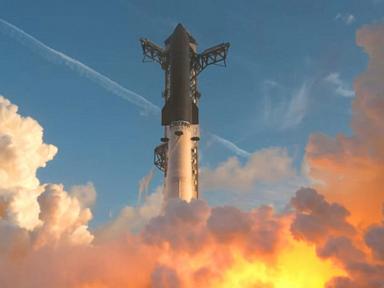
The mission also aims to put Starlink satellites into orbit.
SpaceX on Monday launched the world's largest and most powerful rocket and spacecraft on a mission that, if all goes well, will be the first time the spacecraft has achieved orbit.
If the company's 14th test flight goes as planned, it will also be the first Starship mission to make money for SpaceX. The company plans to deploy 26 Starlink satellites into orbit to build out its satellite internet division, SpaceX's primary revenue generator.
The flight lifted off at 8:50 a.m. ET from SpaceX's Starbase in Cameron County, Texas. The launch was initially scheduled for 8:15 a.m. ET but that was pushed Monday morning to 8:48 a.m. ET. Flight controllers had a 75-minute launch window to get the spacecraft off the pad.
SpaceX's mega rocket Starship lifts off on a test flight from Starbase, Texas, Sept. 28, 2026.SpaceXRelatedSpaceX loses spacecraft after catching rocket booster during test flightThe mission is scheduled to last just under 10 hours, and SpaceX is aiming for about six orbits. However, the mission includes built-in abort opportunities, and SpaceX could end the flight early if it encounters an issue. If SpaceX can get Starship into orbit, the spacecraft will be traveling about 17,500 mph, more than 170 miles above Earth.
During the launch, the Starship will lift off atop the vehicle's Super Heavy booster. The Super Heavy booster will separate from the spacecraft and perform a boostback burn, designed to change its direction so it can return to Earth. After a landing burn, the booster will splash down in the Gulf.
Starship will start its flight on what SpaceX calls a "passively safe" suborbital/free-return path. This is the same trajectory the company used for previous missions.
Seagulls fly near the site of SpaceX's mega rocket Starship as it is prepared for a test flight from Starbase, Texas, Sunday, Sept. 27, 2026.Eric Gay/AP PhotoIf a problem occurs early in the flight, the free-return trajectory provides a built-in abort option without requiring any additional maneuver. The spacecraft would reenter over the Indian Ocean and splash down.
If all is going as planned and the vehicle is healthy, about 25 minutes into the mission, the spacecraft will fire one of its Raptor sea-level engines (the smaller of the two engine types on the vehicle) and perform a circularization burn, putting Starship into orbit around the Earth for the first time.
The flight plan includes regular vehicle health checks during the flight. SpaceX says Starship has more than 500 sensors that measure things such as temperature, pressure and acceleration during the mission. In addition, the vehicle provides flight controllers with continuous telemetry data.
If problems arise, Starship can deorbit early and splash down in the ocean.
About 34 minutes into the mission, Starship will begin deploying its payload of 26 Starlink V3 satellites. This will be the first time that the Starlink satellites are placed into orbit for ongoing use. Previous missions deployed either Starlink simulators or satellites that burned up in the atmosphere.
People gather at sunset as SpaceX's mega rocket Starship is prepared for a test flight from Starbase, Texas, Sunday, Sept. 27, 2026.Eric Gay/AP PhotoAt the end of the mission, Starship will perform a deorbit burn using a single Raptor sea-level engine to prepare to reenter Earth's atmosphere. SpaceX says the spacecraft will splashdown in the Pacific Ocean to the west of Chile.
If the flight ends early because of a technical or mechanical issue, the splashdown location could change.
While SpaceX says Monday’s launch is on track, space flights are also subject to postponement due to bad weather or technical/mechanical issues.