
ST×NLB Cross-References: Old-school cinema snack served in a paper cone - The Straits Times
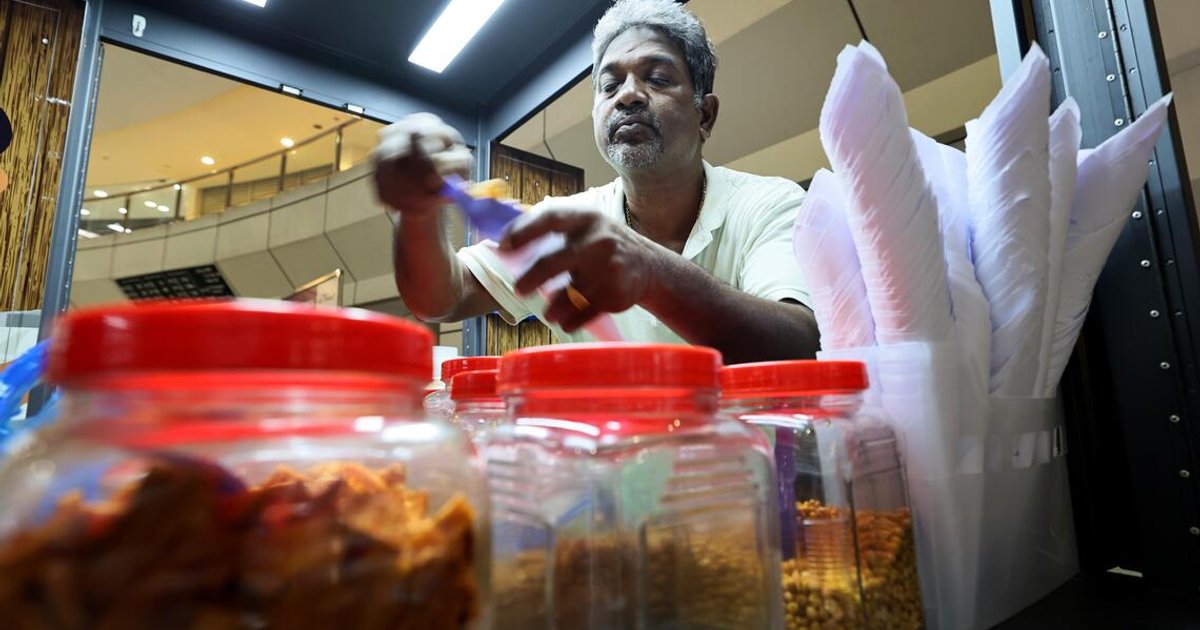
Amirthaalangaram Moorthy is one of the few remaining hawkers in Singapore who sells this old-school snack once ubiquitous at cinema lobbies. The third-generation vendor operates from a stall at the Toa Payoh Bus Interchange.
SINGAPORE – This week’s ST×NLB Crossword was constructed by me, with clue contributions from a team of 40 volunteers from both organisations.
This puzzle strives to be inclusive, with full CMIO racial representation.
The [Common Chinese New Year greeting, when repeated] is GONG XI (2D), which is an expression of congratulations. One can say “gong xi, gong xi” for a casual vibe or go full “gong xi fa cai” (congratulations and may you prosper) for maximum effect. Some cheeky kids might even follow it up with “hong bao na lai” (hand over the red packets).
NASI PADANG (1D) is the [Point-and-choose mixed rice in Malay cuisine], equivalent to economy rice offerings from predominantly Chinese hawkers. As its name suggests, nasi padang has roots in the coastal city of Padang in West Sumatra, Indonesia.
A diner chooses dishes at Warong Nasi Pariaman on Jan 31, 2026, the last day of its operations.
The style of cooking was brought over by Minangkabu migrants, including the patriarch of the family that ran the popular eatery Warong Nasi Pariaman which shuttered in January 2026 after a 78-year run. It was believed to be the oldest surviving nasi padang stall in Singapore at the time.
[Kambing] is also the Malay word for GOAT (2A), while chili PADI (12A) is the Malay name for the small but powerful bird’s eye chilli commonly used in Peranakan cuisine.
From the Indian community, we have KACANG PUTEH (29A), the [Old-school cinema snack served in a paper cone]. Although the Malay-derived name means white nuts, beans or peas, the assortment of treats is quite colourful. It is believed to have been introduced to Singapore by Tamil immigrants in the 1940s.
Vendors once established themselves at cinema lobbies and other areas with high pedestrian traffic, but the trade declined by the 1990s as the older vendors retired. One of the few remaining kacang puteh sellers today, Amirthaalangaram Moorthy, operates out of a stall in Toa Payoh Bus Interchange.
The EURASIAN (15A) community, which has both European and Asian (especially Portuguese-Malay) heritage, is often subsumed under the “Others” category for administrative convenience.
As Melissa De Silva discusses in her book, ‘Others’ Is Not A Race, the category once referred predominantly to Eurasian Singaporeans, but has now expanded to include other new citizens with various backgrounds, such as Filipinos, Caucasians, Africans and Japanese.
Incidentally, I recently made a gift of a jar of KAYA (18A) to a Portuguese friend, who remarked that it tasted inexplicably nostalgic and reminded her of some Portuguese desserts and pastries.
Kaya, a local breakfast staple, likely has Eurasian origins.
The similarity is likely not a coincidence. The name kaya, which means rich in Malay, is short for serikaya. While there are differing accounts on the origin of kaya, one theory holds that it was a Eurasian invention adapted from a Portuguese egg jam. Another claims that the Portuguese dessert sericaia, which is made from eggs, sugar, milk and cinnamon, took inspiration from the Malay serikaya instead.
Let the week’s clues inspire your next read, courtesy of NLB. Follow the links to borrow.
15A. “To me, Kristang was a sepia-tinted relic from the past. But to my grandmother, the language was alive and beating. It was the bond with her EURASIAN mother and nine siblings, growing up in a black and white bungalow perched on MacRitchie Hill.” — ‘Others’ Is Not A Race by Melissa De Silva
21A. “There are ships sailing to many ports, but not a SINGLE one goes where life is not painful.” — The Book Of Disquiet by Fernando Pessoa
20D. “There is a part of me that wants to write, a part that wants to theorize, a part that wants to SCULPT, a part that wants to teach... To force myself into a single role, to decide to be just one thing in life, would kill off large parts of me.” — Notes To Myself: My Struggle To Become A Person by Hugh Prather
7. Pricey centrepiece for a proposal (7,4): DIAMOND RING
10. Emperor said to have played the fiddle while his city burned (4): NERO
15. Ethnicity discussed in Melissa De Silva’s book, ‘Others’ Is Not A Race (8): EURASIAN
16. Singapore ____ (crowdsourced news category on Stomp) (4): SEEN
18. Rich breakfast spread? (4): KAYA
21. 35-year-old BTO applicant, perhaps (6): SINGLE
29. Old-school cinema snack served in a paper cone (6,5): KACANG PUTEH
1. Point-and-choose mixed rice in Malay cuisine (4,6): NASI PADANG
2. Common Chinese New Year greeting, when repeated (4,2): GONG XI
4. Actor Pang of Pangdemonium (6): ADRIAN
7. Blood-sucking baddie (7): DRACULA
18. ____92 FM (radio station that might play popular love songs) (4): KISS
19. Pacific and Atlantic, e.g. (6): OCEANS
20. Shape, as an artist or bodybuilder (6): SCULPT
27. Institution whose motto means “daughters of a better age” (3): RGS
If you have any feedback, feel free to write to us at stgames@sph.com.sg. See you next week!

