Starship crashes and explodes in Pacific Ocean after reaching orbit
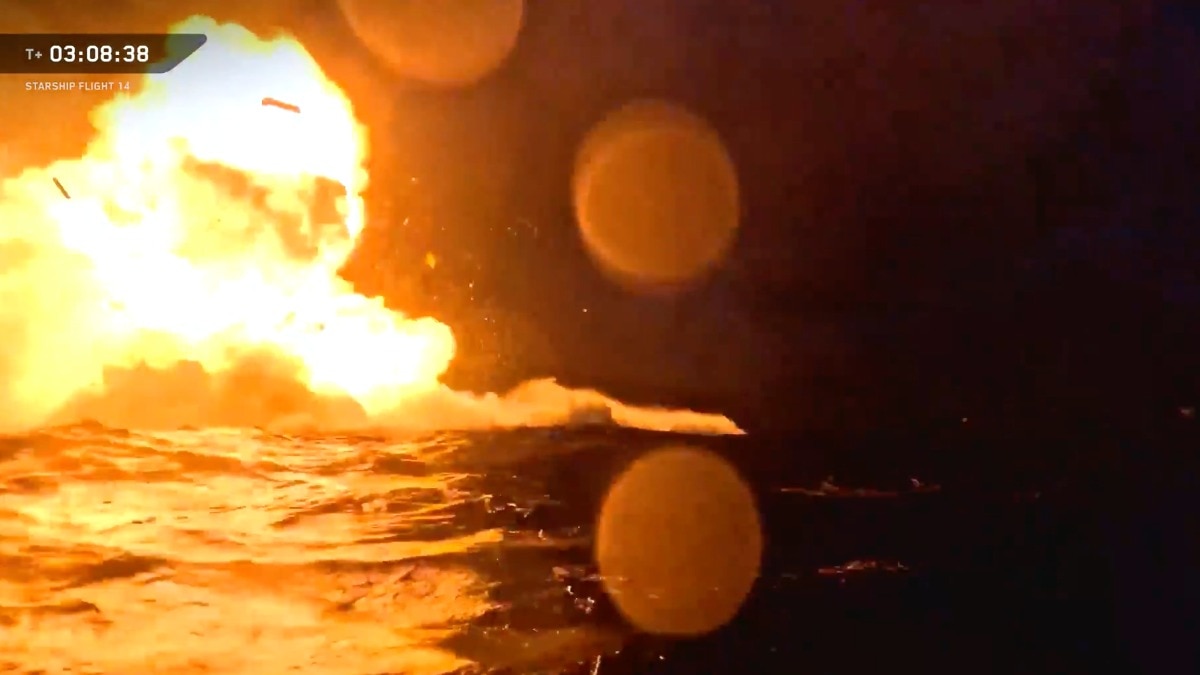
SpaceX's Starship reached Earth orbit for the first time during its 14th flight test on Monday, successfully deploying 26 Starlink satellites before an early thruster failure forced the spacecraft to end its mission nearly seven hours ahead of schedule.
The mission, which was expected to last around 10 hours, ended in just over three hours after Starship suffered a thruster loss following its separation from the Super Heavy booster.
SpaceX subsequently directed the spacecraft towards a controlled splashdown in the Pacific Ocean near Hawaii, bringing the flight to an early end.WATCH STARSHIP CRASHES IN PACIFIC OCEANStarship Flight 14 Concludes! Ship 41 bellyflop, flip-and-burn, and splashdown (and this time, the expected explosion)!Full stream from T-4 hours on X and YT:https://t.co/qFSXNsNURa pic.twitter.com/zFGugrFFrA— NSF - NASASpaceflight.com (@NASASpaceflight) September 28, 2026
The mission marked a significant milestone for Starship, which had conducted 13 previous suborbital test flights without completing a full orbit around Earth.
The 124-metre-tall Starship-Super Heavy rocket lifted off from SpaceX's Starbase facility in Texas on Monday.
The Super Heavy booster separated from the upper stage minutes after liftoff, allowing Starship to continue its journey into space.
During the flight, the spacecraft successfully deployed 26 Starlink satellites, demonstrating its ability to carry and release operational payloads in orbit.SpaceX's Starship rocket has successfully reached orbit and deployed its V3 Starlink satellites into orbit for the first time, officially making this Starship's first revenue-generating flight, a major milestone for the company!Congrats @SpaceX team! Incredible achievement pic.twitter.com/yhFQR7xpHY— Sawyer Merritt (@SawyerMerritt) September 28, 2026The satellites are part of SpaceX's next-generation Starlink network, which aims to expand internet connectivity and increase the capacity of its growing satellite constellation.
The successful deployment was a key objective of Flight 14, even as the spacecraft encountered problems during its subsequent orbital operations.
The thruster failure prevented Starship from continuing with its planned flight profile, forcing SpaceX to bring the mission to an early conclusion.STARSHIP WAS EXPECTED TO FLY OVER INDIA
During its planned orbital trajectory, Starship was expected to pass over India as it completed multiple circuits around Earth.
However, following the failure, SpaceX decided to terminate the flight before the spacecraft could complete its planned trajectory over the country.
The spacecraft instead continued towards its designated splashdown zone in the Pacific Ocean near Hawaii.Booster 21 lands! pic.twitter.com/1PgY1R6LPC— NSF - NASASpaceflight.com (@NASASpaceflight) September 28, 2026
The early return highlights the challenges SpaceX faces as it works to develop Starship into a fully reusable launch system.
Despite the early end, the mission achieved two major objectives: reaching orbit and deploying 26 operational Starlink satellites.
Starship remains central to SpaceX's plans for future human missions to the Moon and Mars, as well as NASA's Artemis programme to return astronauts to the lunar surface.
Nasa has selected a version of Starship as the lunar landing system for its Artemis programme. However, orbital operations, in-space refuelling and reliable recovery remain critical milestones before the spacecraft can support crewed lunar missions.- Ends