Starship Flight 15 didn't go as planned, but SpaceX may still make history
SpaceX fell short of making rocket history during Starship Flight 15 after its Super Heavy booster was diverted from a planned catch by the launch tower’s giant mechanical arms, nicknamed Chopsticks.Watch Starship Flight 15 https://t.co/xvmIH2diNA— SpaceX (@SpaceX) November 13, 2026
The booster instead came down in the Gulf of Mexico. But the mission is far from over as its upper-stage spacecraft, Starship, has reached orbit, deployed its satellite payload and is preparing to become the first spacecraft of its kind to be caught by the launch tower after returning from space.
The 15th test flight lifted off from SpaceX’s Starbase facility in South Texas at 4:17 am IST on November 14, carrying 26 next-generation Starlink V3 satellites.
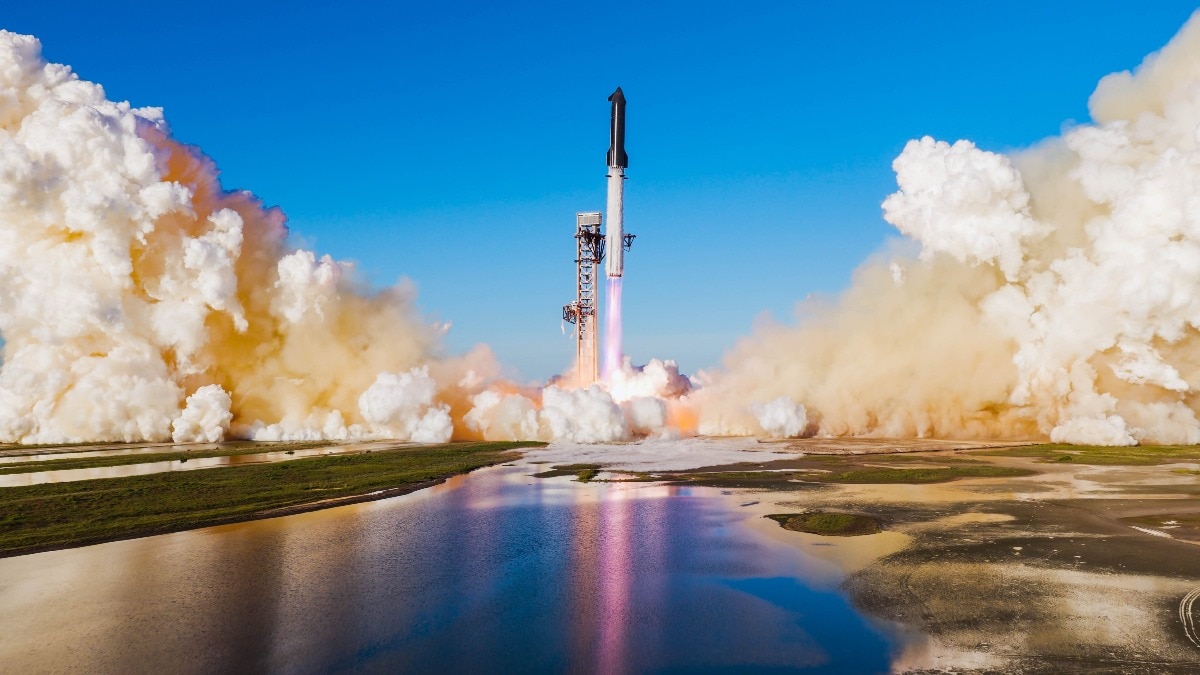
The mission is a crucial step in Elon Musk’s ambition to develop a rocket that can be reused in its entirety. An image of the Starship during Flight 15 launch. (Photo: SpaceX)
The mission began successfully, with the two sections of the rocket separating as planned. However, SpaceX called off the Super Heavy booster’s planned return to the launch tower and redirected it towards an offshore landing.
The booster splashed down in the Gulf of Mexico around six-and-a-half minutes after liftoff, bringing an end to the first attempted recovery of the upgraded Super Heavy V3. The booster for SpaceX's mega rocket Starship explodes after a catch attempt was aborted during Flight 15. (Photo: AP) SpaceX has not publicly established the precise reason for abandoning the catch.
But the development meant the company could not achieve its ambitious goal of recovering both sections of Starship during the same flight.The mission profile for Starship Flight 15 https://t.co/qTZMaoywkW— SpaceX (@SpaceX) November 13, 2026STARSHIP MAY STILL MAKE HISTORY
The upper stage, known as Ship 42, has had a more encouraging flight so far.
It reached orbit and deployed all 26 Starlink V3 satellites, marking the second time the megarocket has successfully reached orbit. An aerial view of Starship lifting off during Flight 15. (Photo: SpaceX)
The spacecraft is expected to complete around 14 trips around Earth during a mission lasting more than 22 hours, with its return scheduled for the wee hours of Sunday, November 15.
If it makes the journey back safely, SpaceX will attempt to catch it using the tower's mechanical arms.
Unlike the booster, which returns within minutes, Starship must survive the intense heat of re-entering Earth's atmosphere before approaching the launch tower.
A successful catch would be a first for an orbital spacecraft of this kind and a major step towards making the entire rocket reusable. An image of the upper and lower stage of the Starship rocket sitting on the launch pad. (Photo: SpaceX) WHY IS FLIGHT 15 A BIG DEAL FOR SPACEX?
Reusability is central to Musk's plans to make space launches more frequent and less expensive.
Starship is also expected to carry larger batches of Starlink satellites, support future Moon missions and eventually help transport people and cargo to Mars.
Nasa has selected Starship as a lunar lander for its Artemis programme, with a crewed Moon landing targeted for 2028. However, major milestones, including transferring fuel between spacecraft in orbit, remain ahead.
Flight 15 may have missed one historic opportunity, but its most ambitious test is still to come.- Ends