Starship launched on historic maiden orbital flight to complete six trips around Earth
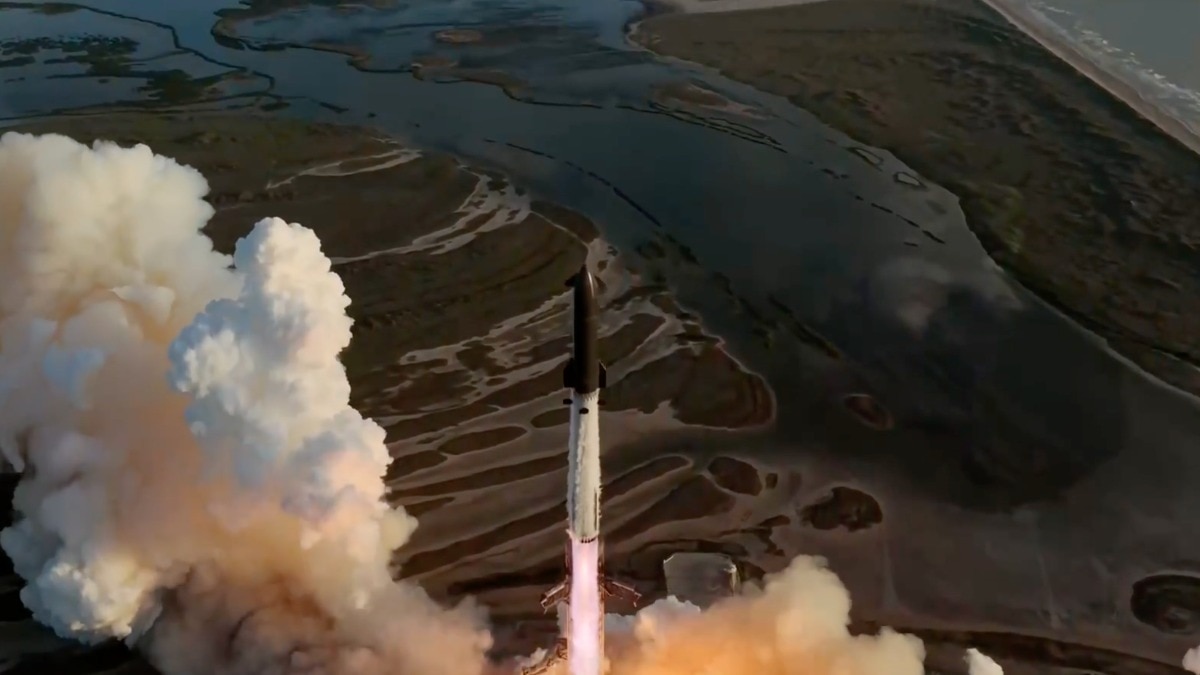
SpaceX's Starship-Super Heavy rocket lifted off on its 14th flight test on Monday, marking a crucial milestone in the company's efforts to develop a fully reusable rocket capable of carrying humans and cargo to the Moon and Mars.
The launch, from SpaceX's Starbase facility in Texas, is designed to take Starship into Earth orbit for the first time, with the spacecraft expected to complete six circuits around the planet before returning to Earth.
The mission is a major test for the world's most powerful rocket, which is central to SpaceX's ambitions for deep-space exploration and Nasa's plans to return astronauts to the lunar surface.Liftoff of Starship! pic.twitter.com/40D8bXSkr2— SpaceX (@SpaceX) September 28, 2026
The mission is expected to last nearly 10 hours and include six circuits around Earth.
The 124-metre-tall rocket lifted off from SpaceX's Starbase facility in Texas during a 75-minute launch window with a picture-perfect stage separation happening minutes later.
While the Starship continued its flight upwards, the Super Heavy rocket made a hard splashdown in the ocean, exploding upon touchdown. It is noted that it was planned by SpaceX.
The mission represents a major shift for Starship, whose previous 13 flights followed suborbital trajectories, reaching space without completing a full orbit.Booster 21 lands! pic.twitter.com/1PgY1R6LPC— NSF - NASASpaceflight.com (@NASASpaceflight) September 28, 2026If the mission proceeds as planned, Starship's upper stage, Ship 41, will perform an orbital insertion burn approximately 25 minutes after liftoff, placing the spacecraft in an orbit about 275 kilometres above Earth.
The spacecraft will then attempt to deploy 26 next-generation Starlink V3 satellites, designed to expand SpaceX's satellite internet network and increase its data transmission capacity. Three satellites will also carry imaging equipment to record the spacecraft's heat shield during flight.
The mission will test critical systems, including orbital engine relighting, satellite deployment, heat-shield performance and controlled re-entry.
After completing its planned six orbits, Starship is expected to conduct a deorbit burn and splash down in the Pacific Ocean west of Chile. The Super Heavy booster will attempt a controlled descent into the Gulf of Mexico.
Starship is central to SpaceX's ambitions to make space transportation fully reusable and support future human missions to the Moon and Mars.
Nasa has selected a version of Starship as the lunar landing system for its Artemis programme. However, orbital operations, in-space refuelling and reliable recovery remain critical milestones before the spacecraft can support crewed lunar missions.