
Student protests spread across Indian universities over safety, rights and reform in 2026
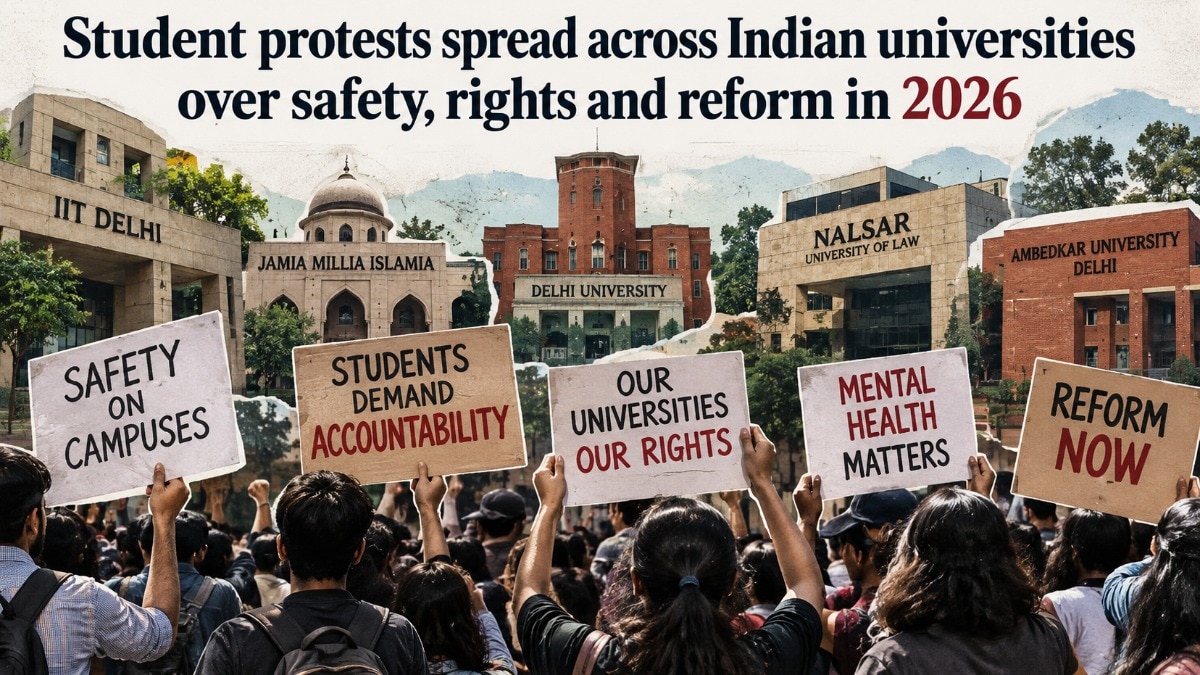
Across India, 2026 has seen student protests move from questions of examinations and admissions to the wider conditions of university life. At IIT Delhi and IIT Bombay, students have protested after the deaths of fellow students, demanding greater accountability and stronger mental-health support. At NALSAR and NLSIU, law students challenged decisions involving their universities and the judiciary.
Jamia Millia Islamia saw protests over alleged irregularities in admissions, while students at Ambedkar University Delhi have raised concerns over campus access, PhD rules and basic facilities.
Taken together, these protests point to a broader shift in what students are asking of their institutions. The disputes are different, but they increasingly centre on the same question: how universities exercise authority, and what students can expect when that authority fails them.
At IIT Delhi, students began protesting after the death by suicide of 31-year-old MSc Physics student Rishikesh Kumar in August 2026. More than 500 students gathered inside the Lecture Hall Complex, while around 2,000 others assembled outside.
Students demanded an independent investigation, accountability from institute officials and financial support for Kumar’s family. They also raised broader concerns about student mental health and institutional support. The Indian Express
IIT Delhi subsequently constituted an External Inquiry Committee to examine the circumstances surrounding Kumar’s death. After students continued to press for a more independent process, the institute reconstituted the panel with retired Delhi High Court judge Justice Mukta Gupta as its head.The institute said it was also strengthening mental-health support, including counsellors, psychiatrists and an external ombudsperson for unresolved student grievances.
At IIT Bombay, students protested following the death by suicide of 20-year-old BTech student Sahil Wakode in September 2026. The protest continued for three days, with students demanding an independent investigation and greater institutional accountability.
Students submitted an 18-point charter that called for an independent probe into suicide cases, stronger mental-health measures, greater student representation in academic decision-making and changes to the institute’s grievance and disciplinary systems. Among the demands was a 24/7 psychiatrist on campus.
After discussions with the protesting students, IIT Bombay Director Prof. Shireesh Kedare signed the 18-point charter, agreeing to the demands in principle. The detailed implementation was to be placed before students at an open house.
At NALSAR University of Law, more than 400 students objected to the proposed attendance of the Chief Justice of India at their convocation.
A similar protest emerged at NLSIU Bengaluru, where hundreds of students and alumni opposed the proposed attendance of senior legal officials. NLSIU subsequently cancelled its 2026 convocation.
Students protested alleged irregularities in the 2026–27 spot-admission process. The university rejected the allegations, while four students were suspended and barred from campus following an unauthorised sit-in.
Students held an indefinite sit-in over student representation, mental-health support, hostel restrictions, disciplinary procedures and campus safety. The institute subsequently discussed additional counselling capacity and changes to hostel and common-space policies.
Both universities faced student unrest after alarming claims concerning female students circulated on social media. The claims at Chitkara were found to be unconfirmed, while the allegation at LPU remained under investigation. The incidents highlighted the risks of rumours spreading before facts are established.
Women and queer students organised demonstrations following an alleged gangrape in Delhi, raising broader concerns about campus safety, unsafe commuting, stalking and women's freedom. Protests took place around several DU colleges and the Faculty of Arts.
Students sustained an ongoing protest over campus governance, access, PhD fees and attendance rules, as well as concerns about facilities and research conditions. The university later revised attendance guidelines for full-time PhD scholars receiving fellowships.
Overall, the university protests were different in their immediate causes, but shared broader concerns about student welfare, institutional accountability, academic freedom, safety and the limits of university authority.- Ends

