Sudan's ousted president Bashir sent to Khartoum for treatment, lawyer says
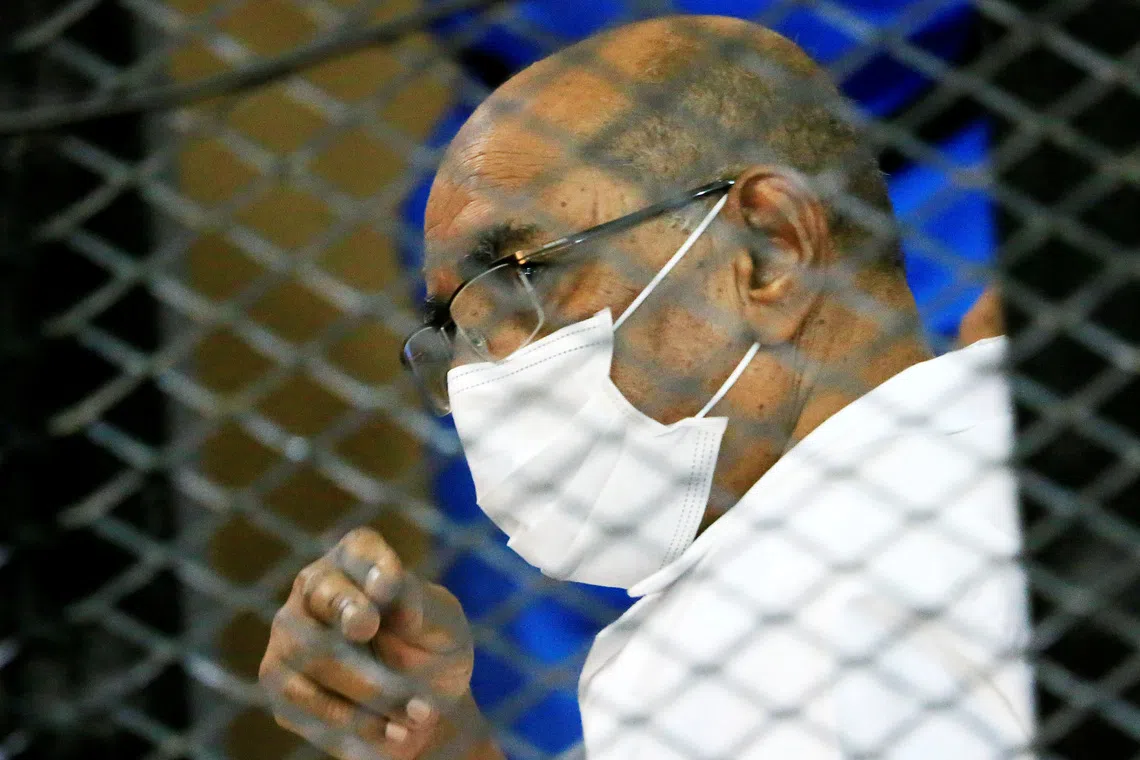
FILE PHOTO: Sudan's ousted President Omar al-Bashir is seen inside the defendant's cage at a courthouse in Khartoum, Sudan September 15, 2020. REUTERS/Mohamed Nureldin Abdallah/File Photo
Oct 1 - Ousted Sudanese President Omar al-Bashir has been transferred to a military-run hospital in Khartoum for medical treatment and requires further care outside the country, his lawyer said on Thursday.
Bashir, 82, was toppled by the Sudanese army and the paramilitary Rapid Support Forces in April 2019, following a months-long popular uprising.
The RSF and army later fell out over plans to integrate their forces during a planned transition to civilian rule and have been fighting a civil war that has laid waste to much of the country over the past three-and-a-half years.
Bashir had been moved from prison to hospital prior to the outbreak of war, and later transferred to the town of Merowe in northern Sudan, where he had been put under military guard.
Bashir was sent to Khartoum for medical tests and he had symptoms that required diagnosis and treatment outside Sudan, his lawyer, Mohamed Alhassan Alameen, told Reuters.
In a statement on Wednesday, Bashir's family said his need for medical treatment outside Sudan "has become critical and urgent, and cannot be delayed any longer", but they had not received official permission to send him abroad.
It was unclear precisely what condition Bashir was suffering. Sudan's military did not immediately respond to a request for comment.
Several prominent Sudanese Islamist figures also called for his transfer out of the country on social media.
Any such move would likely cause discord within Sudan and could draw international condemnation since Bashir is wanted by the International Criminal Court on charges including genocide and also has open cases against him in Sudan.
During Bashir's three decades in power, Sudan was listed by the US as a state sponsor of terrorism and was subject to wide-ranging sanctions. Protesters during the popular uprising accused him and his Islamist National Congress Party of widespread corruption and repression.
After his ouster, Bashir was tried on various charges and convicted of corruption and illicit financing, for which he was serving prison time at the start of the war. REUTERS