Supreme Court Mail-In Ballot Ruling Could Impact These Midterm Races Most - Newsweek
The Supreme Court’s decision to keep new Postal Service requirements on hold preserves existing mail-ballot procedures nationwide, removing a potential source of disruption in several closely contested midterm races.
A Newsweek analysis has found that the ruling may be especially significant for four toss-up House races in Colorado, Arizona and California, where mail ballots accounted for nearly three-quarters or more of statewide turnout in 2024.
Those contests sit in states where between 74.7 percent and 91.3 percent of turnout was conducted by mail in 2024.
Election officials will avoid a late overhaul, but the available data do not show that the decision will favor either party or change any result.
“The RNC will continue to back President Trump’s efforts to secure elections,” Ally Triolo, Republican National Committee (RNC) election integrity communications director, told Newsweek in an emailed statement.
“Voters deserve elections they can trust, and that starts with clear rules and strong safeguards against fraud. This fight is far from over, and Republicans will not rest until America’s ballot box is fully protected.”
When asked for comment, the Democratic National Committee (DNC) pointed Newsweek to a joint statement released by the DNC and its satellite organizations, the Democratic Congressional Campaign Committee (DCCC), the Democratic Senatorial Campaign Committee (DSCC) and the Democratic Governors Association (DGA).
“The highest court in the nation yesterday ruled for the American voter and against chaos,” DCCC Chair Suzan DelBene, DSCC Chair Kirsten Gillibrand, DGA Chair Andy Beshear, and DNC Chair Ken Martin said in the shared statement.
“Donald Trump and the executive branch have no business or legal authority to deny American citizens their right to vote by mail.
“This decision is a testament to the strength of our Constitution, but it’s also a reminder that the Republicans, in an attempt to rig the election in their favor, will try to undermine the will of the voters at every turn. Democrats will use every tool at our disposal to stop them.”
Newsweek also contacted every campaign mentioned in this article via email for comment on Tuesday morning.
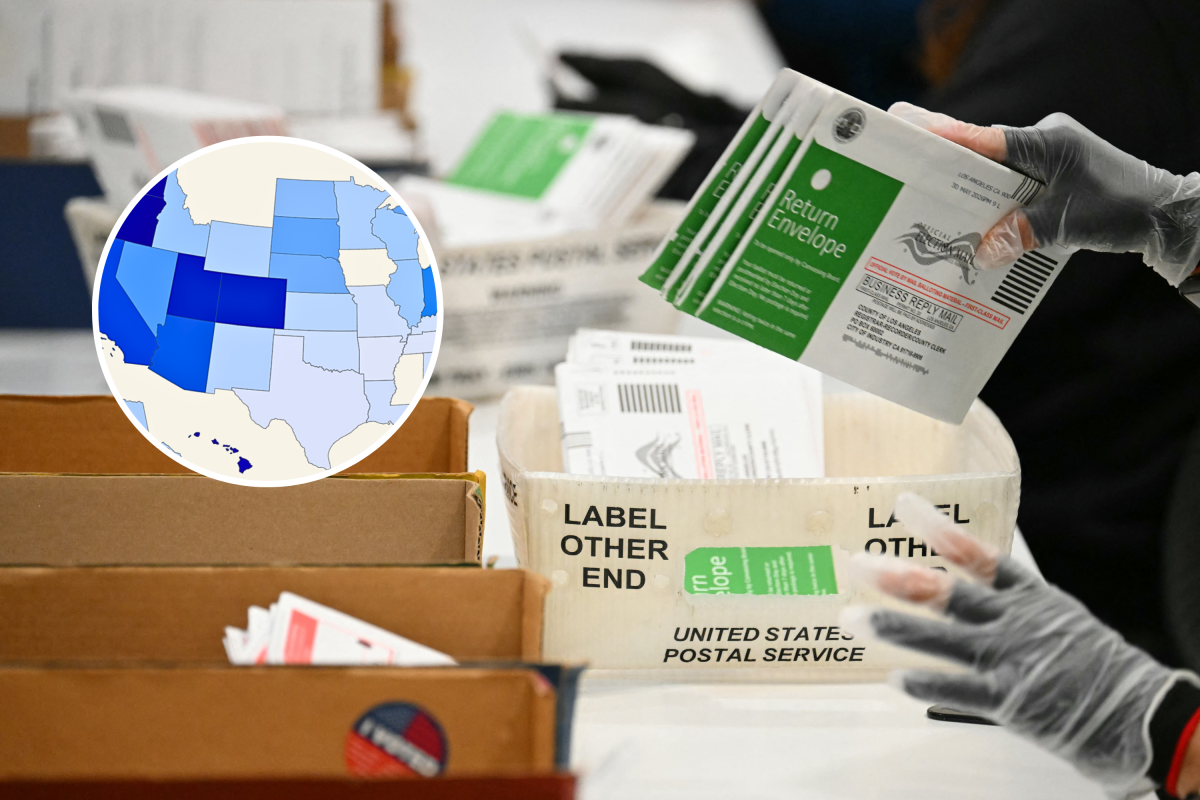
Use the map below to explore how widely mail voting was used in each state during the 2024 general election.
President Donald Trump’s administration sought to introduce approved ballot envelopes, unique bar codes and new voter-data submissions for federal ballot mail.
The Supreme Court kept those requirements from taking effect in 2026 after Justice Brett Kavanaugh said officials lacked sufficient time to implement them.
Use the map below to find your state and see when your mail-in ballot must reach election officials to be counted.
A Newsweek analysis compares the latest House race ratings with the Election Assistance Commission’s (EAC) measure of mail voting in the 2024 general election.
Four districts stand out: CO-08, AZ-01, AZ-06 and CA-22.
Each appears in the September 11 Toss Up category from the Cook Political Report, while all are located in states where mail ballots accounted for nearly three-quarters or more of turnout two years ago.
That overlap does not mean the blocked Postal Service rule would have determined the winner.
Instead, it identifies close contests where a last-minute change would have intersected with a substantial part of the election system.
Mail voting in Colorado accounted for 91.3 percent of statewide turnout in 2024, according to the federal data, with almost 3 million mail ballots counted.
Republican Representative Gabe Evans, a former U.S. Army officer, is running against Democratic State Representative Manny Rutinel, an attorney, in CO-08, which covers parts of the northern Denver suburbs and nearby communities.
Cook rates the district a Toss Up, putting it in the most competitive category.
An RNC strategist previously told Newsweek that the party believes Evans’ Hispanic heritage and ranching background could help him connect with voters in a district shaped by its Hispanic communities and agricultural economy.
The district was closely divided in 2024: Republicans edged the House race by 0.74 percentage points, while Trump won it by 1.9 points.
While recent public voter polling is limited, prediction-market prices favored Rutinel at the time of writing.
Polymarket put him at 74 percent to Republican Evans’ 25 percent, while Kalshi showed a similar 80 percent to 24 percent split.
Percentages may not total 100 because they reflect separately traded contract prices, which can be affected by market spreads and rounding.
Those contracts reflect traders’ expectations rather than voter intentions, and prices can change quickly.
CO-08 is among the most important races identified here because it offers the strongest combination of electoral uncertainty and widespread use of mail ballots.
Mail ballots accounted for 74.7 percent of Arizona turnout in 2024, with more than 2.8 million counted. Two Republican-held House seats there are on the Toss-Up board, according to race forecasters.
AZ-01 is an open-seat contest between Democrat Amish Shah, an emergency physician and former state lawmaker, and Republican Jay Feely, the former NFL kicker and broadcaster endorsed by Trump.
This contest offers a rare political rematch of sorts because the rivals have an unusual past.
Before Shah and Feely became opponents, they shared the New York Jets sideline in 2008 and 2009, with Shah serving as a physician and Feely kicking for the team.
Feely has described their connection as “an old relationship” and said he hoped the campaign would remain respectful.
Cook, Inside Elections and Sabato’s Crystal Ball have rated the race a Toss Up.
A lack of public polling means the Toss Up assessment relies more heavily on district politics, candidate strength and the broader campaign environment than on a current public polling average.
At the time of writing, prediction markets favored Shah, with Kalshi pricing the AZ-01 race at 72 percent for the Democrat and 32 percent for Feely, while Polymarket showed a 72-to-27 split.
Nearby AZ-06 pits Republican Representative Juan Ciscomani, a former gubernatorial adviser seeking a third term after two narrow victories, against Democrat JoAnna Mendoza, a retired Marine who grew up in a farmworker family, as well as Libertarian Jereme Peters and Green Party candidate Gary Swing.
Cook, Inside Elections and Sabato’s Crystal Ball list it as a Toss Up, while Decision Desk has offered a more favorable assessment for the Democrat.
At the time of writing, prediction markets strongly favored Mendoza: Polymarket put her at 83 percent to Ciscomani’s 19 percent, while Kalshi showed an 82-to-17 split.
A previous Newsweek analysis identified Maricopa County as a key battleground in AZ-01 and Pima County as an important Democratic vote source in AZ-06.
The two Arizona districts show how one heavily mail-voting state contains two races positioned near the center of the fight for the House.
California recorded an 80.8 percent mail-turnout share and counted 13,062,318 mail ballots in 2024, the largest state total highlighted by the EAC.
Republican Representative David Valadao, a Central Valley dairy farmer with a record of surviving difficult election cycles who was first elected to Congress in 2012, is defending CA-22 against Democrat Randy Villegas, a political-science professor, school board trustee and Kern County native.
Cook calls the Central Valley contest a Toss Up, but other forecasters disagree over its direction: Inside Elections has rated it Tilt Republican, while Decision Desk and Sabato’s Crystal Ball have leaned toward the Democrat.
One publicly listed poll, conducted by Democratic-aligned Tulchin Research and completed June 21, put Villegas at 48 percent and Valadao at 44 percent among 800 likely voters. Its partisan sponsorship and age mean it should not be viewed as a definitive picture of the race.
The conflicting ratings are more revealing than the isolated poll: analysts agree the seat is competitive, but not on which candidate has the advantage.
Traders, however, favored Villegas in CA-22, with Polymarket pricing him at 88 percent to Valadao’s 13 percent and Kalshi showing a 92-to-10 split at the time of writing.
The EAC figures show how people voted in 2024, not how they will vote in 2026.
They cannot tell us how many ballots would have been affected by the new requirements, whether anyone would have been prevented from voting, or whether either party would have gained an advantage.
What the comparison does reveal is where a late change would have touched the largest share of voting activity in an already close race.
By keeping existing systems in place, the Supreme Court removed that uncertainty from four House contests with little room for error.