Susan Collins Blasted by Troy Jackson Over FBI Probe Report—‘Corruption’ - Newsweek
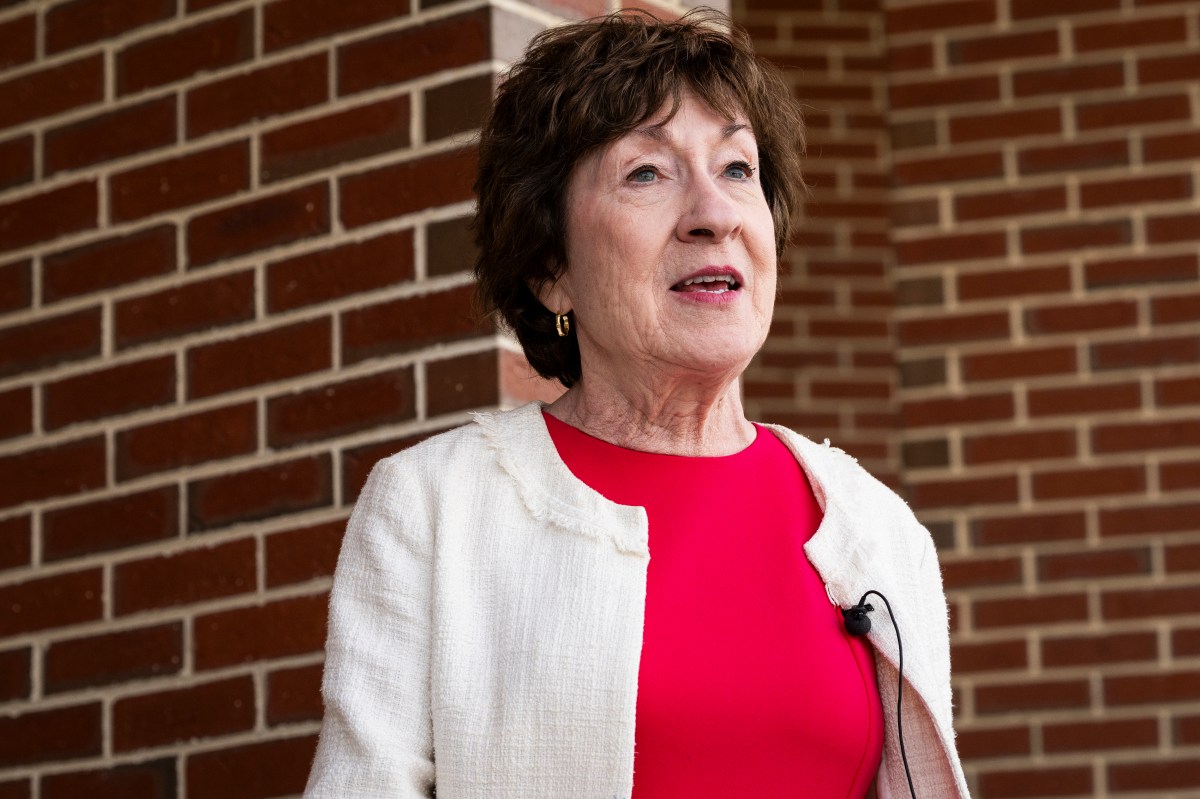
Senator Susan Collins, a Republican, was hit with criticism from her Democratic challenger Troy Jackson after ProPublica published a report about her alleged interactions with a major campaign donor, as polls show a tight race in Maine six weeks out from the 2026 midterms.
The FBI sought to launch a probe into Collins' dealings with a major donor, according to a ProPublica report, and the effort was abandoned after President Donald Trump's return to office, according to an investigation by the outlet.
The report comes amid a tight Maine Senate race, one of the most competitive and closely watched contests in the 2026 midterms.
Jackson responded to the report in a statement provided to Newsweek, accusing Collins of “corruption of the highest order.”
“Susan Collins doesn’t care that we’re losing our health care, that ICE is killing people on the streets, and that we’ve been dragged into a pointless war—as long as her donors get their contracts and her coffers get filled. We deserve answers about every contract and every conversation that Collins and her team facilitated on the backs of taxpayers,” he wrote. “The jig is up.”
One Maine politics expert told Newsweek the report "could sting" Collins' reelection chances.
Collins’ office denied the report in a statement to Newsweek.
Annie Clark, who serves as Collins’ deputy chief of staff, said the claims in the report are “categorically false.”
“There have never been any allegations of wrongdoing by the Collins for Senator campaign, and the campaign was never the target of the FBI investigation,” she wrote.
Although Maine often leans Democratic and backed former Vice President Kamala Harris by about 7 points in 2024, Collins has been a longtime Republican powerhouse in the state. She has won by wide margins in the past due to her personal popularity and bipartisan image.
Democrats have been hopeful about finally unseating Collins this year. The national environment appears favorable for a blue wave due to President Donald Trump’s falling national approval rating and economic concerns tied to inflation and the cost of living.
While Collins has sought to distance herself from Trump, Jackson has painted her as being too close to the president in a state where Trump remains unpopular.
The ProPublica report focuses on alleged interactions between Collins and Martin Kao, the CEO of Navatek, a Hawaii-based military contractor. The report alleged that Scott Reed, a representative from her super PAC, met with the company executives to solicit a $500,000 donation. Government contractors are prohibited from making campaign contributions.
The company’s CEO allegedly told Reed that Navatek “wanted Collins to guarantee tens of millions of dollars in additional federal funding,” ProPublica reported. An initial $150,000 donation was allegedly funneled to the PAC through a shell company, and he later told executives that Collins committed to securing $32 million in contracts for the company.
He was indicted for making illegal campaign contributions in 2022 and told investigators about a wider effort involving Collins and other members of Congress—who were not named in the report—according to ProPublica. The publication noted Kao had “credibility issues.”
Agents had asked for authorization to launch a bribery probe by late 2024. But when Trump returned to the White House, the investigation was effectively abandoned amid his administration’s sweeping changes to the FBI, the outlet reported.
FBI Spokesperson Ben Williamson told ProPublica that the agency “ultimately found nothing implicating Senator Collins or Senator Collins’ campaign,” and nobody from her team has been charged.
Clark said that ProPublica “took the word of someone who pled guilty to five counts of money laundering, three counts of wire fraud, one count of bank fraud, and making false submissions to the FEC.”
“As Martin Kao was awaiting sentencing, he began making outlandish charges about the Collins office, deflecting blame from himself and placing it on Senator Collins, including alleging that our office required contributions before taking meetings and engaged in extortion, pay for play, and bribery,” she wrote.
Clark also noted that the FBI and Court “obviously did not believe Kao,” pointing to his 2025 sentence in two separate cases, and that Collins’ campaign “cooperated fully” with the FBI during the investigation.
She said the issues were resolved in 2021 and that the FBI has not contacted Collins about Kao ever since.
James Melcher, professor of political science at the University of Maine-Farmington, told Newsweek he believes it’s “too early to say with certainty how much impact it could have.” He raised questions about whether the story has been corroborated, and whether she was aware of what her staffers were doing.
“Collins denies any wrongdoing. But if the story has legs, it could have some impact,” he said. “Collins has never been involved in any significant scandal of this type, so it's not a case where one can say ‘ah, same old same old, no big deal.’”
It could play into Jackson’s anti-corruption platform, he said.
The report is a “pretty big deal,” Dan Shea, professor of political science at Colby College, told Newsweek.
“For lots of split-ticket-voters Senator Collins makes sense because she delivers for the state. If that rationale is called into question—that she brings home federal funds in order to bolster her own campaign coffers—she will lose some of these voters,” he said. “Yeah, it could sting.”
Moderate Democrats and unenrolled voters have been “key” to her past victories, he said. Her ability to bring home money to the state “trumps partisan leanings,” but that could be muddied by the report, he said.
Unenrolled voters are also going to play a key role in this race, according to Melcher.
“Collins has always drawn some of these voters by her appeals to bipartisanship, trying to separate herself from Trump (though Ds push back hard on that and say she always votes with Trump and/or party leadership when they really need her). Some of them like Collins because they see her as delivering for Maine and using her connections to benefit our state--which is not a rich one,” he said.
Polls have shown a close race, with the latest survey from Quantus Insights showing a statistical tie, with Collins at 47.1 percent and Jackson at 46.4 percent. It surveyed 644 likely voters from September 14 to September 15, 2026, and had a margin of error of plus or minus 4.3 percentage points.
Jackson, however, has held narrow leads in other polls.
He was up 4 points in a YouGov poll, 48 percent to 44 percent. It surveyed 1,378 registered voters from September 2 to September 8, 2026, with a margin of error of plus or minus 4.9 percentage points.
A CNN poll showed Jackson up 3 points, 48 percent to 45 percent. It surveyed 880 registered voters from August 31 to September 6, 2026, and had a margin of error of plus or minus 3.7 percentage points.
Jackson also led Collins by 2 points in a Fox News poll, 48 percent to 46 percent. It surveyed 1,000 registered voters from August 6 to August 10, 2026, and had a margin of error of plus or minus 3 percentage points. It was conducted by Beacon Research and Shaw & Company Research.
Shea said the race is an “absolute toss up.”
“Collins has more money and usually does better than the polls suggest. But Jackson will have a massive enthusiasm bubble on his side. I'd add that it looks like the Democratic gubernatorial candidate, Hanna Pingree, will win easily. She's at the top of the ticket and that could help Jackson,” he said.
The race is expected to be close, and a Republican victory rests on Collins’ ability to withstand the national headwinds and hold onto support from independent voters and some moderate Democrats despite Trump’s poor national approval rating.
But Republicans believe that if anyone is capable of winning in Maine this year, it would be Collins.
Notably, the 2020 race between Collins and Democratic challenger Sara Gideon saw a notable polling error in Collins’ favor. Polling errors are not always duplicated from cycle to cycle, but a question about whether polls are slightly off this year continues to loom over the race. Maine is a tough state to poll due to its older, rural population.
Collins trailed Gideon in nearly every poll but ultimately outperformed the polls to hold onto the seat, even as former President Joe Biden won the state by 9 points that year.
Melcher said the race is “dead even," adding that there are no major independent or third-party candidates on the ballot this time around, so the race is less likely to head toward ranked choice voting.
Democrats are hopeful that a more blue environment will make Maine unwinnable for Collins, and Jackson, the former Maine Senate president, is viewed as a viable challenger, though Republicans have sought to cast him as too progressive for the more moderate state.
The cycle has also been tumultuous for Democrats.
Graham Platner, a progressive political newcomer whose campaign garnered national attention, was hit with sexual abuse allegations just weeks after clinching the Democratic nomination. He ultimately withdrew from the race but has denied the allegations.
Jackson, who initially ran for governor but ultimately lost the primary, emerged as the new nominee during a convention in July, easily securing the required delegates to find his place on the ballot.
Democrats’ path to a Senate majority runs through Maine.
Democrats are increasingly hopeful about winning the Senate despite a difficult map. Republicans hold a 53-47 Senate majority, so Democrats must flip four seats to win control if they win every race in a seat they currently hold. Vice President JD Vance serves as the tiebreaker in a split Senate.
In order to flip the Senate majority, Democrats have to win every seat they currently hold, flip GOP-held seats in competitive states and win some seats in more traditionally conservative territory.
Democrats are defending seats in Trump-won states Georgia and Michigan. In addition to Maine, they view a GOP-held seat in North Carolina as a top flip opportunity. The race in New Hampshire, which backed Harris by about 3 points, is also competitive.
No other Senate races are in Harris-won or single-digit Trump states, meaning Democrats must expand the Senate battleground and compete in more conservative areas if they want to win the majority. They are targeting GOP-held seats in Alaska, Iowa, Ohio and Texas as potential states to flip. The Cook Political Report classifies those four races as tossups.
Whether or not polls shift over the report could be seen over the coming weeks. Both candidates have agreed to face off in debates. Jackson’s campaign said the first debate could be held on October 6, and it would be hosted by WGME, a Portland-based news station. The race is considered a toss-up by forecasters like the Cook Political Report and Sabato’s Crystal Ball.
Contact Newsweek editors on this story: Jason Lemon and Geoffrey Rowland.