Susan Delacourt: Americans aren’t welcome in our sovereignty debates. That may not stop them - Toronto Star
The U.S. could be a bigger player in Canadian referendums than it has ever been before. Should that concern us? You bet it should.
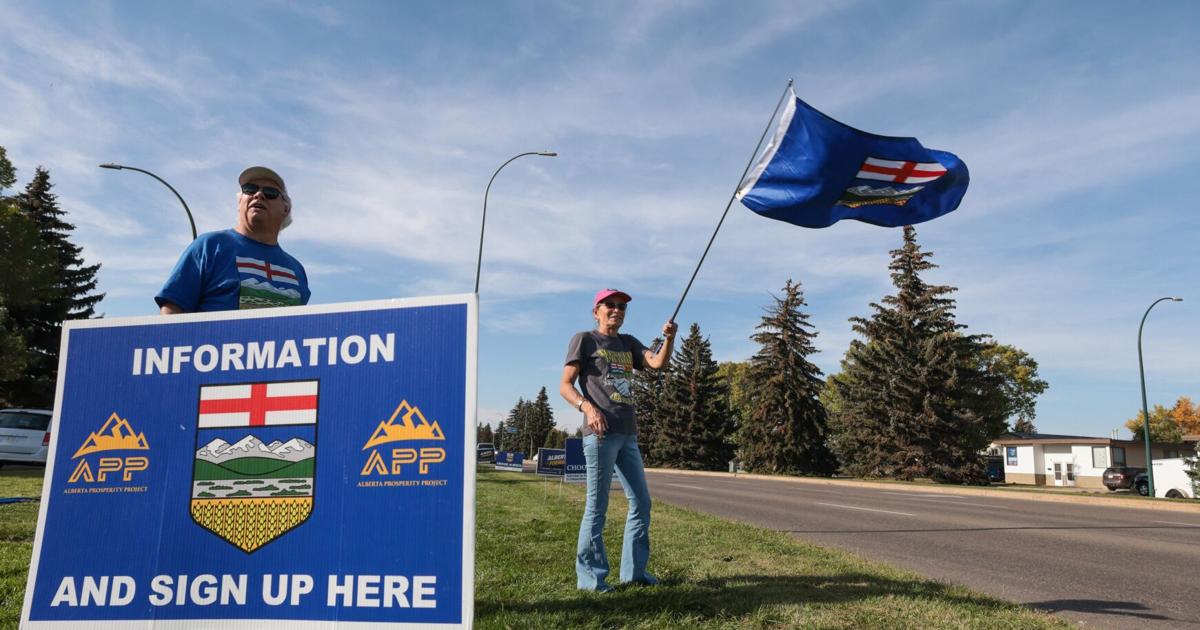
Separatists waves the Alberta flag by the roadside during an event advocating for Alberta’s separation from Canada in Medicine Hat on Sept. 23, 2026.
Susan Delacourt is an Ottawa-based columnist covering national politics for the Star. Reach her via email: sdelacourt@thestar.ca or follow her on X: @susandelacourt
Canadians now have disturbing proof that the referendums of 2026 and beyond are nothing like the ones that have come before.
A Globe and Mail investigation into American involvement in Alberta’s looming referendum shows that the U.S. is far more than a spectator and confirms that its interest may not be entirely in keeping our federation intact.
That is definitely new, no matter how one unnamed U.S. government official, as quoted in the story, reached for the example of Bill Clinton making the pitch for federalism ahead of the 1995 Quebec referendum.
But that connection only reinforces just what different territory we’re in now — Donald Trump’s America doesn’t view Canada’s sovereignty, as previous administrations have, as inviolable.
It means that we should also be keeping our eyes on Quebec if the province is headed to a referendum after Monday’s election. News also emerged over the weekend in the Montreal Gazette that Parti Quebecois representatives had sought meetings with the U.S. government, which were only cancelled because of developments in the Iran war.
That’s two reports in two days about how the U.S. could be a bigger player in Canadian referendums than it has ever been before. Should that concern us? You bet it should.
The Globe investigation also shows how the tools of potential interference have changed radically since 1995. It documented how Republican strategists with ties to Trump went to Calgary to push software that was billed as instrumental for Trump in the last presidential election campaign.
That software, adapted for use in the Alberta referendum, was part of a large data breach, which Elections Alberta said in court filings was connected to a voters list supplied to the Republican Party of Alberta in 2025.
None of this sophisticated machinery was available 31 years ago, nor did would-be foreign meddlers have access to social media and podcasts to wade into a debate that should be up to Canadians to wage and decide for themselves.
When Canada wanted to attend to the delicate relationship with Washington during the last Quebec referendum, it did so mainly through high-level diplomatic engagement, specifically the Canadian ambassador to the U.S., Raymond Chrétien, who was keeping an eye on things for his uncle, prime minister Jean Chrétien. Chrétien and Clinton were also highly involved, as Chantal Hébert and Jean Lapierre documented in their book, “The Morning After.”
These days, we know Mark Carney has been willing to tell Trump to keep his hands off our sovereignty when it comes to trade talks. We don’t know whether he’s said the same thing to the president about Alberta and Quebec sovereignty.
While the New Democrats were calling Monday for an emergency debate, the Prime Minister’s Office was keeping its statements minimal about reports of American interest in referendums here.
“There is regular and ongoing engagement between national security agencies and the relevant authorities in Alberta to ensure the security of the referendum,” PMO spokesperson Audrey Champoux said. “This is the case any time Canadians go to the polls federally or provincially.”
No party, with the exception of the NDP, seemed keen to tackle the disturbing questions raised by the Globe and Gazette reports. Dane Lloyd, the Alberta MP who’s heading up the “Conservatives for Canada” campaign in the referendum, called the Globe reports “concerning,” but didn’t bite on what, if anything, Canada should be doing in response.
One government official, who was not authorized to speak directly on the matter, said on Monday that it is possible to regard American interest in sovereignty matters here as an indication of just how much leverage Canada has — in that this country has things the U.S. wants. Moreover, it also can be seen as vindication for Carney walking away from the trade talks over concerns about sovereignty.
It may also be true, though, that those same trade concerns are standing in the way of Carney speaking out more forcefully about possible U.S. meddling in democratic processes here. Canada doesn’t need to open up a new front in its battle with Trump, obviously, but are these reports a sign the U.S. already has?
Just last week, Peter Navarro, a senior trade adviser to Trump, told Canadian lobbyists to “get the hell out of our country,” and that Canada would “pay even more dearly” if they tried to influence the midterm elections in Maine or Michigan. Oh, the irony.
It’s worth going back to 1995 again, when the federal side came dangerously close to losing the Quebec referendum and a breakup of the country. One of the big problems, as Hébert and Lapierre lay out in their book, is that too many in Ottawa believed they were dealing with the same dynamics as existed in the 1980 referendum.
Canadians now know that any referendums this year and beyond are nothing like 1995 and will be hoping that Ottawa knows that too.
Error! Sorry, there was an error processing your request.
There was a problem with the recaptcha. Please try again.
You may unsubscribe at any time. By signing up, you agree to our terms of use and privacy policy. This site is protected by reCAPTCHA and the Google privacy policy and terms of service apply.
Opinion articles are based on the author’s interpretations and judgments of facts, data and events. More details
Susan Delacourt is an Ottawa-based columnist covering national politics for the Star. Reach her via email: sdelacourt@thestar.ca or follow her on X: @susandelacourt
Related Coverage in Politics