
Taylor Rule: What is the math equation Iran invoked in jibe at Trump? - The Indian Express
In the ongoing US-Iran war now underway for over six months, one of the biggest fallouts has been the global energy supply. With the Strait of Hormuz — a key maritime route through which one-fifth of the global oil and gas supply passes — largely shut to maritime traffic, Iran-backed Houthis have now set their eyes to another crucial maritime route: the Bab al-Mandeb Strait linking the Red Sea with the Gulf of Aden.
The disruptive oil trade has not just hurt the energy suppliers, but also strained economies thousands of miles away in the United States, where the interest rates have been raised this week to control the rising prices.
Iran, which has also been waging an internet war aimed at social media influence and perception management, recently posed a mathematical equation — the Taylor Rule — to US economic challenges. Here’s what the equation means, and the extent of its application to the US’ current economic situation.
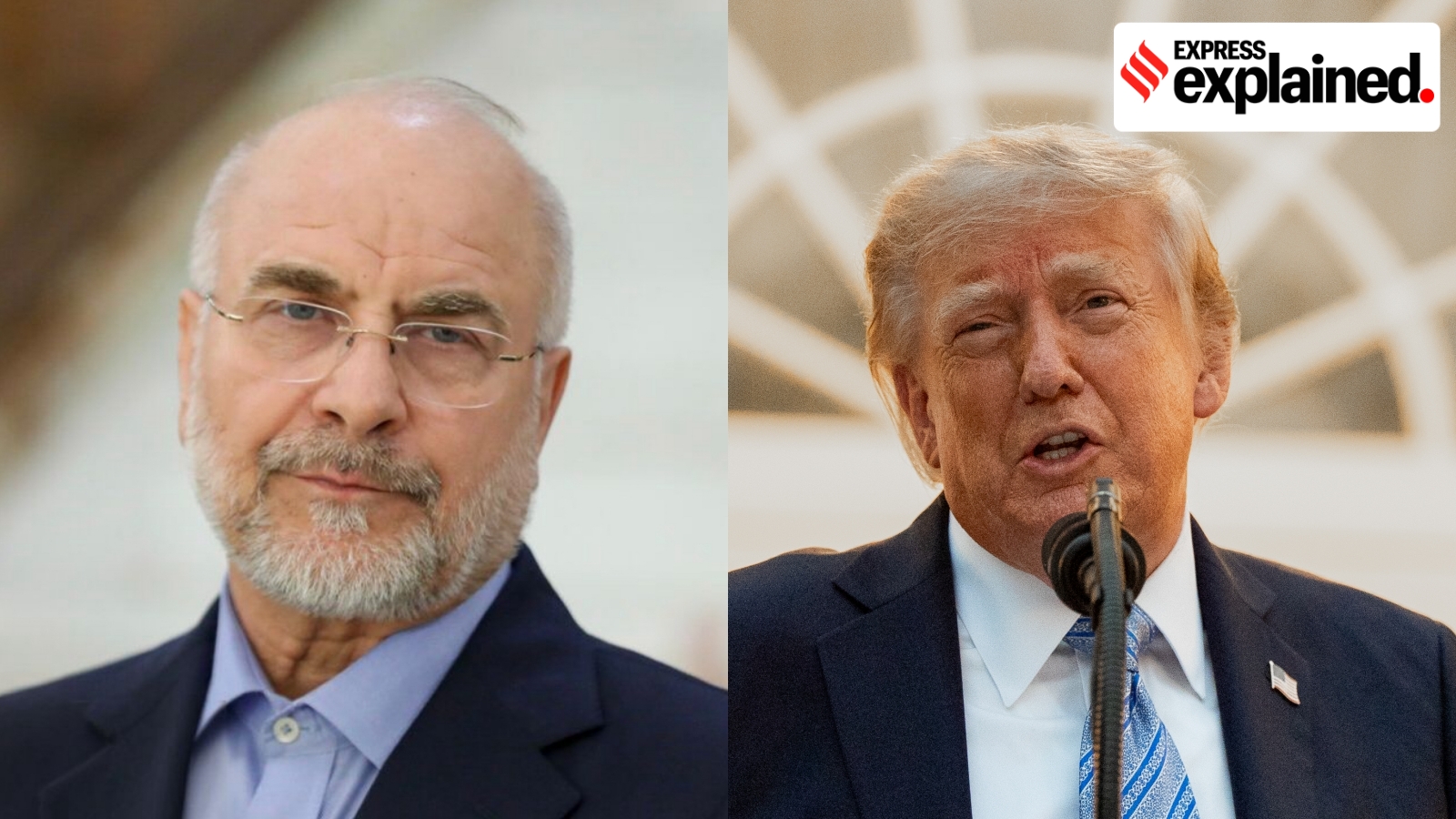
In a post on X on Wednesday (September 16), Iranian Parliament Speaker Mohammad Bagher Ghalibaf invoked a 1990s mathematical equation to pose a question regarding the US economy: if soaring inflation can be curbed by hiking interest rates.
Using the Taylor Rule, an equation introduced by the American economist John Taylor in a 1993 paper to determine interest rates, Ghalibaf suggested that the impact of monetary policy would be limited as long as the Strait of Hormuz remains blocked.
i = r* + π* + 1.5(π−π*) + 0.5(y−y*) + α(SOH−SOH*) + β(BEM−BEM*), α,β > 0
You can’t 25bp a chokepoint and r* isn’t neutral. It’s SOH risk premium, and We set it.
“Straits Taylor Rule: i = r* + π* + 1.5(π−π*) + 0.5(y−y*) + α(SOH−SOH*) + β(BEM−BEM*), α,β > 0 Let’s see if a hike could open SOH or produce a single barrel,” Ghalibaf’s post read. The post highlighted two geopolitical “shocks” in the equations: the Strait of Hormuz (SOH) and Bab el-Mandeb (BEM).
He added, “You can’t 25bp a chokepoint and r* isn’t neutral. It’s SOH risk premium, and We set it.” The SOH risk premium here apparently referred to the risks emanating from the halted energy exports flowing out of the Strait of Hormuz.
Hours after Ghalibaf’s post, the US Federal Reserve did raise the interest rates from 3.75% to 4% by 25 basis points — the first such hike in over three years.
The Taylor Rule is an equation John Taylor introduced in a 1993 paper that prescribes how central banks should set interest rates in response to inflation and economic activity. In simple terms, the rule suggests that a central bank sets a higher rate when inflation is above target and a lower rate if inflation is below target. Similarly, real GDP growth above a target would mean a higher interest rate, while weaker growth would dictate lowering it.
A commonly used version of the equation is: i = r∗ + π + 0.5(π−π∗) + 0.5(y−y∗), where:
y−y∗ = the output gap: the difference between actual and targeted growth in real GDP. If the output gap is 0, then the economy is operating at its potential.
For instance, consider a hypothetical scenario where the real interest rate is 2%, current inflation rate is 4%, the inflation target is 2%, and output gap is 0. Then the equation is —
i = 2 + 4 + 0.5(4−2) + 0.5(0), where i equals 7. So, the rule suggests an interest rate of 7%.
The Taylor Rule, however, is not a law but more of a rule of thumb: it offers a framework to central banks for deliberating monetary policy. When it comes to real-world applications, central banks such as the Fed consider many other factors while setting interest rates.
The rule has also been seen generally less effective in times of economic crises, forcing central banks to deploy alternative policy tools, as the Fed noted in a 2022 report. In the years since 1993, alternative versions of Taylor’s original equation have been used.
In his post, Ghalibaf also used a modified version of the equation, accounting for two variables in the form of the Strait of Hormuz and the Bab el-Mandeb. The point he appeared to be making was that while the rule suggests setting interest rates after considering inflation and an economy’s strength, the Fed raising rates wouldn’t solve a physical oil-supply problem caused by the two Straits turning into chokepoints.
Although Ghalibaf altered John Taylor’s equation giving it a ‘Hormuz’ twist, does it really make any sense? Rahul Menon, associate professor at the Jindal School of Government and Public Policy, told The Indian Express that while the social media post shared by the Iranian speaker is “rhetorical”, the main factor remains the oil flowing out of the Gulf.
“Essentially he’s (Ghalibaf) saying that the interest rate changes right now are just tinkering at the margin, because the main factor that’s going to drive up prices for the American population is the fact that Iran is not letting any oil pass through the Strait of Hormuz,” Menon said.
“I don’t think we should look too strongly at the mathematical nature of that equation. What matters is the fact that you don’t have any oil coming through these places,” he added.
Highlighting the importance of the US interest rates, Menon said the inflation rate matters for common Americans and for US President Donald Trump, especially ahead of the mid-term elections slated for November.
“The US electorate is very sensitive to inflation rates. We have seen the effect of inflation on the last US Presidential election, which brought Trump back to power on the promise of greater growth and employment. But the rising inflation will play a role in affecting the midterms and I think higher inflation will definitely affect the Republicans in the midterm,” he added.
Even as the US and Iran battled over the control of Strait of Hormuz, the maritime traffic remained largely hit, with sporadic instances of vessels getting attacked while transitioning the narrow waterway.
According to Reuters, the 10-day average of vessels commuting through the Strait of Hormuz was around 16, while the number was 26 for Bab el-Mandeb Strait.
The Iran-backed Houthis in Yemen have strengthened their grip over the Bab el-Mandeb Strait with rapid advances over the past week. The Houthis have been firing at Saudi oil facilities and tankers, threatening Saudi’s exports.
Majid Alam is a Senior Copy Editor at Indianexpress.com. With over seven years of experience in journalism, he has worked across leading newsrooms, managing online news desk operations, heading shifts, and handling breaking news in fast-paced environments. While his primary experience has been on the news desk, his interests extend to field reporting and in-depth storytelling. He has reported stories on government policy, health, climate, and migration. He has previously worked with Hindustan Times, ABP LIVE, and News18. Majid holds a Master's degree in Convergent Journalism from the AJK Mass Communication Research Centre at Jamia Millia Islamia. He was also selected for an international mobility programme to study International Affairs at Sciences Po, Paris. He is part of the OCEANS Network, the alumni network of Erasmus+ exchange scholars, where he serves as the National Representative for India. ... Read More
