
Team depth to individual gaps: India’s Asian Games report card for 2028 Olympics - The Indian Express
* Between the 2022 Asian Games in China’s Hangzhou and the latest edition that wound up Sunday in Japan’s Nagoya, the Government spent Rs 97.84 crore under the Target Olympic Podium Scheme (TOPS). Only two per cent of it, approximately, translated to gold medals this time.
* Teenager Kumkum Mohod won arguably India’s biggest individual gold despite not being in the flagship scheme; Suruchi Singh, the shooter, was added only recently, while her mixed team partner, Kamaljeet Singh, isn’t on the list; Neeru Dhanda, who won a trap gold in shooting, remains outside the TOPS core group, too.
* Thirteen of India’s 21 golds came in team events, some of which aren’t in the Olympics, while 19 of its 27 silvers came in individual events.
These numbers present different stories from Nagoya: the first about talent identification, the second on allocation of considerable investment in elite sport, and the third offering encouragement and a warning — there is growing depth in team events but athletes are struggling in individual events to make that final push from silver to gold.
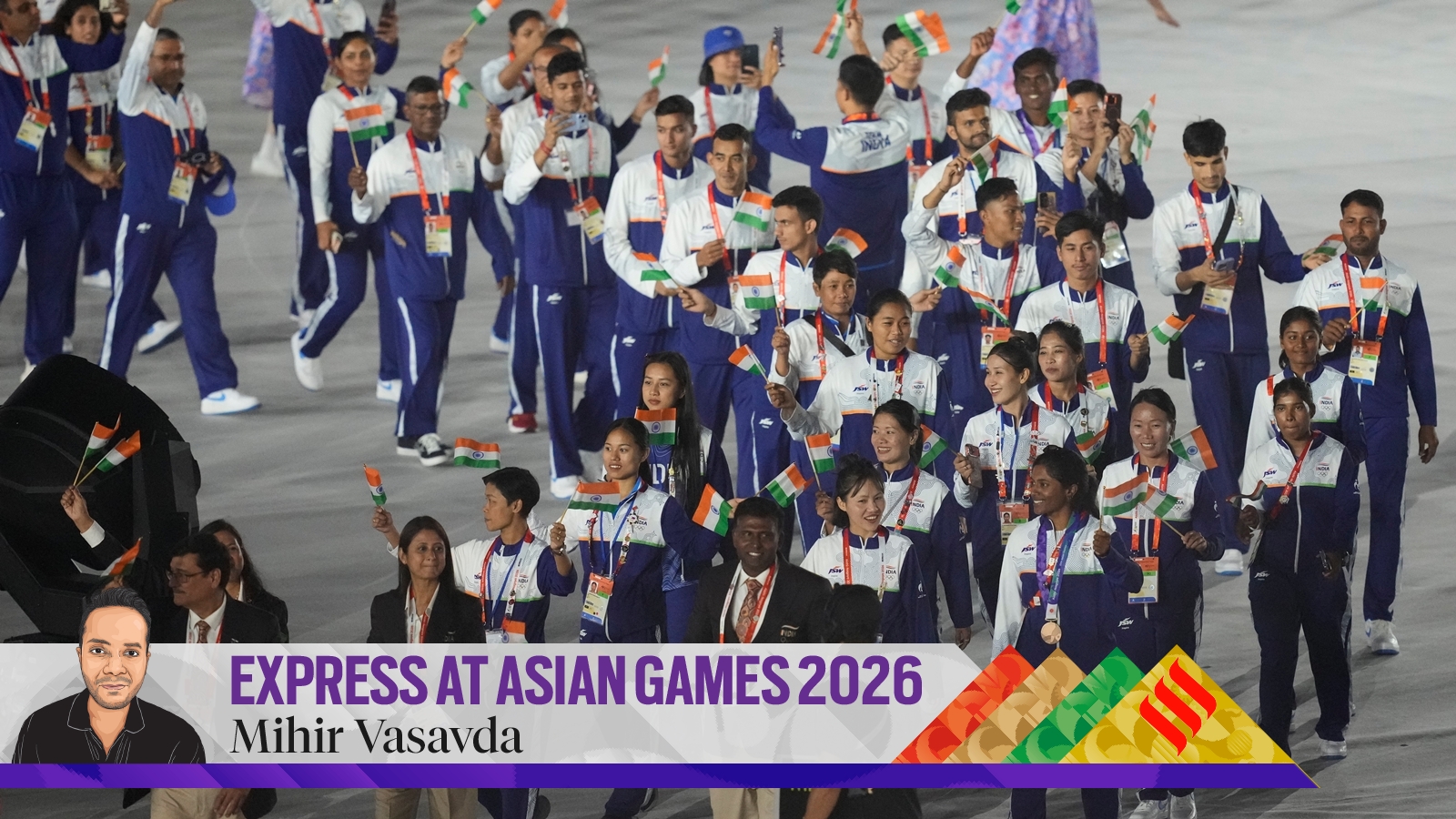
India finished fourth at the Asian Games with 21 gold, 27 silver and 37 bronze medals, 85 in all. It fell short of the 100-medal target and finished 21 medals behind its record haul in Hangzhou.
“We may have lost a few medals compared to (Hangzhou) but individual performances were satisfying,” Adille Sumariwala, the Athletics Federation of India spokesperson, said. “Going just on the basis of medals may not be the only way to judge. Improvement in performance is what should be tracked for future preparation for Olympic Games.”
Though the gold rush of the last two days ensured a heady end to a dwindling campaign, the overall number does not tell the entire story.
Start with the gold. More than half of India’s gold medals came from events where several athletes contributed to one result —cricket, kabaddi, hockey, archery, athletics relays and shooting.
The individual events produced a different pattern. Those 19 silvers came from athletes who had already negotiated the difficult part of reaching an Asian Games final but could not make that push to gold.
That makes the gold medals of Kumkum, Suruchi-Kamaljeet and Neeru significant. Kumkum was not part of TOPS when she became India’s first individual Asian Games champion in women’s recurve. Suruchi was added to the programme only recently before winning shooting mixed team gold along with Kamaljeet Singh, who, too, isn’t part of TOPS. Neeru remains in the developmental group despite becoming India’s first women’s trap champion at the Asian Games.
Collectively, these three medals translate to Rs 3.5 lakh of TOPS funding — three gold medallists, three Olympic hopefuls who were either outside or only recently inside the established priorities of the country’s elite funding system.
According to the Sports Ministry, Rs 97.84 crore was spent under TOPS during the Asian Games cycle. The money goes towards customised training programmes, foreign exposure, specialised coaches, support staff and equipment. Of this, it turned out, Rs 2.05 crore was spent on athletes who ultimately won gold.
Under the Annual Calendar for Training and Competitions programme, which funds camps, tournaments, coaches’ salaries and other competition expenses, the Government spent another Rs 702.86 crore between 2023 and 2026. Only 12.5 per cent of that spending was associated with gold medals in Nagoya.
A senior official of a federation governing an Olympic sport in the country said: “The pattern was seen during the Paris Olympics too, and raises a question over whether the system is identifying the athletes who will eventually deliver at the biggest events early enough for that investment to follow them.”
When contacted, a Sports Ministry official said, “The performance of the contingent has been very encouraging and players have performed creditably. Some disciplines have not performed up to their potential but there have been some incredible results.”
The official said TOPS “follows a dynamic and continuous evaluation process”. “The TOPS team closely monitors emerging and established elite athletes, with regular assessments to ensure that deserving athletes are inducted into the Development and Core Groups based on their performance, potential and medal prospects,” the official said.
Nagoya also confronted some of India’s traditional strongholds with reality checks.
* In badminton, India failed to win an individual medal for the first time in 12 years. The sport had already returned empty-handed from the Paris Olympics, its first medal-less Olympic campaign since 2012.
* In weightlifting, Mirabai Chanu’s silver was India’s first Asian Games medal in the sport since 1998. At 32, she remains the country’s most established name, but the only one doing the heavy lifting, with no obvious successor.
* Athletics and shooting, which won 51 medals combined in Hangzhou, contributed 39 this time (athletics 24, shooting 15).
According to the Sports Ministry official, there will now be a review of the performance. “Where performance has been below expectations, a thorough assessment will be undertaken to identify gaps, draw lessons and strengthen preparations, with a clear focus on the Los Angeles 2028 Olympic Games,” the official said, adding that the review would have been conducted “irrespective of whether performance exceeds expectations or falls short of targets”.
Archery provided one of the clearest signs of what is possible. India’s women’s recurve team ended South Korea’s 28-year Asian Games reign before Kumkum won the individual title, evidence that a younger generation is now capable of challenging a programme that has dominated the event for decades.
Women’s hockey offered another example of how quickly a programme can change. After missing the Paris Olympics, the players went through specialised penalty-corner and goalkeeping clinics with foreign experts, while 11 injured players received rehabilitation support. In Nagoya, they beat China for gold and secured qualification for Los Angeles.
Men’s wrestling produced Aman Sehrawat and Sujeet Kalkal as gold medallists. Ankush Panghal, Lovlina Borgohain and Parveen Hooda helped return boxing to the top of the Asian Games podium. Women’s pistol shooting, where India has considerable depth, continued to produce results.
These are the reasons Nagoya can offer encouragement ahead of Los Angeles.
The Asian Games are a mid-term examination before the Olympics. India has shown depth in several team events, new names have emerged in individual sports and established athletes remain capable of providing a foundation for the next cycle.
Over the course of a 18-year-long career, Mihir Vasavda has covered 2010 FIFA World Cup; the London 2012, Tokyo 2020 and Paris 2024 Olympic Games; Asian Games in 2014 and 2022; Commonwealth Games in 2010 and 2018; Hockey World Cups in 2018 and 2023 and the 2023 ODI Cricket World Cup. ... Read More
