Tensions between India and Bangladesh are is in focus after Dhaka skipped the BRICS summit in Delhi
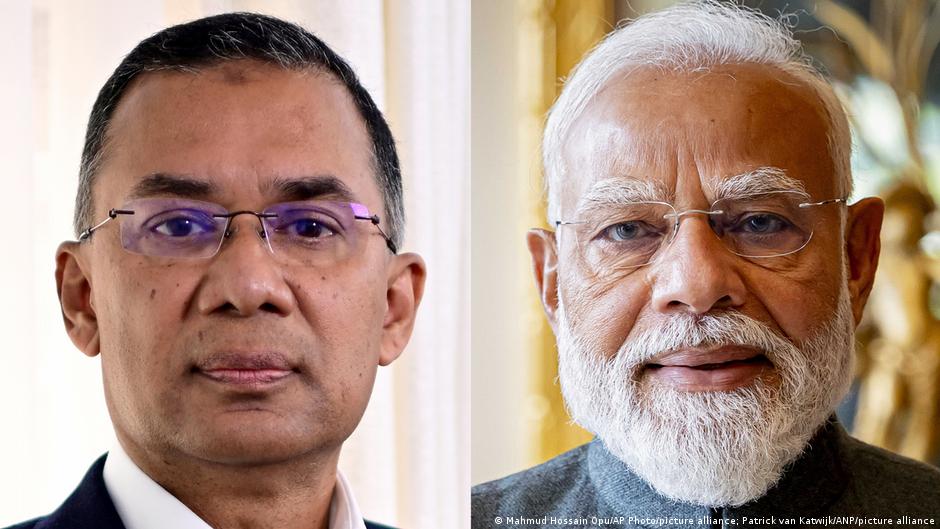
Bilateral ties have improved since Rahman took office but are still far from normalizedImage: Mahmud Hossain Opu/AP Photo/picture alliance; Patrick van Katwijk/ANP/picture allianceAdvertisementWhen India hosted a BRICS leaders' summit in New Delhi earlier this month, a notable absentee was Bangladesh's Prime Minister Tarique Rahman.
The Indian government says Rahman received two invitations: one to attend a BRICS outreach session as the chair of a regional group of nations around the Bay of Bengal, known as BIMSTEC, and another for a bilateral visit to India.
But in Dhaka, these invitations were viewed as a snub, as Rahman was not formally invited to the summit proper in his capacity as prime minister, but only as the chair of BIMSTEC.
This represents a departure from Bangladesh's previous prime minister, Sheikh Hasina, who was invited as premier to previous BRICS summit events, even though Bangladesh is not a member.
The case is the latest example of the frosty ties between the two South Asian neighbors that have developed since Hasina's ouster in 2024 following huge protests and a deadly crackdown.
Hasina fled to India, and last year was sentenced to death after being convicted in absentia of crimes against humanity over the response to the protests.
Bangladesh has called on India to extradite Hasina so that she can face justice.
Hasina has rejected the verdict, calling it politically motivated.
After her ouster in 2024, bilateral relations entered their worst period in years — visa services were curtailed as disputes mounted over her presence in India as well as the management of the border and alleged forced returns without due process of undocumented, mostly Muslim, Bengali-speaking migrants — known as "push-ins."
Since Rahman's Bangladesh Nationalist Party (BNP) won February's election, that drift has partly reversed. India resumed tourist visas in June and appointed Dinesh Trivedi as its new high commissioner.
But while a bilateral summit is being discussed for November, Hasina's exile in India remains a major obstacle to normalizing relations.
Former Indian diplomat Ajay Bisaria told DW that Bangladesh had "missed a trick" by staying away.
"It was a chance to engage not just with India but with other global leaders," he said. "But the lost ground is easily recovered."
Both sides, he added, would need to manage the "irritant" of Hasina's presence in India. A positive bilateral summit later this year could reset ties, he added.
Humayun Kabir, a former Bangladeshi diplomat, said the relationship is not what it was before Hasina fled to India.
"Ties were one-sided before the uprising, and Dhaka is now looking for something different," Kabir told DW. "There has to be dignity and equality."
Dhaka is willing to engage, but New Delhi must create a congenial atmosphere for a Rahman visit, Kabir said, including by keeping Hasina from making "provocative" remarks and acknowledging the court verdict against her.
Zafar Sobhan, a Bangladeshi political analyst, told DW that Bangladesh will now engage only on equal terms.
"It was hoped that with the exit of the (Mohammad) Yunus-led interim government, New Delhi could mend ties with the elected BNP government," he said. "However, both sides are held hostage by hardliners, giving them limited room for maneuver."
Sobhan said the best way for India to rebuild trust with authorities in Bangladesh is "not to allow Hasina to destabilize Bangladesh with provocative statements."
"Failure to rein her in is seen as an act of unfriendliness," Sobhan explained.
Others read Rahman not taking part in the BRICS summit more sharply.
Shanthie Mariet D'Souza, founder of the Mantraya Institute, called it "clearly a snub", even though Dhaka cited procedural problems with the invitation.
She said the episode must be viewed alongside the unresolved Hasina question, stalled talks on the Ganga Water Sharing Treaty — which is set to expire in December — and Bangladesh's deepening ties with China and Pakistan.
"The BNP is clearly on its way to diversifying its relations amid China's growing overtures and India's hard postures," D'Souza told DW, describing it not as a pivot away from India but a "recalibration toward hedging and greater autonomy."
Sreeradha Datta, a Bangladesh expert at the Jindal School of International Affairs in India, offers a more cautious take.
"India will always remain an important neighbour for Bangladesh," Datta told DW, "but India holds few advantages over Dhaka, and both sides understand that."
"It's too early to suggest the two neighbours have moved apart," she said. "Delhi and Dhaka seem measured in their overtures to each other."
That caution matters because the China relationship is not new. Beijing has spent a decade building its economic and strategic presence in Bangladesh, spanning infrastructure, energy, trade and defence, since Dhaka joined the Belt and Road Initiative in 2016.
China is now Bangladesh's largest trading partner and a major defence supplier.
Beijing also pledged support for Bangladesh's long-delayed Teesta initiative, a major river-management and infrastructure project to control floods and improve water supply on the Teesta river, which flows between India and Bangladesh.
Despite years of talks, Bangladesh and India failed to sign a Teesta water-sharing treaty.
On his June visit to Beijing, his first overseas trip in office, Rahman leaned into that relationship, securing agreements on trade, investment, infrastructure and defence.
"It is normal for a mid-sized state like Bangladesh to seek relationships with Beijing and other nations," D'Souza said, warning that heavy-handed pressure from India could push Dhaka further that way.
D'Souza advises New Delhi to separate the bilateral agenda from the Hasina question, offer Rahman a concrete package on water, trade and connectivity, and hold firm red lines on any Chinese military presence near the Siliguri corridor and the Bay of Bengal.
Shahab Enam Khan, a Bangladeshi scholar of international relations, pushed back on the idea that improving ties is only in Dhaka's interests.
"If anyone should worry about this relationship, it is New Delhi," Khan told DW, citing India's trade surplus and its dependence on Bangladeshi goodwill for its own security.
India, he said, treated the 2024 uprising "as the loss of a client rather than a neighbour's political transition," pointing to suspended visas, closed land ports and shelter for Hasina.
"Bangladeshis took it as a message that Delhi's goodwill depended on who held power in Dhaka," Khan said.
Rebuilding trust, he said, means ending Hasina's party activity in Delhi, resolving bilateral disputes, and lifting post-2024 trade restrictions.
Geography still complicates any clean break. Bangladesh and India share a 4,096-kilometer (2,400 mile) border, the longest either country has. Bangladesh still depends on India for trade routes, transit, electricity, fuel, medical travel and regional connectivity. The two countries also share 54 rivers.
But those dependencies are also friction points.
The 1996 Ganga Water Sharing Treaty expires in December, the Teesta dispute remains unresolved, and alleged Indian push-ins of undocumented migrants across the border remain a sore point.
Bisaria sees some balancing of its ties between India and China as "natural."
"India can live with that, as it does with its other neighbours," he said.
The real question, then, may not be whether India is losing Bangladesh outright, but whether it is losing its old ability to shape the relationship on its own terms with an increasingly assertive Dhaka.