
The $6 Price Tag on Trump’s Tough Talk About Putin’s Russia - Newsweek
A year ago, Donald Trump was talking tough about Russian oil.
NATO countries should stop buying it altogether, the president declared in a Truth Social post on September 13, 2025. Their continued purchases were "shocking," Trump said, because they weakened the alliance’s leverage over Russian leader Vladimir Putin. If NATO acted, Trump was "ready to do major Sanctions" on Russia, and added the bloc should slap 50 to 100 percent tariffs on China for good measure.
"This is not TRUMP’S WAR," he pointed out—but sounded willing to help finish it.
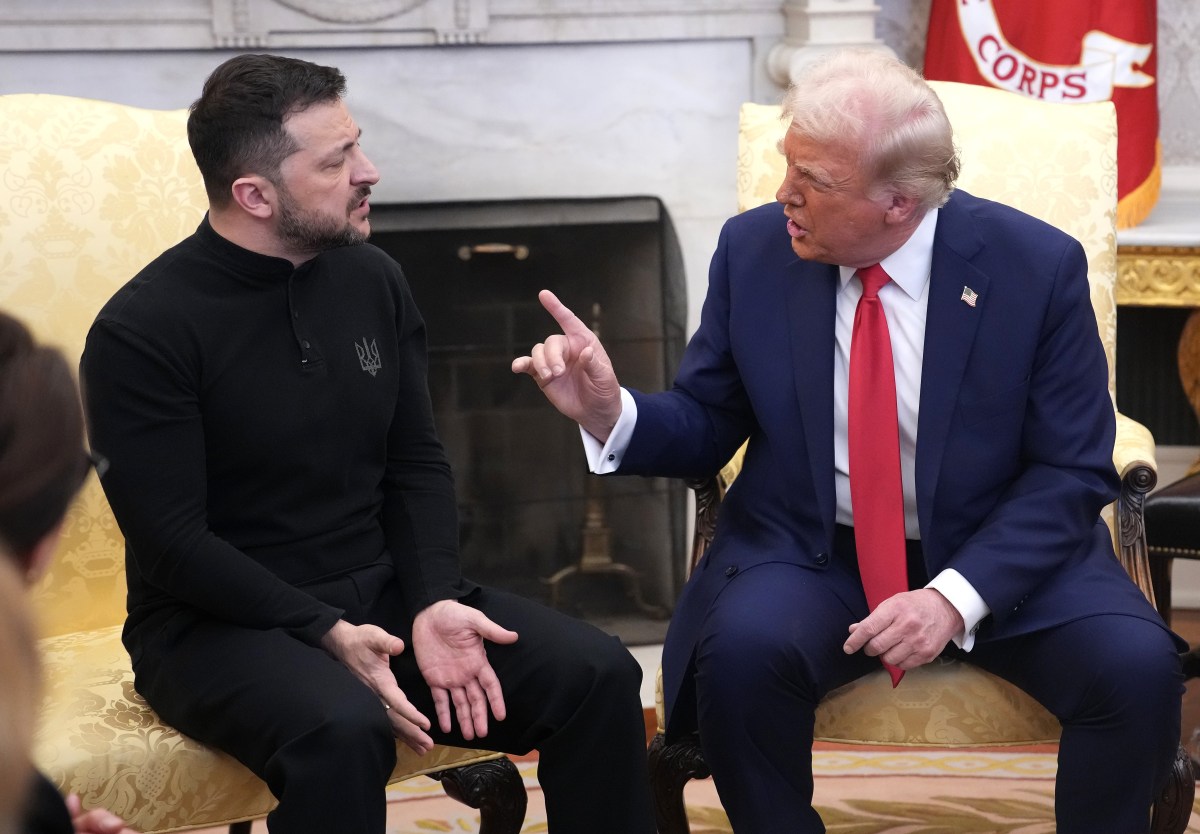
Exactly one year later, the U.S. president had a very different message for his opposite number in Kyiv. "Stop knocking out diesel fuel in Russia," he warned Volodymyr Zelensky on Sunday, as prices hit $6 a gallon. "That’s hurting the world!"
Russia-Ukraine might not be Trump’s war, but he started one of his own in the Middle East. Now, that conflict is dictating his policy toward this one.
Trump unleashed Operation Epic Fury on February 28—a shock-and-awe campaign designed to ensure Iran would never have a nuclear weapon. And to cripple its missile industry. And its Navy and Air Force. And end its threats to shipping. And trigger regime change.
More than six months later, Washington has failed to produce a result on several of those counts, but has succeeded in tearing apart the energy market on which Trump’s Russia policy, and U.S. diesel and gasoline prices, depended.
The numbers are ugly. The International Energy Agency estimates that more than 10 million barrels a day of Gulf oil production remained shut in during August. Gulf oil exports were running at roughly half their prewar level, while diesel and gasoline exports—the kind that dictate the numbers appearing outside gas stations across the U.S.—averaged just 390,000 barrels a day, barely a quarter of what they had been before the fighting began.
The chances of this improving any time soon also look rather slim.
Washington and Tehran are yet to reach a deal on the fate of the Strait of Hormuz. Meanwhile, Iran’s allies are putting pressure on the region’s other major chokepoint, the Bab el-Mandeb Strait.
Last week, Yemen’s Houthi rebels launched missile and drone attacks on Saudi infrastructure before seizing the strategic Red Sea port of Mokha and Mayun Island, which sits inside the Bab el-Mandeb. Days later, Saudi Arabia shut its East-West pipeline after it was hit by drones launched from Iraq. The pipeline had become a crucial alternative route, allowing Riyadh to bypass Hormuz by moving crude overland to the Red Sea.
Back in the States, Americans are feeling the consequences.
The U.S. Energy Information Administration put the average price of diesel at $3.72 per gallon in February. The latest EIA reading is $5.97, while AAA put the national average at $6.20 on Sunday—the first time it has crossed $6 in nominal terms.
The Trump administration is feeling the consequences, too.
Pew found in July—before this month’s spike in fuel prices—that 60 percent of Americans believed Trump’s economic policies had made conditions worse, up from 52 percent in January. The share very concerned about gasoline prices had jumped from 34 percent to 56 percent. Even among Republicans, the proportion saying Trump’s policies had worsened the economy rose from 18 percent to 28 percent.
Apparently, that is now Ukraine’s problem.
In Washington, the request has a certain Art of the Deal logic: we're in a pinch, so help us out. Ease up on the refineries now, maybe we’ll owe you one later. In Kyiv, it must’ve sounded ludicrous.
Ukraine is preparing for its fifth full winter of war, and by now, Russia’s strategy is hardly a secret: try to freeze Kyiv into submission.
On September 1, Putin declared: "The Armed Forces of the Russian Federation have been instructed to prepare and carry out mass strikes on Ukraine's energy facilities." Those forces are now equipped with a steady supply of ballistic missiles and jet-powered drones, which Ukraine’s conventional air defenses are ill-prepared to deal with.
There is also the small matter of Russian elections to consider. Putin’s subjects go to the polls on Friday for the first State Duma elections since before the full-scale invasion; an event that Zelensky believes will mark a turning point in Russia’s war effort.
The Ukrainian president has claimed Moscow is holding off on announcing policies to shift Russia’s war machine into a higher gear until those elections are sewn up, including a potential call-up of 300,000 troops, while Ukraine’s armed forces continue to suffer manpower shortages and bleed territory—albeit very slowly.
Facing the prospect of a replenished Russian army and a winter of ballistic and jet-powered misery, long-range attacks on oil refineries and export terminals—the infrastructure upon which the Russian economy rests—constitute one of the few tools Kyiv has to impose measurable costs on Moscow.
A year ago, Trump said buying Russian oil weakened the West's leverage over Putin. Now that Ukraine has managed to create some leverage of its own, Trump wants Zelensky to drop it.

