
The Backlash to “NAZA” Shows How Little Israeli Citizenship Really Means - The Intercept
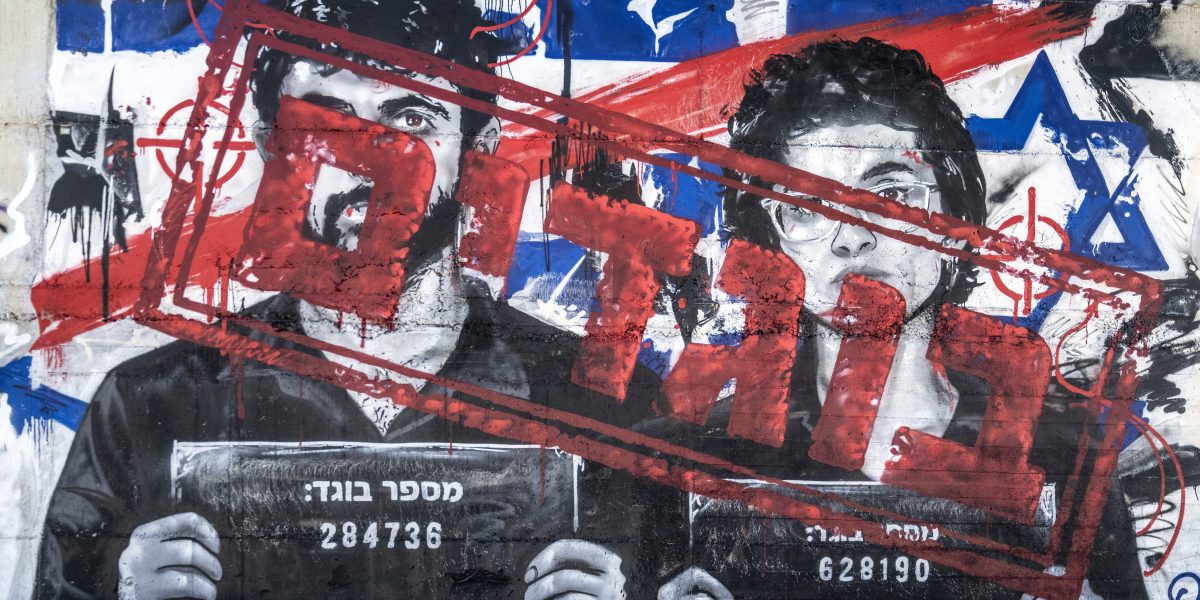
The Israeli documentary “NAZA” will make its North American premiere tomorrow at the New York Film Festival on the heels of Israeli Prime Minister Benjamin Netanyahu’s vitriolic speech at the United Nations, which was met by mass protests, arrests, and diplomats walking out. Other Israeli documentaries have screened at Lincoln Center, including one at the New York Jewish Film Festival in January on the movement for LGBTQ+ rights or another about an October 7 hostage. But this film, co-directed by Yuval Abraham and Rachel Szor, has proven extraordinarily controversial in its home country, reviled by nearly every sector of media and politics.
The documentary, which is composed of anonymous interviews with those active in Israel’s military and intelligence service during the war against Gaza, depicts extensive, highly detailed confessions of their participation in the mass targeting and killing of Palestinian civilians. The film’s title comes from the Israeli military’s system for assessing collateral damage, an interface that one of the anonymous confessors says can map out every building in the Gaza Strip and predict what civilians may be killed in an airstrike. One man who used the NAZA interface remarks in a clip from the film that the military once approved a single strike the system calculated would kill 500 Palestinians, and said the system makes no distinction between adults and children.
The revelation of the film’s existence — its world premiere was at the Venice Film Festival earlier this month after being produced in secret for three years — sent shockwaves through Israeli society. Two contradictory claims have begun to dominate discussions of the documentary, at the highest levels of both the Israeli government and the military brass, both aiming to neutralize the film’s reach and the ability of its filmmakers to continue working. The first is that the film released highly sensitive and classified information about the Israel Defense Forces’ operations in Gaza, contravening the law. The second line of attack claims the film is a complete fabrication, a hoax, and in the words of IDF Chief of the General Staff Eyal Zamir, a “blood libel.” Key Israeli politicians argue Abraham and Szor are aiding the enemy in wartime, with National Security Minister Itamar Ben-Gvir calling them “friends” of Hamas who should be held accountable as such.
While some opponents of the current Israeli government, such as Yashar leader Gadi Eisenkot, have attempted to tack in a more liberal direction by saying “criticism is legitimate” — while also decrying the film for “present[ing] a distorted and one-sided picture” at a time when “the State of Israel [is] in a time of distress” — both the Israeli state and the army have begun proposing legal action be taken against the filmmakers, with their citizenship in particular coming under attack from not only Culture Minister Miki Zohar, but Prime Minister Benjamin Netanyahu himself.
In an unprecedented move, Netanyahu announced on September 16 in a video message posted on social media that his government would “revoke citizenship from anyone who defames IDF supporters abroad” in addition to raising the fine for defamation “twentyfold” to 1 million shekels (nearly $330,000 at the current exchange rate) to punish them further. Calling out the “NAZA” filmmakers specifically, Netanyahu went on to say “their place does not belong with us.”
Most Read DoorDash Spent $1.4 Million Trying to Stop Mamdani From Becoming Mayor. Now We Know Why. Meghnad Bose, Macy Hanzlik-Barend Robert Kraft Claims His Donations Help Palestinians. Turns Out He’s Funding Friends of the IDF. Jonah Valdez Pink Supported Macklemore’s Firing. Now Activists Want UNICEF to Cut Ties With Her. Jonah Valdez
The phenomenon of revoking Israeli citizenship is not novel. Earlier this year, two Palestinians from East Jerusalem were convicted of security offenses and stripped of their Israeli nationality, which paved the way for their deportation to either the occupied West Bank or even the Gaza Strip. But revoking the citizenship of Israeli Jews on any kind of similar grounds is without historical precedent. Both Abraham and Szor — who also co-directed the documentary “No Other Land” — are Jews born in Israel, have no Palestinian ancestry, and no public record of citizenship for any other country.
Proposals have been made in the past for the revocation of Israeli citizenship from certain Jews, most notably Yigal Amir, who killed Israeli Prime Minister Yitzhak Rabin. The far-right assassin, who is from an Orthodox Jewish family, was the subject of a public petition demanding his citizenship be revoked. But the Israeli Supreme Court rejected it on the grounds that “the dignity of the right” for every Jew to acquire and have Israeli citizenship overruled the “dignity of the murderer.” Now, for the first time, a sitting Israeli leader is advocating for the so-called “dignity of the right” to be overturned, not for murder, but for mere “slander,” in Netanyahu’s description, against the Israeli military.
Although Israeli politicians and other officials have categorized the filmmakers as antisemites spreading lies about the Jewish people, Abraham and Szor are not explicitly anti-Zionist in the way that other prominent critics of Israel, like the historian Ilan Pappé and the architect Eyal Weizman, have defined themselves, or even how a Communist member of Israel’s Knesset, Ofer Cassif, has defined himself. Both co-directors have openly stated their belief in a future where both Israelis and Palestinians “are equally sovereign and free.” Abraham himself has said Israelis have a “right” to “sovereignty and security in this land,” just as Palestinians do.
Despite these threaded needles, the Jewish filmmakers of “NAZA” now find themselves in the position of being treated much the same way Palestinian citizens of Israel are: as though their citizenship was bestowed upon them in error, a mistake of history where convenience trumped logic, a catastrophe that needs to be rectified immediately.
The Law of Return — the idea that every Jewish person, even those who converted to the religion and have no ancestral ties to the land of Palestine, should be allowed to “return” to their homeland, to settle, to live, and to be treated as an equal alongside every other Jewish person, no matter their birthplace — was one of the fundamental building blocks of the Zionist project. But the Law of Return did not become law until 1950, and the Citizenship Law, which defined the terms of its larger eligibility, did not become law until 1952, four years after the State of Israel’s founding.
For a short period in Israel’s history, citizenship had no clear definition, but it required quick clarification, not just because it is a key part of any fledgling state, but because they needed to be able to define which Arabs, who remained inside Israel’s new borders on temporary “red card” permits after the Nakba, could be allowed to stay, and who could be removed as an illegal infiltrator. Then-Agriculture Minister Dov Yosef remarked plainly during a cabinet debate in 1949: “When we publish the citizenship law and a person is found not to be a citizen, we can then deport him.”
Citizenship was granted in limited quantities to the Palestinians who had been able to remain inside the newly established Israel and did not confer all the rights it supposedly guaranteed. Palestinian citizens of Israel remained under control of a military governance system up until 1966, with their movements strictly controlled and their political activities restricted to rein in criticism of the Jewish state they now found themselves living under.
The discourse about citizenship has taken on an unmistakably Americanized character, one defined by a larger “Love it or leave it” mentality.
The Law of Return, considered “inalienable” by many politicians, where any concrete restrictions must entail tearing of the law in its entirety, contained seemingly contradictory restrictions within its formally expansive framework. Israeli Communist Party leader Meir Vilner noted back in 1950, during discussion of the Law of Return in the Knesset, that even though Jewish citizenship was technically expansive, it still entailed restrictions to those who “endangered … the security of the state,” a vagueness that Vilner opposed on the grounds that it could be used by the government “against sections within the Jewish people.” The Polish-Israeli anti-Zionist intellectual Israel Shahak noted in 1975 that all the punishments normally doled out against Arabs, including losing their citizenship, remained theoretically possible against Jewish dissenters under Israeli law, but only “racism” against Arabs had prevented setting that precedent.
As the United States became Israel’s primary benefactor in the 1960s and 1970s, previously dormant discussions about the grounds for revoking Israeli citizenship from Jews began to reemerge. They coalesced around insufficient connection to Israel, with some aiming to establish a system of permanent residency, disallowing citizenship for Jews who did not spend enough time inside the Jewish state. After 9/11, these proposals took on a much more ideological, and much more far-right, character.
The Israeli right was soon overtaken with the possibility of revoking the citizenship of those it considered to be aiding the enemy, with Arab citizens of Israel being the primary target. But anti-Zionist Jews were also in their crosshairs, including members of the ultra-Orthodox Jewish fringe sect Neturei Karta, or Jews who were insufficiently supportive of Israel, like Israeli journalist Gideon Levy. Calls for “loyalty oaths” from both Arabs and Jews became a cause célèbre for people like then-Deputy Prime Minister Avigdor Lieberman in the late 2000s, who would insist on the equality he advocated for by saying, “It’s not racism. The test is loyalty, not their religion.”
A certain McCarthyist strain familiar to Americans under the Bush administration, looking anywhere and everywhere for national disloyalty, was confirmed in 2007 by Likud MK Gilad Erdan, who would later become Netanyahu’s ambassador to the United Nations during the height of the war on Gaza in 2023. Erdan claimed revoking citizenship would not be wrong because the U.S. also had a basis for revoking citizenship based on “disloyalty to the state,” which included “citizens by birth,” and that there was a threat that needed to be dealt with, even from Jewish people inside the State of Israel, who did not recognize Israel’s “sovereignty.”
The Second Intifada and the disintegration of the so-called Israeli-Palestinian peace process preceded these events, but now, the discourse about citizenship has taken on an unmistakably Americanized character, one defined by a larger “love it or leave it” mentality that allows for officials like Ben-Gvir to post about putting Jewish and Arab politicians who oppose the unfettered expansion of Zionism on planes to be deported.
By virtue of their criticism of Israel, the self-proclaimed representative of the Jewish people, they become enemies of the Jewish people, and therefore in the minds of the state’s most ardent defenders, politically Arab, and therefore able to be viewed as an existential threat just the same.
We’re independent of corporate interests — and powered by members. Join us.
Original reporting. Fearless journalism. Delivered to you. Will you take the next step to support our independent journalism by becoming a member of The Intercept?
By signing up, I agree to receive emails from The Intercept and to the Privacy Policy and Terms of Use.
Netanyahu’s proposal to strip the “NAZA” filmmakers of their citizenship is unlikely to come to pass. It is undeniably being utilized as a political cudgel, with Netanyahu also calling for the revocation of political opponent Yair Golan’s citizenship on the same grounds, despite Golan having been a major general in the IDF. Israeli President Isaac Herzog has, in turn, dismissed the plan, calling it “completely irrelevant.” But as Shahak said in 1975, the grounds for expanding the revocation of citizenship from Jewish Israelis is there in the law, even if the precedent has not yet been set. In 2022, the court upheld a law that allowed for revoking citizenship from Israelis who “carry out actions that constitute a breach of trust against the state.” Earlier this year, in a move met with much less controversy, Netanyahu began initiating proceedings to strip citizenship from those who allegedly aid Iran through espionage, cases which have involved Jews as well as Arabs.
While the chances of the Supreme Court upholding the stripping of citizenship in this particular case are almost nil, a future Israeli administration, one that does not recognize the court’s powers, or an administration that serves alongside a court far more aligned with disqualifying the insufficiently Zionist from politics, could tell a much different story.
A future government where Israel can strip anyone’s citizenship for not only being Palestinian, but also for speaking out in any way against the state, a future where Ben-Gvir is defense minister, or even prime minister, may be closer than many defenders of the “only democracy in the Middle East” imagine.
What we’re seeing right now from Donald Trump is a full-on authoritarian takeover of the U.S. government.
Court orders are being ignored. MAGA loyalists have been put in charge of the military and federal law enforcement agencies. The Department of Government Efficiency has stripped Congress of its power of the purse. News outlets that challenge Trump have been banished or put under investigation.
Yet far too many are still covering Trump’s assault on democracy like politics as usual, with flattering headlines describing Trump as “unconventional,” “testing the boundaries,” and “aggressively flexing power.”
The Intercept has long covered authoritarian governments, billionaire oligarchs, and backsliding democracies around the world. We understand the challenge we face in Trump and the vital importance of press freedom in defending democracy.
IT’S BEEN A DEVASTATING year for journalism — the worst in modern U.S. history.
We have a president with utter contempt for truth aggressively using the government’s full powers to dismantle the free press. Corporate news outlets have cowered, becoming accessories in Trump’s project to create a post-truth America. Right-wing billionaires have pounced, buying up media organizations and rebuilding the information environment to their liking.
In this most perilous moment for democracy, The Intercept is fighting back. But to do so effectively, we need to grow.
That’s where you come in. Will you help us expand our reporting capacity in time to hit the ground running in 2026?
I’M BEN MUESSIG, The Intercept’s editor-in-chief. It’s been a devastating year for journalism — the worst in modern U.S. history.
We have a president with utter contempt for truth aggressively using the government’s full powers to dismantle the free press. Corporate news outlets have cowered, becoming accessories in Trump’s project to create a post-truth America. Right-wing billionaires have pounced, buying up media organizations and rebuilding the information environment to their liking.
In this most perilous moment for democracy, The Intercept is fighting back. But to do so effectively, we need to grow.
That’s where you come in. Will you help us expand our reporting capacity in time to hit the ground running in 2026?

