The best space heaters for every kind of space
NBC Selected independently determines what we cover and recommend. When you click on or buy through our links, we earn a commission. Learn more.
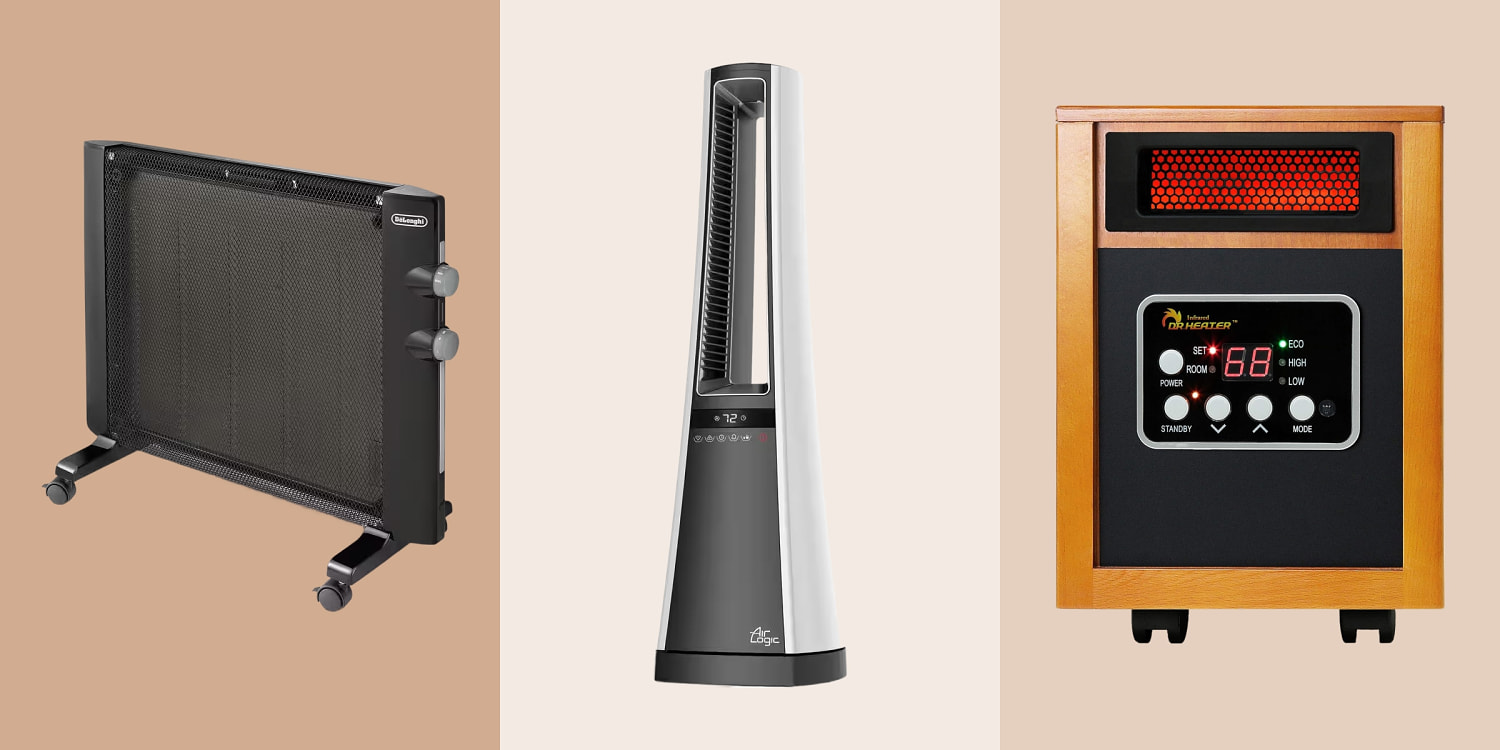
I asked experts how to shop for space heaters, as well as where to find some good options.DeLonghi; Home Depot; AmazonSpace heaters are a fast and affordable way to warm up your home when temperatures dip — and they can be a beneficial tool to keep on hand in case of emergencies. Whether it’s a drafty bedroom or outside on the patio during a cool night, space heaters can give an effective boost of heat wherever you need it.
To determine the best one for you, I spoke to home and safety experts about the benefits of space heaters, what features to look for when shopping for one and how to use them safely.
selectedselectedAllergies acting up? You may need a humidifier. Want more from NBC Selected? Sign up for our newsletter, The Selection, and shop smarter.
Listed below are expert-recommended options at various price points.
$22.99$26.99AmazonNow 15% offWhat to knowType: radiant | Safety features: tip-over protection, overheat protection | Testing: n/a | Warranty: 1-year limited warrantyWhat we likecompactbuilt-in handleSomething to notenot ideal for large spacesThis space heater comes recommended by NBC Selected senior editor Nikki Brown, who loves how quickly it warms up. “This heater is small but it packs a punch. On the highest level, it heats up a large room in under an hour,” she says. “There’s also a mechanism on the bottom that can gauge if it’s sitting on a flat surface or not. If it’s not, it will automatically turn off, which I love.” The heater is made of comes with three temperature setting and a built-in handle so you can easily carry it from room to room.
$112.99$129.99AmazonNow 13% off$112.99Home Depot$104.94Lowe'sWhat to knowType: radiant | Safety features: auto shut-off | Warranty : 1 to 3 yearsWhat we likeRuns quietlyGood temperature accuracyCost effectiveSomething to noteOnly high and low settingsGlenn Wiseman, sales manager of Top Hat Home Comfort Services in Ontario, recommends this portable infrared model for its dual heating system and built-in thermostat that ranges from 50 to 85 degrees Fahrenheit. The energy-saving space heater offers 1,500 watts and is powered through an electric cord with 120 volts, which can evenly heat a 150-square-foot room, he says. It also has an automatic 12-hour shutoff timer.
$129.99AmazonWhat to knowType: electric | Safety features: tip-over shut off, overheat protection, child lock | Warranty: n/aWhat we likestylishwhisper quiethas wheels for portabilitySomething to notemay be bulky for small spacesThis RealSmart infrared space heater is for spaces up to 350 square feet. It has a maximum setting of 1,500 watts, a remote and three different heat modes. It also includes an ”eco setting,” which the brand says maintains a constant 68-degree temperature using less power for when you want to bring it into a smaller room.
$129.95AmazonWhat to knowType: convection | Safety features: auto shut-off | Testing: n/a | Warranty: 1 to 2 yearsWhat we likeWorks quicklySleek and minimal designSomething to noteNothing to note at this timeThe nice thing about this lightweight, compact space heater is that it can either be mounted on the wall or set on the floor. It also comes with wheels so you can easily move it from room to room. It packs a powerful punch with 1,500 watts of heat and has an adjustable thermostat and multiple heat settings so you can personalize for your comfort, according to the brand.
$179.95Walmart$152.96$179.95eheat, Inc.Now 15% offWhat to knowType: convection | Safety features: temperature-controlling thermostat | Testing: UL | Warranty: 3 yearsWhat we likeQuiet operationSomething to noteBetter for small spacesArie Van Tuijl, a licensed home inspector and founder of home-maintenance website Home Inspector Secrets,recommends this wall-mounted, convection space heater, which has a temperature-controlling thermostat and the brand’s Wall-Sens technology, which cuts out the power for safety when the unit is removed from the wall, according to the brand. The unit, which Envi says heats rooms between 130 and 150 square feet, is just 2 inches thick and can automatically dim the power light in dark rooms.
$90.00$125.99WalmartNow 29% off$106.99$116.99Home DepotNow 9% offWhat to knowType: convection | Safety features: safe-touch surface and automatic 8-hour shut off switch | Testing: ETL | Warranty: 3 yearsWhat we likeEasy to useQuiet operationSomething to noteBetter for small spacesThis Lasko space heater has a bladeless design at a more affordable price than similar brands, like Dyson. Lasko says it’s equipped with a slew of safety features, including a safe touch surface and an automatic 8-hour shut-off switch. With its quiet oscillating mode, this tower can evenly distribute heat in rooms up to 300 square feet, according to the brand.
$135.99Amazon$139.99Home Depot$178.99Lowe'sWhat to knowType: combination | Safety features: auto shut-off | Testing: ETL | Warranty: 3 yearsWhat we likeOscillatesComes with a remoteHas multiple fan speedsSomething to noteOnly for up to 150 square feetThis oscillating tower unit is both a space heater and fan. It has four fan speeds and three heat settings, according to the brand. It also comes with a 6-foot power cord, a remote and has a 1 to 8-hour auto shut-off feature.
$74.99AmazonWhat to knowType: combination | Safety features: auto-shut off | Testing: ETL | Warranty: n/aWhat we likeLower price pointQuiet operationTurns off automaticallySomething to noteNot great for large roomsVan Tuijl recommends this convection space heater from Dreo due to its easy-to-use touch screen panel, strong heat output and remote control capabilities. This model has three heating modes and a digital thermostat that ranges from 41 degrees to 95 degrees Fahrenheit. It also has a timer that automatically shuts off after 12 hours, and the remote lets you turn the unit off from up to 26 feet away, according to the brand.
$499.99$659.99Best BuyNow 24% off$659.99Walmart$659.99DysonWhat to knowType: combination electric | Safety features: n/a | Testing: UL | Warranty: 2 yearsWhat we likeNice airflowSoft, comfortable heatSomething to noteMore expensive than the othersThe bladeless Dyson Pure Hot + Cold is a remote-controlled combination heater, fan and air purifier all in one, according to the brand. The remote-controlled fan can oscillate up to 350 degrees and offers different modes, including a backward airflow mode that diverts air through the rear of the space heater, continuing its purifying effect without the draft, according to the brand. It also includes a nighttime mode with a dimmed display, according to Dyson. Wiseman noted this space heater is “substantially quieter” than many other models and can regulate indoor air quality: using a HEPA-style filter, it can capture 99.97 percent of particles that are 0.3 microns in size, says the brand. The unit can also connect to Wi-Fi so you can control your machine remotely and schedule when your air purifier is on, using the Dyson Link app.
$34.99Best Buy$34.57Lowe's$49.99WalmartWhat to knowType: radiant | Safety features: auto shut-off | Testing: ETL | Warranty: n/aWhat we likeAutomatically shuts offCost-effectiveQuiet operationSomething to noteBest for small spacesThe portable Lasko Oscillating Ceramic Heater, is a worthwhile option if you’re on a budget: besides our editor's pick, it's the most affordable one on our list. Lasko says this space heater can heat rooms up to 300 square feet and offers two heat levels — low heat and high heat — along with a cool air fan setting. You can also use the thermostat knob to both turn on the unit and have it shut off automatically once a certain temperature has been reached (though the knob itself doesn’t list actual numbers), according to the brand.
$54.95DeLonghi$60.95Global Industrial$79.99Tractor Supply Co.What to knowType: convection | Safety features: two-stage overheating protection | Testing: n/a | Warranty: 1 yearWhat we likePortableLots of safety featuresAffordableSomething to noteBest for smaller roomsThis compact and portable heater from DeLonghi packs 1,500 watts of power and is great for all-season use; it has heat settings for the winter and a cooling, fan-only functionality that’s perfect for summertime, according to the brand. You can customize your heat settings using the adjustable thermostat and also carry the heater with you using the cool-touch handle at the top. This heater also has a number of built-in safety features that make it easier to have around a busy home, including a two-stage protection against overheating and an internal tip-over switch that automatically shuts the heater off if it falls over, according to the brand.
There are several factors to consider when choosing a space heater. Here’s everything I kept in mind when making this list:
Once you’ve decided that you want a space heater, factor in the aspects below to choose the exact one that’s best for your space and situation.
Choose between a radiant, convection or combination space heater. Depending on your living situation, one may be better for you than the other. If you have a small space, choose a radiant heater and if you have a large space to warm up, a convection may be best. Additionally, if you don’t mind the noise, a combination space heater is good for families with small children since they’re less of a safety hazard, according to our experts.
In addition to the type of space heater you want, you should consider where you’ll put it, which will determine what size and shape is best. Plus, if you’re only getting one to heat a small room, this will further make it easier to decide on a type.
Some space heaters tend to make a lot of noise, some more than others. Keeping this in mind, I made sure to include units from brands that mention minimal to moderate noise. units are louder than others. If you’re shopping for a bedroom or home office, that’s something to keep in mind. One resource for finding devices that are especially quiet is Quiet Mark, which tests and awards products based on their noise output.
Space heaters are generally more energy efficient than central heating since you’re only heating up the room and some space heaters are also more energy efficient than others. Since space heaters don’t have Energy Star ratings — which independently certifies a product’s energy efficiency — the easiest way to determine if your unit conserves energy is by checking whether it has features like an adjustable thermostat and auto shut-off option that can maintain a certain temperature and prevent a room from overheating, according to the Department of Energy.
The U.S. Consumer Product Safety Commission estimates more than 25,000 residential fires are associated with the use of space heaters every year, and an estimated 6,000 people go to the emergency room for burn injuries associated with contacting the hot surfaces of heaters.
To prevent fires and injuries, many experts recommend looking for space heaters that are tested by independent safety laboratories, like Intertek (ETL) and Underwriters Laboratories (UL). Joel Hawk, principal engineering manager for small appliances at UL, tells us that these laboratories test space heaters based on nationally recognized safety standards, and add that space heaters can be very safe as long as they’re used per the instructions.
While the features that can certify products as “reasonably safe” vary from one space heater to the other, Hawk says his engineers typically look at whether the product adequately responds to overheating conditions or a malfunction (and if it permanently shuts down in unsafe conditions) and whether there are features that prevent electric shock, like suitable insulation and heat-resistant cords. Another important attribute that’s tested is what Hawk calls “personal injury” — UL tests to ensure the unit won’t catch fire and that there aren’t surfaces hot enough to cause a thermal burn or moving parts that may cause injury if they’re touched.
While independent testing and built-in safety features from the manufacturer can mean a space heater is functionally safe, our experts note that common sense also plays a big role in safety. The CPSC recommends the following safety tips to minimize the risk of fire:
To prevent electrical shocks, always keep electric heaters away from water, and never touch an electric heater if you’re wet.
If you have central heating and some spots in your home get chilly, or you just want a blast of warm air in a given area, space heaters are a great option, says Van Tuijl. Instead of paying to heat up an entire house and keep it warm, space heaters act as a supplement to your main HVAC system to only increase the temperature in a given area.
But Van Tuijl also adds that a drafty house can reduce the effectiveness of space heaters. “If there are bottom gaps in the exterior doors, a door sweep should be installed, [and] windows frequently have small gaps at the top that can be sealed with weather stripping,” he says. With that said, it’s best to use a space heater as a temporary solution to uneven heating in your home. If your home is consistently cold or unevenly heated, consider calling a professional to come in to address the problem.
In addition to heating up a room, space heaters have several other potential benefits.
Space heaters work fast: A space heater takes less time to distribute heat and warmth within an area compared to an HVAC system, explains Wiseman. “Central heating often takes some time to reach a set temperature,” he says. “It’s a convenient way that you can quickly raise the room temperature and add warmth to any space needed.”
Space heaters are consistent: Some space heaters offer a simple high or low heat setting; others allow you to set a specific temperature between 60 and 80 degrees. Regardless, once you find your ideal heat level, space heaters maintain that level in a space for as long as you want.
Portable space heaters come in various shapes and sizes and can work in nearly any space. As a rule of thumb, according to indoor air-quality company Sylvane, you need roughly 10 watts of heating power for every square foot of floor area in the room. This means that a 1,500-watt space heater can be the primary heat source for an area measuring up to 150 square feet. There are a few different types to choose from, and each is designed to heat up your space through a different method. There are three main types of space heaters: radiant, convection and combination.
Radiant heaters are ideal for heating up a particular area in a room, rather than an entire space, because they emit infrared heat in one direction. One advantage of these heaters is that they are typically silent, portable and easy to install.
While radiant heaters will typically warm an individual spot or group of people, convection heaters warm the air in a room. According to Wiseman, the air inside a convector heats up and becomes less dense than the surrounding air. When that happens, the air rises and the cooler air on the floor is drawn into the convector, creating a constant flow. Since convection systems rely on hot air rising and cold air falling, they’re able to silently disperse the heat without using a fan.
Although these space heaters take the longest to warm a room, they are ideal if your goal is even heat distribution, according to experts we spoke to. Common convection models include baseboard or floor heaters (these are typically more permanent options that you can control with a thermostat, but portable options exist too). Those include ceramic convection heaters, which warm the air over hot ceramic plates using a fan, and oil-filled convection heaters, which work by using an electrical element to heat a reservoir of thermal oil inside the appliance. A convection option that can save floor space is a wall heater—some models can be plugged into a wall outlet, but most need to be professionally installed and hardwired inside the wall.
“Convection heaters may not be suitable for homes with small children because they [can] get hot to the touch,” Van Tuijl says.
Combination heaters utilize a fan to disperse heat relatively quickly, but they can be noisier than convection or radiant options. “The nice thing about these heaters is that they don’t get hot enough to become a fire or burn risk and there is no annoying orange glow,” says Van Tuijl. However, he adds that these types of heaters can “dry out the skin” and typically make a lot of noise.
At NBC Select, we work with experts who have specialized knowledge and authority based on relevant training and/or experience. We also take steps to ensure that all expert advice and recommendations are made independently and with no undisclosed financial conflicts of interest.
I’m an updates editor at NBC Selected, covering a wide range of lifestyle topics including the best meal delivery services, the best vacuums and more. I spoke to industry experts about how to find the best space heaters and what to keep in mind while shopping.
Catch up on NBC Selected’s in-depth coverage of tech and tools, wellness and more, and follow us on Facebook, Instagram, X and TikTok to stay up to date.
Mili GodioMili Godio is the updates editor for NBC Selected. Her expertise lies in wellness, skin care, hair care and pets.