The changing face of the Swiss Alps - CGTN
By continuing to browse our site you agree to our use of cookies, revised Privacy Policy and Terms of Use. You can change your cookie settings through your browser.
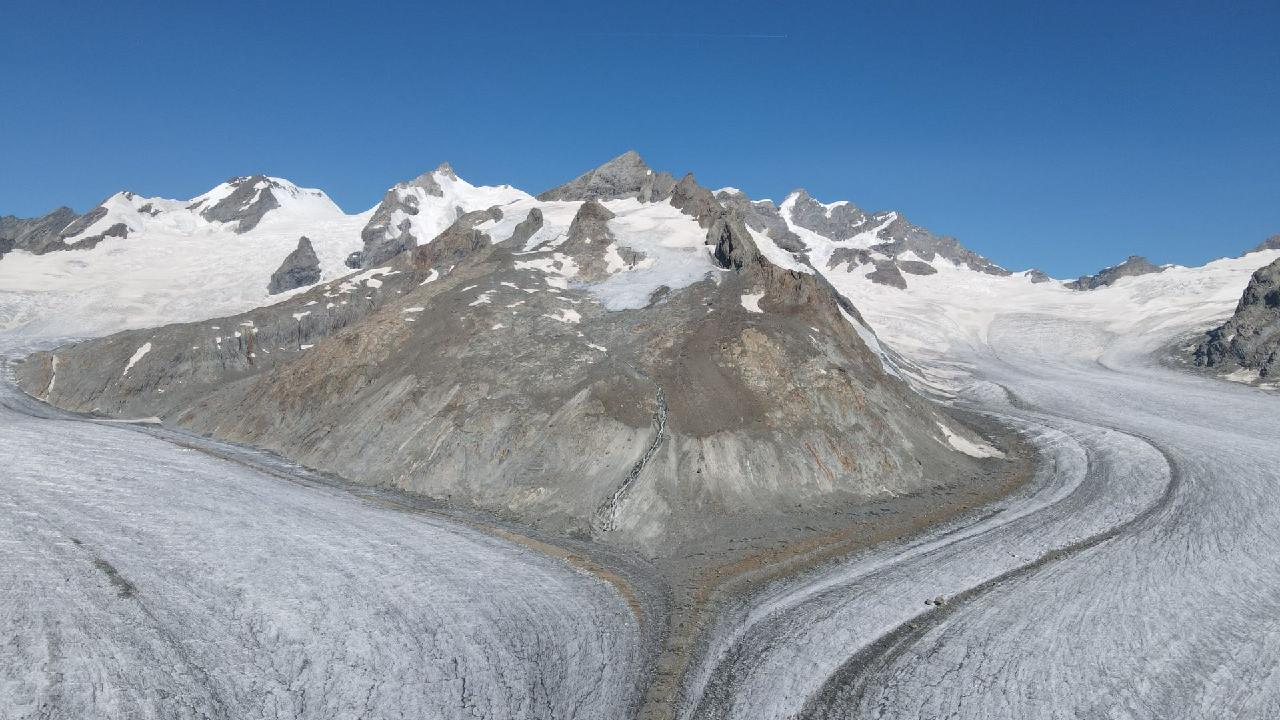
Europe's heatwaves have left no land untouched, including the usually-snow-covered peaks in the Swiss Alps. /Julia Hamilton.
The extreme heat and successive heatwaves across Europe are changing the face of the Alps, accelerating glacier melt and making some high mountain routes more difficult and dangerous to access.
Warm weather early in the season caused glaciers to lose much of their protective snow cover, while the freezing level repeatedly rose above 4,000 meters.
Matthias Huss, head of Glacier Monitoring Switzerland, says this has created what he describes as a “perfect storm” for Alpine glaciers.
“There were several heat waves. They were exceptionally intense and long-lasting,” Huss said. “In combination, there was also a winter that was too poor in snow.”
He says Switzerland is likely to record another very bad year for glacier loss. Around 20 to 30 small glaciers could disappear completely this summer, although final measurements will not be available until the end of the glacier year.
As the mountains change, how they are used will also shift, with Alpine sport and tourism already taking a hit. /Julia Hamilton.
The changes are also affecting people who work in the mountains. Richard Lehner has been a mountain guide in Zermatt for more than 30 years. He says guides are seeing more crevasses, drier ridges and greater rockfall risk.
“The routes up to the mountains are changing,” Lehner said. He added that guides are increasingly changing plans, starting earlier in the day and sometimes choosing lower mountains during very hot periods.
The iconic Matterhorn peak surveys the bare rock below. /Julia Hamilton
The impact is already being felt across Alpine sport and tourism. The Marco e Rosa hut near Piz Bernina closed in August after extreme heat damaged the snowpack and made access routes unsafe.
In Zermatt, mountain guides temporarily stopped taking clients up the Matterhorn because of increased rockfall risk. Summer skiing was also suspended in both Zermatt and Saas-Fee because of deteriorating glacier conditions.
Huss says the Alps are changing at a speed that is becoming difficult to ignore. For mountain guides, climbers and tourism operators, adapting to those conditions is increasingly becoming part of life in the high mountains.