The China paradox: Top-ranked universities, 'completely restricted' academic freedom
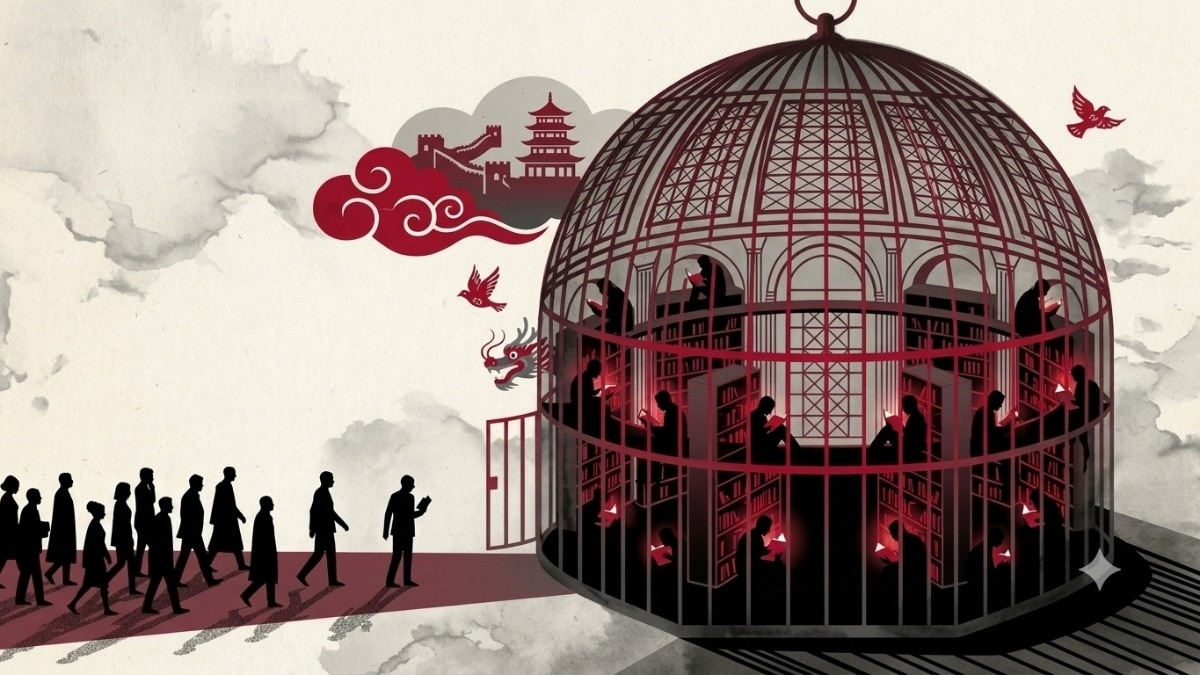
China’s universities are no longer simply regional powerhouses. Several now sit among the most highly ranked institutions in the world, sharing the upper reaches of global league tables with universities such as Harvard, Princeton, Yale and the University of Pennsylvania.
Yet the country’s academic freedom record tells a very different story.
The Free to Think 2026 report by Scholars at Risk, drawing on the 2025 Academic Freedom Index, gives China an AFI score of 0.07, placing it in the category of “completely restricted”, the bottom 10% of the world and sharing space with Russia, Iran, Afghanistan, Syria, North Korea, South Sudan, and a few others. The report says China has remained in this category for the past decade.
The apparent contradiction raises a crucial question: How can a country build globally competitive universities while limiting the freedom to research, teach, question and express ideas?
The answer lies in the difference between university performance and academic freedom. (Photo: AFP) CHINA’S UNIVERSITIES ARE NOW GLOBAL ELITES
The latest QS World University Rankings 2026 show how far Chinese universities have climbed in the global academic race.
Peking University ranks 14th globally, unchanged from its 2025 position. It sits directly behind the University of Chicago at 13th and ahead of the University of Pennsylvania at 15th.
Tsinghua University ranks joint 17th, rising from 20th in 2025. It shares that position with the University of California, Berkeley.
The picture becomes even more striking in the regional rankings. In the QS World University Rankings – Asia 2026, here's where prominent Chinese universities stand:
Mainland China is also the most represented location in the QS Asia 2026 rankings, with 394 ranked institutions, including three in the Asian top 10, 13 in the top 50 and 25 in the top 100.
QS identifies research-related indicators, including citations per paper, papers per faculty and international research networks, as areas of particular strength for Chinese institutions.
These rankings place China’s leading universities alongside established academic powers in the United States, Britain, Singapore, Hong Kong, Japan and South Korea.
But a high ranking does not necessarily indicate that scholars can freely challenge the state, investigate politically sensitive subjects or publish research without pressure. (AI-generated image) WHAT THE SAR REPORT DOCUMENTS
The China section of Free to Think 2026 describes surveillance, censorship and arrests involving academics and students in China and abroad.
The report says scholars working on subjects critical of the Chinese government have faced online harassment, death threats, censorship, visa denials, espionage-related requests and uncertainty over research funding.
Chinese scholars and students overseas have also reportedly faced pressure, as have foreign academics researching China.
The report cites the July 2025 arrest of student Zhang Yadi, reportedly linked to her work in France promoting dialogue between Han and Tibetan communities.
It also records the reported arrest of a Chinese student at the University of Sydney after the student participated in pro-democracy protests in China. The student was charged with secession and allegedly sentenced to six years in prison.
In June 2026, Chinese authorities arrested U Min Zin, a US citizen and political scientist, while he was travelling in Kunming for academic purposes. Chinese officials said he was suspected of “engaging in espionage and endangering Chinese national security”.
The report further notes that the whereabouts and conditions of several prominent Uyghur scholars, including Rahile Dawut, Ilham Tohti, Tashpolat Tiyip and Abdulqadir Jalaleddin, remained unknown. (AI-generated image) WHY CHINA’S ACADEMIC FREEDOM HAS LONG BEEN LOW
China’s academic restrictions have deep historical roots.
After the establishment of the People’s Republic of China in 1949, universities and academic institutions operated within a political system dominated by the Chinese Communist Party. Ideological education and political loyalty became important parts of university life, while scholarship and expression that challenged the political system faced restrictions.
Human Rights Watch has documented the long-running role of Communist Party control and ideological supervision within Chinese universities.
The Cultural Revolution, from 1966 to 1976, caused one of the most severe disruptions in modern Chinese higher education. Universities were disrupted, academic work was subordinated to political campaigns, and intellectuals and academics were subjected to political persecution.
The post-1978 reform period brought major changes. Universities were rebuilt and expanded, scientific research received greater investment, and China increasingly engaged with the international academic community. The country subsequently developed a large and globally competitive higher education and research system.
However, political controls did not disappear. The 1989 Tiananmen crackdown was followed by tighter ideological controls on universities. Under Xi Jinping, who became China's top leader in 2012, ideological supervision and political control over education have become increasingly prominent.
Human Rights Watch has documented tighter ideological control over universities, including punishment of academics for critical comments and pressure around politically sensitive subjects.
This helps explain why China can have a large and highly developed scientific and technological research system while academic freedom remains restricted, particularly around politically sensitive research, criticism of the government and the Communist Party, and subjects such as Tibet, Xinjiang, Hong Kong and Taiwan. The bottom 50% of the countries as divided into 5 categories. China is ranked among the bottom 10% of all countries in the world (Source: Academic Freedom Index Update 2026 report) advertisementHOW CHINA’S AFI SCORE CHANGED OVER TIMEThe historical AFI figures show that China’s academic freedom did not follow a steady upward path alongside its economic and technological rise.
1975: 0.03 (started climbing again from 1976)
The figures show a sharp decline around the establishment of the People’s Republic. China’s AFI stood at 0.44 in 1948 and 0.08 in 1950. It fell further during the Cultural Revolution, reaching 0.02 in 1967 and remaining at 0.03 in 1975 and 1976.
After the Cultural Revolution, the index began to recover. It rose from 0.03 in 1976 to 0.14 in 1979 and 0.26 in 1980, reaching 0.31 in 1987.
The score then fell sharply around the period of the 1989 Tiananmen crackdown, from 0.31 in 1988 to 0.19 in 1989 and 0.17 in 1990. It subsequently recovered to 0.27 in 2008.
Since then, the longer-term trend has been downward. The score was 0.28 in 2009, 0.23 in 2010 and 2011, 0.19 in 2012, and 0.13 in 2013. It fell to 0.09 by 2017 and remained around that level for several years, before reaching 0.07 in 2025.
The figures do not suggest that China’s universities became less capable as the country’s academic and research system expanded. They show that the growth of a higher education and research system and the level of academic freedom are not necessarily the same thing. (AI-generated image) WHAT QS MEASURES, AND WHAT AFI MEASURES
The QS World University Rankings 2026 assigns the greatest weight to Research and Discovery, at 50 per cent. This includes Academic Reputation at 30 per cent and Citations per Faculty at 20 per cent.
QS therefore rewards research reputation, citation impact, employer perception, graduate outcomes, staffing, international networks and sustainability.
The AFI examines a different set of conditions: freedom to research and teach, freedom of academic and cultural expression, freedom of academic exchange and dissemination, institutional autonomy, and campus integrity.
In simple terms, QS asks how an institution performs. AFI asks how freely its academic community can operate.
That is why the two assessments can produce such different pictures. China can have universities with major laboratories, high research output, international visibility and strong global reputations, while scholars still face restrictions over what they can study, say or publish.
The contradiction is real only if university excellence is assumed to require academic freedom. The data suggest otherwise: a university system can become globally powerful while the intellectual space within it remains tightly controlled.- EndsPublished By: Roshni Published On: Sep 17, 2026 18:10 IST