The dad of all Tata group battles: When Ratan Tata took on old guard, and won
Three decades ago, Ratan Tata fought to establish who called the shots inside the Tata Group. Today, a new battle over authority, succession and control is unfolding at the same Bombay House.
The headquarters of the Tata Group — Bombay House — has witnessed its share of boardroom battles. But few have echoed the power struggle of the early 1990s, when a young Ratan Tata was fighting to assert his authority over the sprawling Tata empire. The battle of power in the 1990s was more intense than the current tussle between N Chandrasekaran and Noel Tata.
The personalities are different, and so are the institutional circumstances.
The present confrontation erupted after the Tata Sons board reappointed Chandrasekaran as executive chairman for another five-year term and backed steps towards complying with the Reserve Bank of India's (RBI) listing requirements.
Noel Tata, Chairman of Tata Trusts — which is the largest shareholder of the Tata Group — opposed both moves. Tata Trusts, which owns about 66% of Tata Sons, subsequently called Chandrasekaran's reappointment a "legal nullity", arguing that the company's Articles of Association (AoA) require the support of its nominee directors.
Three decades ago, in the 1990s, Ratan Tata, the former Chairman of Tata Sons, faced a different version of problem.
He had inherited the chairmanship of one of South Asia's largest corporations from JRD Tata in 1991. But becoming chairman did not automatically mean that every Tata company answered to him.
Some of the group's biggest businesses were controlled by powerful executives who had spent decades building their own empires in the Tata Group. And the first major test came at Tata Iron and Steel Company (TISCO), which is now known as Tata Steel Limited.WHEN RATAN TATA INHERITED AN EMPIRE DOMINATED BY THE SATRAPS
Ratan Tata was 54 when he became chairman of Tata Sons. Around him stood a generation of powerful Tata executives who had flourished under JRD Tata.
Russi Mody ran TISCO, Darbari Seth was a towering figure at Tata Chemicals and Tata Tea, while Ajit Kerkar headed Indian Hotels and the Taj empire.
The TISCO's succession fight became a power struggle between Mody and his proteges on one side and the Tata leadership, led by Ratan Tata, on the other. The fiasco was bigger than one man's job.
The Tata Group had developed through a relatively decentralised structure in which individual companies and their chiefs enjoyed considerable autonomy. As India entered the era of economic liberalisation, Ratan Tata wanted a more integrated group with stronger central oversight.
That brought him into conflict with the old guard of the Tata Group.
Mody was the most formidable of them. He had spent 53 years at TISCO and, by the time of his removal, had become almost synonymous with the company. His popularity among employees and his stature in corporate India made him far more than an ordinary company chief.
The battle between Mody and Tata became the defining episode of the transition in 1992. Beyond family: JRD Tata and Ratan Tata were distant relatives and shared a close mentor-protege bond. (Image: India Today Group) HOW RATAN TATA MANAGED TO CEDE RUSSI MODY OF TATA STEELS
The conflict between the two intensified around succession. Mody had sought to elevate his adopted son, Aditya Kashyap, within TISCO. The move became part of a larger dispute over who would eventually control the company.
At the TISCO's Annual General Meeting (AGM) in 1992, Mody stepped down as managing director and Jamshed J Irani was appointed in his place. "The atmosphere was conciliatory on the surface, but the previous year's struggle had exposed the fault lines inside the Tata group," according to the India Today Magazine's 1992 report.
A year later, Mody was gone from TISCO altogether. When India Today Magazine interviewed Mody in 1993 after his removal, Mody was remarkably candid about the confrontation.
"There is no question of liking or disliking him [Ratan Tata]. I only talked about his track record as a manager," Mody told India Today Magazine when asked why he disliked Ratan Tata, the then-newly appointed Chairman of Tata Sons.
Mody insisted that his objections were about management rather than personality. He also acknowledged that the TISCO board was within its rights to remove him.
But his words revealed how deeply the battle had affected him. "I spoke against mismanagement in the company," Mody told India Today Magazine in a 1993 interview.
Ratan Tata had demonstrated that the head of one of the group's biggest companies could no longer operate entirely independently of Bombay House. The Tata tycoon: Ratan Tata took over a $5-billion Tata Group in 1991 and, by the end of his tenure, had turned it into a global conglomerate with annual revenue of more than $100 billion. advertisementTHE RETIREMENT RULE BY RATAN TATA THAT CHANGED THE GAMEThe Mody battle did not happen in isolation. In 1992, Ratan Tata introduced a retirement policy that set age limits for senior executives and directors. With the policy, Ratan Tata managed to force the exit of Tata Group satraps, including Mody, Kerkar and Seth.
The rule provided something the new chairman badly needed — a formal mechanism to change the leadership of businesses that had long been dominated by powerful individuals.
Mody left TISCO in 1993. Darbari Seth retired from his leadership positions in 1994. Ajit Kerkar eventually left Indian Hotels in 1997 amid a separate governance controversy.
The departures were different in circumstance, but collectively they marked the end of an era in the Tata Group. Ratan Tata was not simply replacing individual executives, he was changing the architecture of power inside one of South Asia's biggest conglomerates. The troubleshooter: Ratan Tata was not airdropped into the top job. In 1970s, he worked his way through managerial roles within the group, where he achieved major successes. (Image: India Today Group) advertisementTHE BOMBAY HOUSE BLITZ BY RATAN TATAThere was no single boardroom coup. Ratan Tata's consolidation of power happened through retirement rules, board appointments, succession decisions, and a gradual strengthening of Tata Sons.
That is why the TISCO episode mattered so much. Mody was arguably the most visible symbol of the old order. Removing him sent a message to every other Tata company.
The days when individual chiefs could build semi-independent kingdoms within the Tata empire were ending.
The transformation also had a larger economic backdrop. India was liberalising, competition was increasing, businesses needed capital, technology and global scale. For Ratan Tata, a group that functioned as a collection of powerful independent companies had to become something more coordinated.
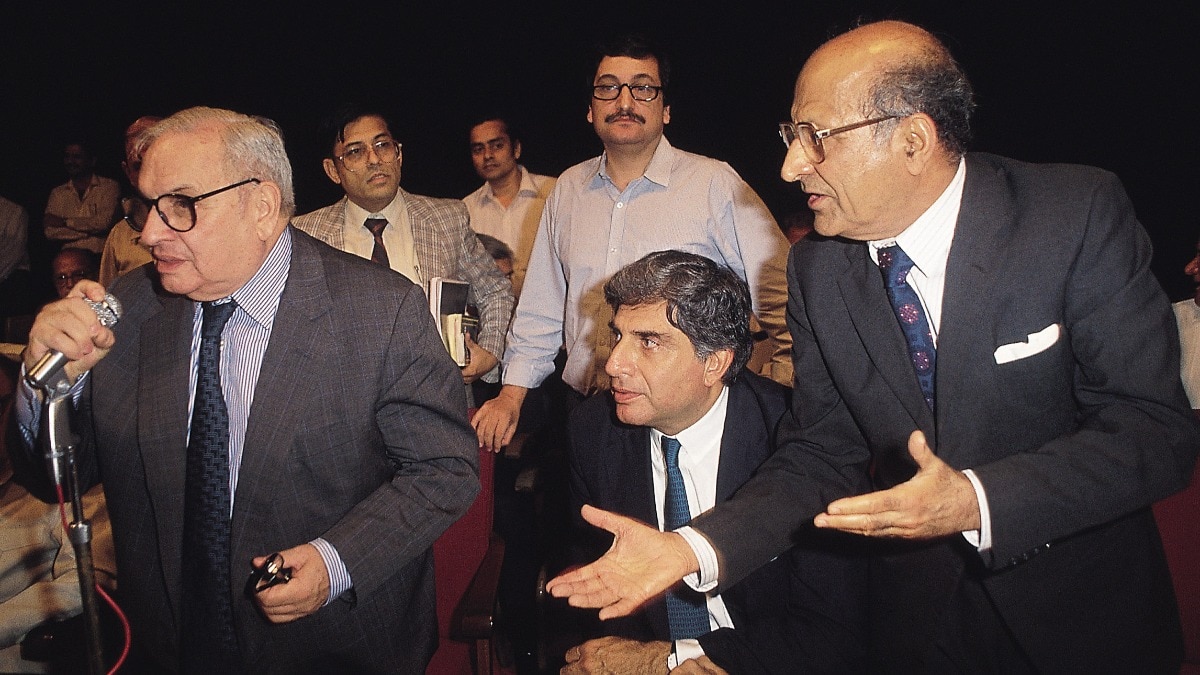
The old guard had built the Tata Group. The attempt by Ratan Tata was to integrate it. In this image, Ratan Tata and other top executives of the group are holding a meeting during the years of power tussle in the conglomerate. (Image: India Today Group) DARBARI SETH AND AJIT KERKAR: THE OTHER POWER CENTRES
Russi Mody's battle with Ratan Tata was out in the open, but the challenges posed by Darbari Seth and Ajit Kerkar were quieter but equally significant to Tata's effort to centralise authority.
Seth, who had built Tata Chemicals into a major enterprise and played a key role in expanding Tata Tea, was a respected figure with considerable influence within the group. As he approached retirement, attempts to maintain his influence through succession, including the elevation of his son Manu Seth at Tata Chemicals, ran against Ratan Tata's vision of preventing hereditary power centres from taking root in Tata companies.
Kerkar, meanwhile, had built Indian Hotels and the Taj brand into a formidable hospitality empire and operated with considerable autonomy. Growing concerns over governance and decision-making at Indian Hotels eventually strained his relationship with Tata Sons, with his exit further weakening an independent centre of power within the group.
Together, the departures of Seth's camp and Kerkar showed that Ratan Tata's restructuring was not limited to removing one powerful chairman. It was a broader attempt to ensure that succession, governance and strategic authority flowed from the group's centre rather than individual corporate barons. One power centre: Ratan Tata faced much resistance during his initial years as chairman, but he managed to navigate the situation and made authority more centralised. (Image: India Today Group) THE JOURNEY OF TATA GROUP FROM BOMBAY HOUSE TO THE WORLD UNDER RATAN
The consequences of the confrontation against the old guards of Ratan Tata became visible over the next two decades.
Tata Sons exercised greater influence over its companies, the group developed a more unified identity and pursued an increasingly ambitious global strategy. Tata companies expanded overseas and made headlines with acquisitions including Tetley, Jaguar Land Rover and Corus.
Though not all attribution of success can be given to the 1990s battle, the organisational transformation that Ratan Tata pushed through created a Tata Group in which large strategic decisions could be pursued with considerably greater central coordination.
The old decentralised Tata model had produced legendary corporate personalities. The new model produced a more integrated conglomerate. And Mody's exit was one of the clearest moments when that shift became visible.
Three decades after Ratan Tata used the power of Bombay House to bring the Tata Group's sprawling satrapies under a stronger centre, the same headquarters is once again at the heart of a battle over who ultimately calls the shots.
The Chandrasekaran versus Noel Tata confrontation is not a replay of the Ratan versus Mody episode, but it raises one familiar question that where does the final authority lie when the interests of Tata Sons, its board and the trusts that control it collide?
The answer this time could shape not just who leads Tata Sons, but how power itself is distributed across the Tata Group for the next generation.- EndsPublished By: Avinash KateelPublished On: Sep 19, 2026 07:00 IST