The Earth has a new moon - The Independent
Want to bookmark your favourite articles and stories to read or reference later? Start your Independent Membership today.
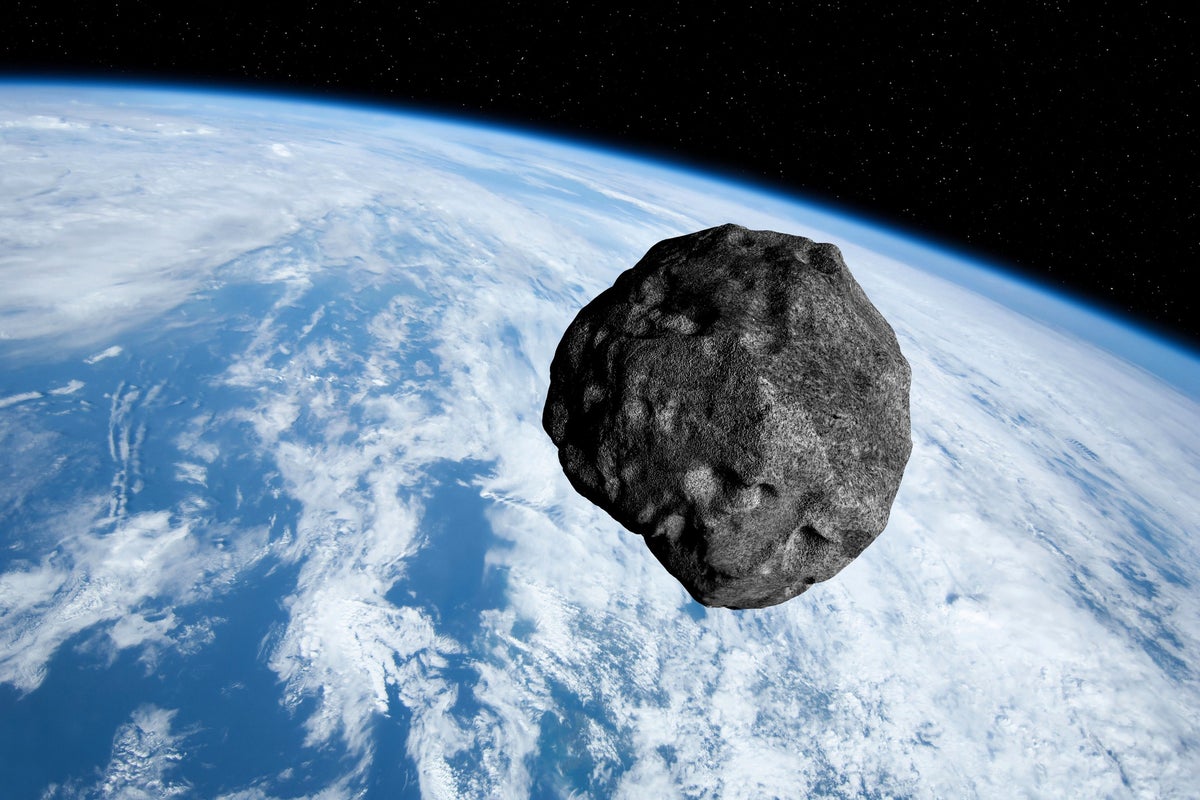
A new “lilliputian” mini-moon is orbiting Earth after falling into our planet’s gravitational pull.
Asteroid 2026 QQ8 was caught in Earth’s gravity in April and has entered a looping obit around the planet.
First detected by Hungarian astronomer Kriztián Sárneczky, who is a prolific asteroid hunter, the new moon will complete one and a half revolutions before escaping in 2027.
Mr Sárneczky first observed the space rock in August but has only recently been reported by the International Astronomical Union’s Minor Planet Center.
The asteroid typically orbits the Sun every 359 days, according to a reconstruction of its orbital path, and makes a close approach of Earth every 10 years or so.
The closest it will come to Earth during its brief orbit of our planet will be around 568,000 kilometres (353,000 miles), which is around 1.5 times the average distance between the Moon to Earth.
With a diameter of around 2 metres, Asteroid 2026 QQ8 poses no risk to Earth as it would likely be destroyed by the atmosphere if it was on a direct collision course.
It is not unusual for the Earth to have small chunks of space rock fall into its orbit, with a study last year suggesting there could be up to six temporary mini moons around Earth at any one time.
Many of the mini moons could be part of the actual Moon, which shoot off into space following an impact event.
One such minimoon that may have originated from the Moon is Kamoʻoalewa, which was discovered in 2016 when the 40-metre asteroid became a quasi-satellite of Earth.
“Its spectrum closely resembles that of space-weathered lunar samples, which suggests a lunar origin of Kamo’oalewa,” the study’s authors wrote.
“The lunar origin of Kamoʻoalewa implies that the impacts on the Moon have scattered substantial fragments into the Earth-Moon system, which is crucial for understanding the origins of NEOs (near-Earth objects), the formation of terrestrial planet’s satellites, and their potential hazards to Earth.”
NEOs typically have a lifespan of between 1-10 million years, though some persist for up to 150 million years.