The federal law aimed at protecting college students from sexual abuse

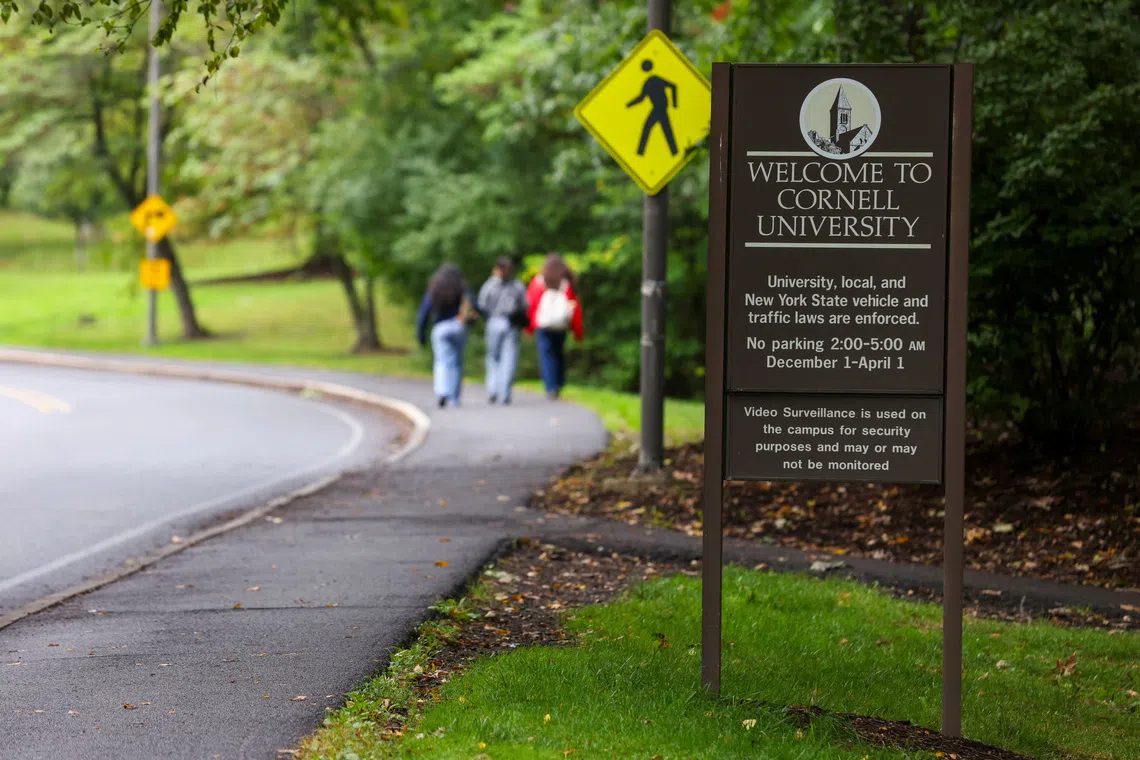
People walk on the campus of Cornell University in Ithaca, N.Y., in 2024. Seth Wenig/AP hide caption
When colleges receive reports of sexual assault on a student, a federal law dating back to 1972 is supposed to ensure that they investigate, and take steps to protect those students.
It's called Title IX, and it's aimed at prohibiting discrimination in schools based on sex. The law says a university must allow all students to have a safe campus environment, and that sexual violence doesn't hinder a student's equal access to an education.
It's supposed to offer students protection in cases such as the one at issue in the lawsuit by a former Cornell University student, referred to as Jane Doe. The lawsuit claims that she was drugged and raped by seven students at a fraternity house in October 2024.
The campus police investigated the incident and referred the case to the local district attorney. Though no criminal charges resulted from that investigation, the student's report triggered the campus Title IX process at Cornell.
The lawsuit states that in May 2025, at least 12 hearings were held before a panel of faculty and staff.
Cornell said in a statement that its investigation took "several months." As a result, the university said there were expulsions and suspensions, and the fraternity chapter involved "was closed in 2024 and remains barred from campus."
Title IX investigations can work in parallel with a criminal investigation, explains Beth Gellman-Beer, who spent nearly two decades at the U.S. Education Department's Office for Civil Rights.
"The school's role in Title IX, as opposed to criminal proceedings, is to determine whether or not the person accused of this sexual assault should remain on campus," she says. "Schools are not determining if somebody is going to go to jail. The school's responsibility is to ensure a safe and inclusive environment where all students have access to the educational environment."
Title IX sets a lower burden of proof than a criminal case, and it can be another route for a student to seek justice if prosecutors don't end up picking up the case, Gellman-Beer adds.
Depending on the severity of the incident being investigated, Title IX outcomes can include, in addition to suspension or expulsion for the accused, steps like providing a student victim with different housing, establishing a "no-contact" order, or creating a work schedule so that student victim and perpetrator don't work at the same time.
The goal, Gellman-Beer says, is to provide support to the victims so that they can still go to class.
In recent years there have been big changes to how Title IX is implemented. In 2020, the Trump administration raised the burden of proof – and also required schools to conduct "live hearings with cross-examinations" – among other changes.
The Biden Administration sought to expand Title IX by including protection for LGBTQ students and by removing the requirement for hearings, as critics charged that it stifled students' willingness to report incidents.
The Trump administration this week overturned those additional protections and reverted to the 2020 version of the law.
The back and forth has created confusion at colleges about Title IX and how they should implement it.
"It's often a flawed process," says Carolin Guentert, a lawyer who has represented victims in Title IX cases involving sexual assault allegations.
"Title IX coordinators or individuals tasked with investigating these kinds of situations don't have the proper training, and are not always trauma-informed," she says. "The regulations are changing so quickly and schools' policies have to keep up." She says that can lead to an investigator being "out of step with their own schools' policies"
Meanwhile, sexual assault on college campuses remains a major problem.
"I hear a lot of people talking about, 'How could this happen at such an elite institution?'" says Guentert. "And really the answer is, this happens everywhere, all the time."
At Cornell, a 2025 survey found that more than 1 in 3 undergraduate women reported experiencing a sexual assault at some point during their time there, up from 23% in 2023.
The school created a task force to make recommendations on how to curb sexual violence on campus – which included increased knowledge about sex and school-specific processes for reporting behavoir.
Historically, a student who believes their college has failed to protect them, by not upholding Title IX, could file a complaint with the Education Department's Office of Civil Rights (OCR), which would trigger an investigation.
In its efforts to eliminate the Education Department, the Trump administration has drastically cut back that office, transferring many of its lawyers to the Justice Department.
The administration has also focused its Title IX enforcement much more heavily on gender identity and transgender athletic policies.
In 2025 OCR didn't reach any resolution agreements for major discrimination cases involving sexual harassment or sexual violence on campus, according to a recent report from Sen. Bernie Sanders, I-Vt.
NPR does not offer or accept money for coverage or interviews. Anyone who makes such an offer or request is not an NPR employee and does not represent NPR.