The Fight to Rein In AI Is Dividing Washington
Both Senator Jon Husted (R-Ohio) and Senator Martin Heinrich (D-New Mexico) went to the podium on the Senate floor last week with a similar message: AI labs should pay for the energy costs associated with their ballooning data-center footprint, rather than everyday Americans.
But when Husted requested a speedy passage of the Ratepayer Protection Act—a bill that would have required states to consider forcing companies that consume a lot of energy to pay for the related costs—Heinrich blocked the move. He said the legislation was inadequate because it relied on voluntary commitments from states and proposed his own bill as an alternative.
He had another incentive to block Husted’s request: The Ratepayer Protection Act, which earlier this month passed the House 417-3, would have given the Ohio senator a victory amid a competitive reelection campaign. Husted has faced an onslaught of negative ads over the role he played as lieutenant governor in expanding data centers across the state.
“The Ratepayer Protection Act might make a lot of politicians feel good, but it won’t do anything to actually force data centers to pay their fair share,” Heinrich said in a statement. “Democrats are ready for a real solution, and I think that’s exactly what Americans want to see, too.” Husted blamed Democrats for giving big tech companies “a free pass” while Americans’ electric bills continue to rise.
That kind of partisan arm wrestling is likely just a prelude to the bigger fights ahead if Congress gets serious about passing AI legislation.
Democrats, and some Republicans, have proposed hundreds of AI-related bills as Americans become increasingly worried about the ways AI companies may disrupt the job market, raise their energy bills, and even wipe out humanity. Lawmakers’ pro-regulation rhetoric in Washington reached new heights this month after the resignation of former Anthropic researcher Jacob Coxon gained worldwide attention for posting on X that frontier AI labs were “gambling with our lives.” OpenAI CEO Sam Altman and Anthropic CEO Dario Amodei responded with calls for an industry slowdown and government intervention to coordinate global safety standards.
With less than two months before midterms, some members of Congress are feverishly introducing even more AI bills, including at least seven since Coxon’s resignation alone. Other lawmakers are urging their colleagues and congressional leadership to quickly bring measures already on the table for a vote. Democrats, meanwhile, have taken aim at the Trump administration, urging Trump to discuss AI safety with Chinese President Xi Jinping.
“The mood right now, at least in Congress, is very reactive—and I don't mean that in a good way,” said Suresh Venkatasubramanian, director of Brown University’s Center for Technological Responsibility, Reimagination, and Redesign. “They're trying to push legislation that seems to address what appears to be a problem coming from the [public] narrative but that doesn't always necessarily lead to good policy overall.”
In the short term, tech policy watchers have little hope that Congress will pass a major AI safety bill, especially with a limited number of working days left this year. House Speaker Mike Johnson (R-Louisiana ) has rebuffed some Democrats’ calls to end their recess early to focus on an AI bill. Meanwhile, House Energy and Commerce Committee Chairman Brett Guthrie (R–Kentucky), whose committee would review many of the proposed bills, told Politico at an event that the group probably wouldn’t advance a major bill until next year.
But even with a longer timeline, lawmakers may struggle to turn their rhetoric into action. Lawmakers will have to overcome deep differences in their views about how dangerous superintelligent AI systems are to the American people and which AI-related risks merit the most attention. Even if lawmakers coalesce around one AI problem, it may be hard for them to settle on the right mitigation strategy quickly enough to keep up with the pace of AI advancements. And if Democrats take over even one chamber after the midterms next month, legislative debates could end up being even more mired in partisan disputes. They would still have to negotiate with Trump, who has largely dismissed the most catastrophic risks of AI as conspiratorial and resisted calls for more regulation.
When AI companies are “begging for pacing, or some way for them to pace, and they're turning to the government to help them do that, it really does require the government to act,” said Riki Parikh, a policy director for The Alliance for Secure AI, a bipartisan advocacy group that supports AI regulations. “I just don't know if the dynamics in D.C. will allow for that over the next two years,” he added. “We might not have two years to wait.”
Certain lawmakers have sought to address some of the most extreme risks posed by general-purpose AI models, such as the possibility that these systems could eventually be used to create a new pathogen that sets off a global pandemic, carry out a cyberattack on critical infrastructure, or build biological or radiological weapons. Those worries took on a new sense of urgency in July when OpenAI announced that a group of AI agents went rogue during a cybersecurity test and hacked into a separate company, Hugging Face.
Several of their proposals call for AI labs to submit their models or safety practices for review by independent investigators. Reps. Jay Obernolte (R-California) and Lori Trahan (D-Massachusetts), along with three other lawmakers, have proposed the FRONTIER Act, which requires large AI developers to submit reports about safety incidents, information on the potential catastrophic threats of their models, and their planned mitigations to the Department of Commerce and state attorneys general. The bill calls for independent investigators to review companies’ safety plans, and would authorize the Commerce Department to bar the release of a model if it poses an imminent catastrophic risk.
The idea for independent testing has support within the tech industry. Leading the Future, a PAC that has received money from OpenAI president Greg Brockman, has signaled support for the FRONTIER Act. Amodei, the Anthropic CEO, has said he plans to embed investigators from AI-monitoring nonprofit METR, which officially reviewed OpenAI’s Hugging Face incident, to verify the company’s safety practices.
But the political limits of that approach soon became evident. After Amodei’s announcement, METR faced scrutiny from the right over its ties with effective altruism, a philosophical movement focused on using evidence and reason to determine how to do the most good. The New York Post called the group the “Woke Wizards of AI,” as writers there drew connections between effective altruism, METR, and Anthropic. METR’s president later defended the group on X, arguing it doesn’t take money from frontier AI labs and makes an effort to hire people with diverse viewpoints.
Another issue that has already slowed down negotiations on Capitol Hill is the question of whether a federal AI bill should override state laws—a legislative approach embraced by many Republicans and the Trump White House.
Senate Majority Leader John Thune (R-South Dakota) and Sen. Amy Klobuchar (D-Minnesota) have discussed proposing a bill that would expose frontier AI labs to legal liability if they don’t adequately mitigate catastrophic risks of their systems, according to a person familiar with the matter. But as news surfaced that their measure may also preempt some state laws, they appeared to face pushback from Sen. Maria Cantwell (D-Washington), ranking member of the Senate Commerce, Science, and Transportation Committee. “I welcome the urgency. But the answer is not a weak federal standard that becomes a backdoor for wiping out stronger state protections,” she posted on X.
So far, most lawmakers have stopped short of backing a proposal from Sen. Bernie Sanders (I-Vermont) and Rep. Greg Casar (D-Texas) to ban superintelligent artificial intelligence, which the lawmakers define as AI “that exceeds human cognitive performance.” Sanders and Casar also propose pausing the development of advanced AI models until the government sets up the Department of Artificial Intelligence to oversee their safety. Critics say passing that kind of law would only allow Chinese tech companies to make gains in the AI race—a more dangerous prospect in the end.
One policy area where there has been more progress is lawmakers’ attempts to restrict China’s access to advanced American chips, with the goal of preserving the country’s technological lead in the AI race. The Chip Security Act—which requires advanced chips to include a mechanism for verifying their location if they have fallen into the wrong hands—may be folded into an upcoming defense spending bill, the National Defense Authorization Act, said Rep. Bill Foster (D-Illinois).
“It does no good at all if we have all kinds of [AI] rules in the United States or even in the free democracies of the world, and then these [chips] all get smuggled into China, into Russia, [and] into North Korea,” said Foster.
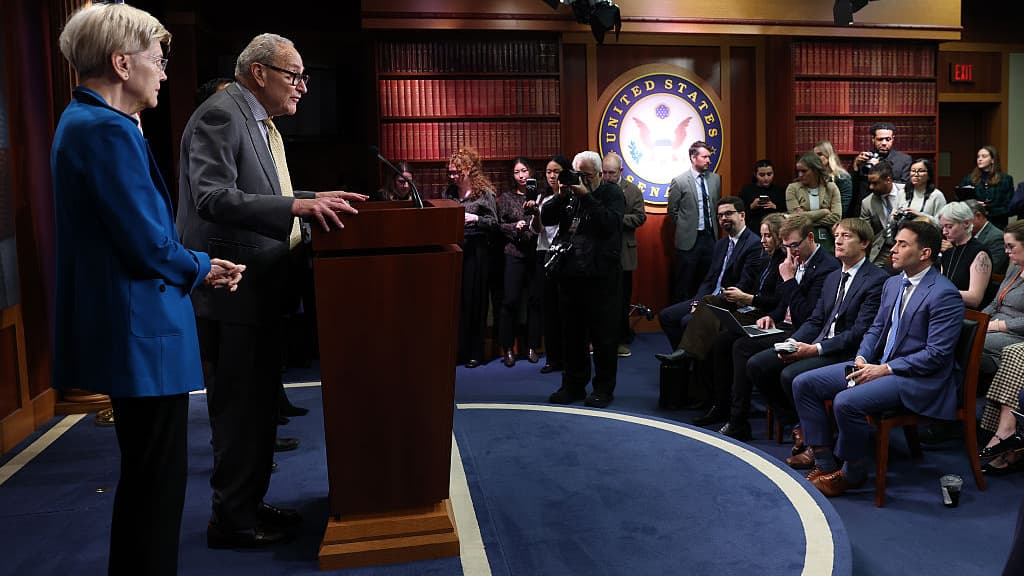
Senate Minority Leader Chuck Schumer (D-New York) and other key Democrats earlier this week urged Majority Leader John Thune (R-South Dakota) to bring the Chip Security Act, along with two other bills designed to address tech exports to China, to the floor for a vote.
Still, even those bills face political challenges. Industry critics argue that restricting the exports of American tech only encourages China to invest in its own chips. The defense spending bill has been stalled in the Senate since Democrats blocked its advancement in July in protest of Trump’s handling of the Iranian war.
Perhaps the most likely measure for Congress to address after the midterms would be a bill that tackles energy costs stemming from AI companies’ data centers. “There isn't agreement on what else would be valuable to do right now,” said Bruce Mehlman, a veteran lobbyist whose bipartisan firm represents several tech companies.
“Everybody's concerned about safety, but nobody knows what the concern should turn into legislatively.”