
The Future of Surgery: Robots, AI and the Surgeon’s Hand - Le Figaro
Pour sauvegarder un article vous devez être connecté, vous pourrez ainsi les consulter sur tous vos appareils.
Robots are quietly entering operating rooms across the world. More than 10 million robot-assisted procedures have already been performed globally. Yet in Europe, robotic surgery still represents only around 2% of interventions, far behind the United States, where it is closer to 15%. By 2030, the European market is expected to reach 3.3 billion dollars.
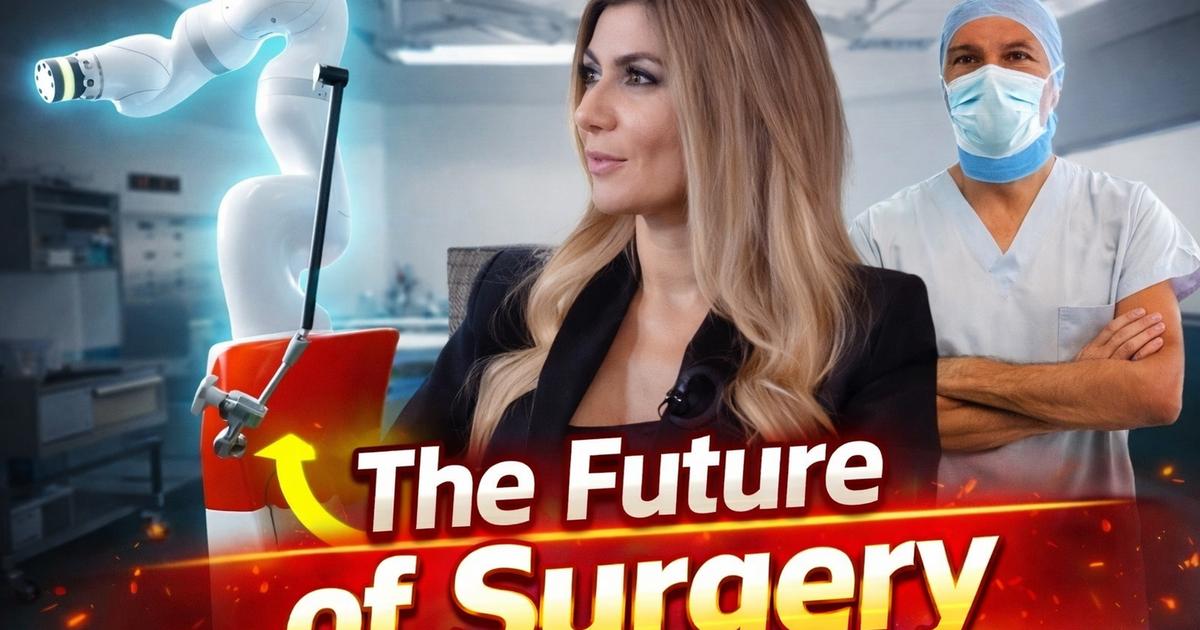
To explore this, Alexia Borg travelled to the Émeraude Clinic in Saint-Malo, the first centre equipped with ROBIN, a knee surgery robot developed by United Orthopedic . ROBIN does not replace the surgeon. It analyses the patient’s anatomy in real time and guides the most delicate gestures, helping position a knee prosthesis with millimetre precision.
“The robot is a tool that helps the surgeon be precise. The more precise you are, the longer the prosthesis lasts.”
Robotics brings rigor to pre-operative planning and intra-operative execution. Angles, cuts and positioning become more reproducible from one patient to another. But in the operating theatre, not everything can be scripted.
During a knee replacement, the surgeon still has to manipulate the limb, feel the tension, verify stability, and adapt to each body’s particularities. These micro-sensations, accumulated over years of experience, remain out of reach for machines.
“A force applied to two different bodies doesn’t mean the same thing. The surgeon’s experience remains essential,” Bopp reminds us.
“I don’t see a surgeon in New York operating on a patient in Paris. What I imagine is a surgeon operating on two or three patients at the same time.”
In other words, technology is a multiplier of skills, not a substitute for the surgeon.
Joint replacement has become a routine procedure. But the idea of 100% custom-made prostheses, designed or printed for a single individual, raises both hope and doubts.
“If it’s 100% custom, which reference do you choose? The intact knee? Usain Bolt’s?”
Some experiments have already hit their limits. The Swiss manufacturer saw its customised implants banned in the UK after high failure rates. Full anatomical personalisation may sound ideal in theory – but in practice, it does not automatically guarantee better outcomes.
The future, Bopp suggests, may lie in a balance between standardisation and adaptation: robust, proven designs that can be fine-tuned to the patient rather than reinvented from scratch each time.
“The surgeon of the future will be a technology specialist.”
Robotics, 3D planning, virtual reality, simulators: these tools are already entering medical education. The objective is simple:
“We should never perform a procedure on a patient for the first time.”
Future generations of surgeons will be trained to navigate between analog and digital, between direct manual practice and simulated environments. The challenge is to master the technology while preserving independent clinical judgement.
“The surgeon must remain the captain of the ship.”
The path forward is therefore hybrid: learning both with and without robotics, developing technical dexterity, spatial vision, and the ability to take over at any time if the machine fails or behaves unexpectedly.
Who is responsible if an error occurs in a robot-assisted procedure?
“Always the surgeon. You can’t sue a machine.”
Robotics does not dilute medical responsibility, nor does it erase ethical questions. The surgeon remains the legal and moral decision-maker.
Robots may calculate, assist and correct – but they do not sign consent forms, announce diagnoses, or face families.
Could a robot one day perform an entire operation alone, from incision to closure?
Technically, some steps already can be automated. But orthopaedic surgery remains a highly complex discipline:
The first attempts at robotic orthopaedics in the 1990s – such as Robodoc – failed because the robots were too aggressive and not sufficiently adapted to variations in human tissue.
Future systems will undoubtedly be smarter, safer and more refined. But even if full autonomy becomes possible, the question will remain: is it desirable? And under which conditions?
Around 20% of patients undergoing knee surgery remain dissatisfied – not necessarily because of surgical error, but because their profile was not suited to this type of procedure.
This is where predictive AI could play a key role.
“AI will help analyse emotional state, activity level, pain type… It will help select the right patients,” explains Professor Hulet.
By integrating clinical, psychological and lifestyle data, AI could help surgeons better identify who will truly benefit from a prosthesis – and who should instead be offered another treatment.
“The first role of AI will be predicting outcomes. But nature will always be stronger than AI.”
Is robotics truly transforming outcomes, or is it still mostly a technological promise?
“Robotics is the beginning of 3D surgery. We still have so much to learn about the knee,” says Dr Vanderschelden.
“For the moment, robots automatically increase expenses,” notes Professor Hulet.
Short term, the value of robotics is often more educational, strategic and technological than purely economic. The long-term equation will depend on clinical outcomes, durability of implants and system-wide efficiency gains.
“It is not because things are difficult that we do not dare; it is because we do not dare that they are difficult.”
The message is less about blind confidence and more about measured courage: understanding the tool, questioning it, and using it where it truly adds value.
The Future of Surgery is hosted by Alexia Borg and produced in collaboration with United Orthopedic, a Taiwan-based company founded in 1993, specialising in the design and manufacturing of orthopaedic implants (hips, knees) and surgical instruments.
Together, they sketch a future where robots and AI become powerful allies – but where the surgeon’s hand, judgement and responsibility remain firmly at the heart of the operating room.
