The good, the bad and the grumpy: Will Joe Aston’s Rampart go soft on its corporate backers?
You have reached your maximum number of saved items.
Remove items from your saved list to add more.
In this week’s On Background, the media deal on everyone’s lips, the ABC quietly trims its news bulletins, media’s best corporate citizens and the journo coming back from the dark side.
The fangs are out at The Australian Financial Review after its fearless leader James Chessell told staff he was leaving the business masthead last week, pointing out that the strain of the job was exhausting.
A handful of staff from the masthead say this is a tough line to buy, considering he is walking into its aspirational rival Joe Aston’s Rampart with an equity stake. It’s fair to say that there is a sense of betrayal in the air in the nation’s premier financial masthead. (We should note the AFR sits in the publishing basket alongside this masthead at Nine.)
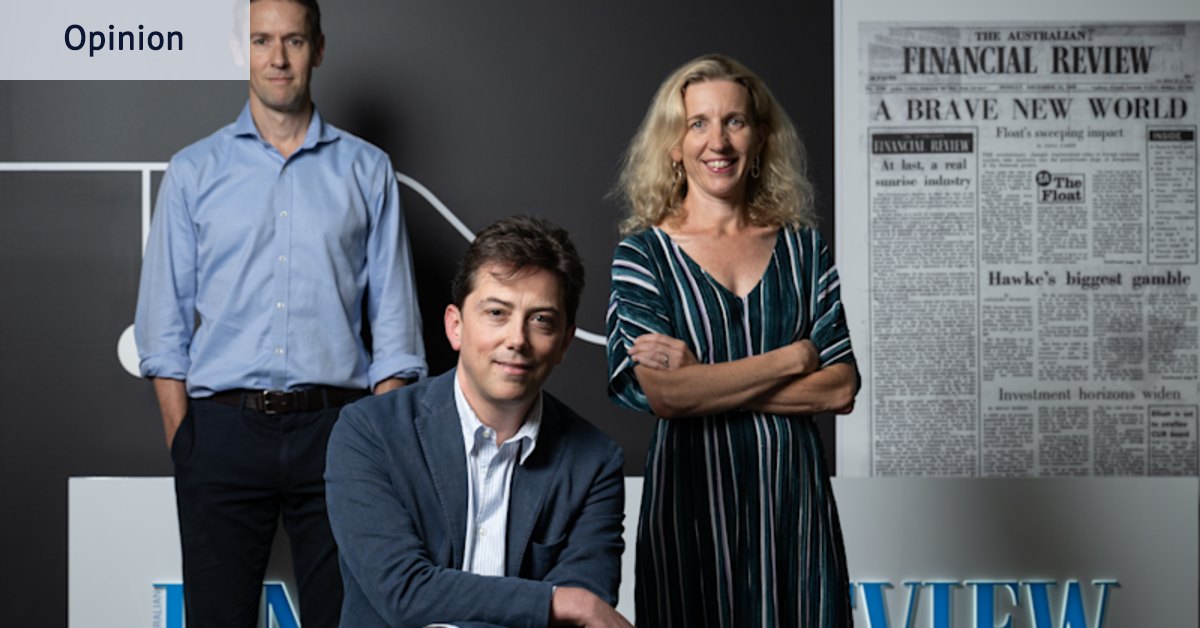
From left: The Australian Financial Review’s former editor-in-chief James Chessell, former columnist Joe Aston and editor, and newly appointed editor-in-chief Cosima Marriner in the Sydney bureau last year.Louie DouvisAdvertisementAFR’s newly appointed editor-in-chief Cosima Marriner, who cut her holiday short to steady the ship after the news of Chessell’s departure, now has to make sure the defection doesn’t become a distraction for the paper.
Aston’s Rampart logo was splashed across the Weekend Fin’s back page regularly.AFRStaff feel aggrieved, having toiled away at Chessell’s punishing behest, by the conditions that led to his departure. Add to that Rampart’s deal with Nine, which helped provide its runway to launch.
Just six months after Chessell returned to Nine as editor-in-chief of the AFR, Nine struck a deal for a cut of Rampart’s revenue and provided legal services and access to its photography. That legal deal meant Aston, whose at-times vicious writing has been a magnet for defamation concern notices, could avoid costly monthly insurance, which otherwise surely would have hindered growth.
In return, Aston’s Rampart branding was splashed across the back page of The Weekend Fin alongside an exclusive column, published on a monthly basis, often with a pointer on the front page, too. That is one hell of an advertising deal. Aston even called it a “win-win” for him at the time. When he launched his Rampart Talks series, those were dutifully written up by AFR and linked off to the Rampart site, too. Priceless.
A Rampart subscription costs $680 per year and it has racked up about 4000 paying customers so far, inside sources tell On Background. How many are paying for the $6600 “chairman’s lounge” tier is unknown. Nonetheless, reader revenue is already in the millions, plus ad dollars.
This is a tricky one for On Background to cover, considering the parties involved, and the fact The Age and Sydney Morning Herald’s business editor is also leaving to join the start-up.
Chessell and Aston are two of the most connected figures in the modern media game.
Some of Aston’s own connections are already involved in Rampart. Ashok Jacob, executive chairman of Ellerston Capital (which was founded as a vehicle for James Packer’s inheritance) was revealed as one of five investors in August. Aston is famous friends with Packer and, as this masthead previously reported, spent so much time on the billionaire’s boat he even earned the nickname “Gilligan”. Ellerston and Ashok remain a “close associate” of Packer’s, according to Rampart.
Aston was back on Packer’s 354-foot superyacht “IJE” in Fiji to interview the man to launch his Rampart Talks series in October last year, staying aboard for a few days afterwards to enjoy the luxuries of the $288 million vessel. Who wouldn’t?
To be fair, he is more than open about this particular relationship, and says the easiest thing is to just not write about Packer. That was until he needed a big splash for the first guest of the vodcast series. It delivered. Packer is not an investor himself, however.
“You get close to a lot of these powerful people in the process of writing about them and inevitably you do become friends with some of them and some of them you don’t,” Aston said on a podcast released this week but recorded almost two months ago.
Aston and Chessell met working for former Liberal minister Joe Hockey, who later became known as the Trump whisperer for Australians. Trump appears to be a figure who looms large over sections of Australia’s corporate world. Aston himself has visited Mar-a-Lago on three separate trips over Trump’s two terms, each of them at the invitation of Australian billionaire Anthony Pratt, he has declared.
Anthony Pratt, Australia's richest man, at Donald Trump's Mar-a-Lago resort in Florida in May 2018. Michelle McMinnAdvertisementAston’s first post-Chessell piece this week took the sword to those in Australia’s corporate world who have legitimised our own MAGA, Pauline Hanson. “How did the prevailing mood become one of weak acceptance that maybe she’s not so radical?” he wrote.
It’s well documented that some journalists are rewarded with free trips to Mar-a-Lago (as this column has covered previously). Others, including some business leaders, have to pay for the pleasure.
Included in the piece by Aston was a swipe at fund managers Angus Aitken of Mount Capital and Ben Cleary of Tribeca Investment Partners, who travelled to Mar-a-Lago with Gina Rinehart as their chaperone this year to meet Trump, part of a deal which included $100,000 donations to One Nation.
But wait. Didn’t three fundies make that deal? The third traveller and donor, Doug Tynan of GCQ Funds Management, didn’t get a mention in Aston’s piece. Wouldn’t you know it, he was announced as one of the five Rampart investors two months ago. GCQ also happens to be Aston and Rampart’s landlord.
“I would have preferred this stay a private matter,” Tynan told the AFR in March about his travel to Florida, insisting his interest was “psychological” rather than political.
For a fledgling start-up, access to funds is crucial. Some big advertisers are already on board at Rampart, including BHP which sponsors the flagship Talks series.
The question will be, as coverage develops, whether advertisers or investors get similar treatment to those who aren’t involved.
Even a week after Four Corners’s BHP Files episode in late May, Aston’s monthly Rampart column in the AFR smashed the mining company’s mortal enemy and good guy in the story, Twiggy Forrest, for his professed green credentials. Valid, sure. But sticking the boot in would no doubt have pleased BHP.
Some in this world say this is just a natural part of the game and that columnists always have favourites. It is the “dark arts” of how you get information. And if every media organisation avoided their backers or advertisers, we’d barely have any news to write about.
Fairfax, now Nine Publishing, previously allowed Antony Catalano to launch a rival real estate-focused publication, later buying him out over a series of deals valuing the company at $150 million. Could Aston and Chessell be angling for a similar deal?
The other option being discussed in the market is whether Rampart may do the opposite in lobbing a bid for the AFR themselves down the line, with the help of some cashed-up connections.
While this may appear unlikely, so did the events of the past week. Aston declined to comment, as did Chessell and Nine.
The ABC has axed what was left of its standalone Stateline news packages as well as its special weekend extended news stories as part of a push to make nightly news bulletins shorter and sharper, On Background can reveal.
The new director of news, Simon Robinson, began at the ABC just last month, but the changes were made before then, On Background hears. Robinson has said he will sit and observe for some time before enacting change of his own, but change waits for no one.
All of this forms part of a revamp of the ABC’s nightly bulletins, which also includes a move to ensure no single package is longer than one minute and 40 seconds, more closely aligned with what you might see on the likes of 7News or Nine News. Is it a case of Aunty’s news bulletins being too slow, or has TikTok and Instagram just shortened our attention span?
The ABC isn’t waiting for Simon Robinson to make changes to its news output.AdvertisementThe Saturday and Sunday extended packages, known internally as “special reports”, were informally axed over the winter months. These were usually about five minutes long and ran across national bulletins. Five minutes is plenty of time to dig your teeth into a story. But alas, no more.
The same goes for the Stateline packages which ran at the end of each state bulletin on a Friday evening. This decision is more symbolic as Stateline, which until 2011 ran as a standalone weekly program in each state, was reintroduced in 2023, but didn’t have any of its own dedicated staff.
An ABC spokesperson confirmed the changes, and said that axing the extended reports allowed the ABC to do more stories per program.
Staff and the public are awaiting more big changes hinted by managing director Hugh Marks at the broadcaster’s annual content showcase this month. The above could be a sign of things to come.
Speculation is hot that Radio National’s PM program and The World Today could also be on the chopping box. We won’t have to wait long to find out.
While the industry chats about “who is next” to defect to Rampart, it has already built a fairly decent team. One of those is Ben Espiner, its content and production manager.
Espiner was the producer of the ill-fated Freya Fires Up for its record-breaking six-episode run on Sky News Australia (now News24).
He left the company after the network aired an interview with a chap who wore rashers of raw bacon on his shoulders and launched into an Islamophobic tirade. The show was brought to an end shortly after.
Sky News’ short-lived Freya Fires up aired an interview with a guest wearing raw rashers of bacon.AdvertisementFine judgement, I say. On Background has been assured there will be no extremists or raw deli goods on the next series of Rampart Talks.
News Corp racked up its 12th year in a row of paying precisely zero tax in Australia, despite posting revenues of well over $1 billion, new ATO data on Thursday revealed. Much of this revenue comes from REA Group, a company majority-owned by News Corp that benefits from a growing housing market.
No wonder the company’s editorial coverage has been so against Labor’s tax changes this year, which are squarely aimed at bringing down house prices.
Netflix paid a grand total of $8.4 million in tax on $1.4 billion in local revenue, while TikTok Australia paid $17.3 million on $686.6 million.
Journalism to communications is a well-trodden path, or say, revolving door, with companies keen to draw on the knowledge and connections those hacks have built during their time chasing stories.
Sometimes, though rarely, the lure of the chase can be too much despite newsrooms offering salaries that fall well short of corporate life. That is the case for Samantha Hutchinson, a former scribe for this masthead, the AFR and The Australian, who in 2024 gave it all up to be oil and gas giant Santos’ senior media manager.
She is now returning to The Oz as a senior business journalist, On Background hears. We just hope she isn’t on the energy beat.
Hutchinson was approached for comment.
The Business Briefing newsletter delivers major stories, exclusive coverage and expert opinion. Sign up to get it every weekday morning.
You have reached your maximum number of saved items.
Remove items from your saved list to add more.