The Hidden Irony of the Fairford B-1 Retreat - Newsweek
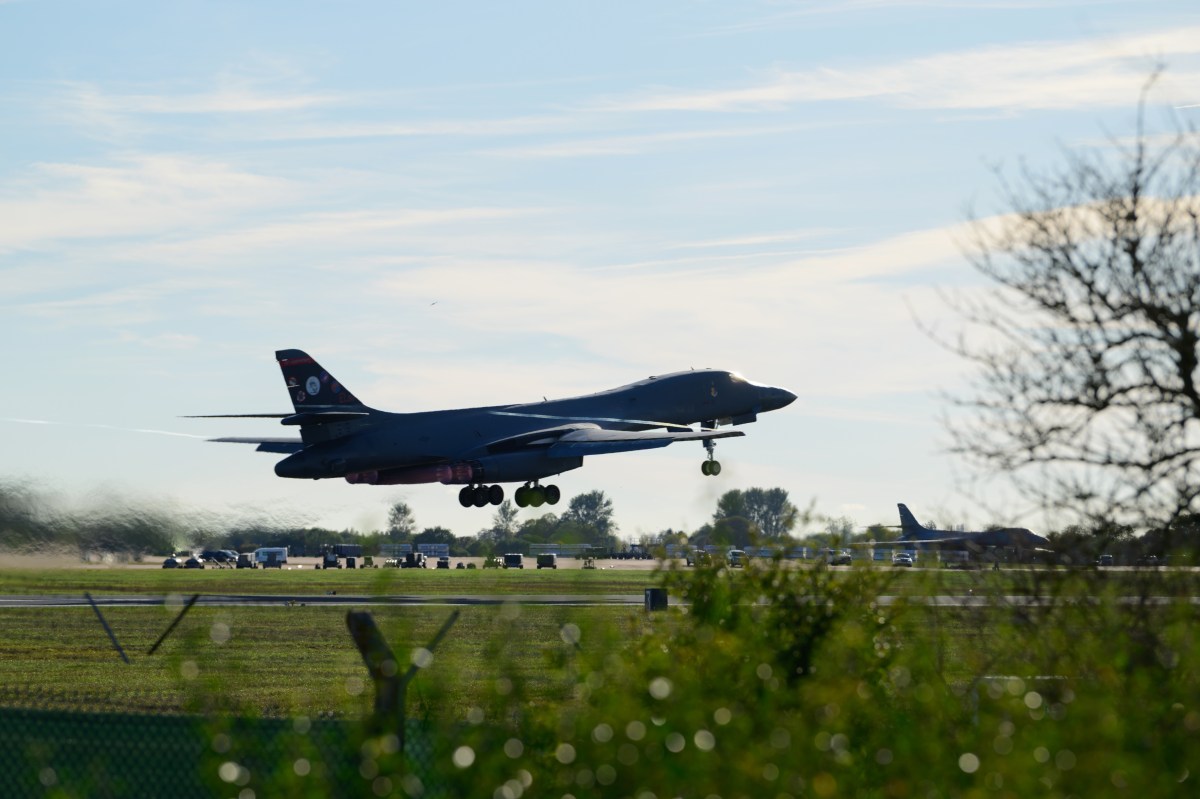
On Sunday, all 12 B-1 bombers at RAF Fairford, the main U.S. bomber hub in Europe, suddenly and unexpectedly took to the skies, catching everyone’s attention and provoking fevered speculation about what was afoot.
The aircraft flew not to Iran on a surprise sortie, but instead home to the U.S., days after an alleged Iranian-backed terror plot targeting the base was foiled.
Why? Yesterday, where his own vice president and secretary of state had offered haze, President Donald Trump delivered clarity. There had been “threats,” Trump said, linked to Iran. “It costs very little money to move them,” he said.
Trump is right about the money, but the real cost is distance. Fairford is one of only a few European airfields suited to heavy bombers. It sharply cut flight times to Iran. Trump, when Britain had briefly withheld its bases, complained of U.S. planes “flying many extra hours.”
Beneath that lurks the hidden irony of the Fairford retreat. Trump’s Pentagon is deliberately shrinking America’s permanent military presence in Europe, seeking to shift more of NATO’s security burden on the allies who actually live there.
But Fairford’s apparent vulnerability shows why the U.S. actually needs more of Europe. Not more Ramstein-style mega-garrisons, but a greater number of runways it can use, stock, and count on in times of war and crisis.
The Pentagon’s 2026 National Defense Strategy tells NATO allies to take primary responsibility for Europe’s conventional defense, with “critical but more limited” U.S. support.
In June, Defense Secretary Pete Hegseth told allied ministers that U.S. troop levels in Europe were back to pre-2022 levels after a further 5,000-troop cut, and announced a review of American posture and basing there.
Fairford is the kind of presence that such a strategy should prefer. No American aircraft are permanently assigned there. A U.S. support wing hosts rotating bombers on a British runway. Its weakness is scarcity.
A dozen B-1s at one of Europe’s few bomber-capable fields gifts America’s many adversaries, and particularly Iran right now, a short list of targets. Naturally, Iran’s Revolutionary Guard declared Fairford a legitimate target in July.
Ukraine gave a stunning demonstration of the modern threat to bases like Fairford. Its Operation Spiderweb last year struck Russian strategic bombers parked thousands of miles from the front line with drones launched from trucks nearby.
A similar close-range attack, prepared by malign actors already operating inside allied European nations, poses a likelier threat to Fairford than much else. Iran can’t reach it with a missile. But it doesn’t need to, as Spiderweb proved against Russia.
Fairford hasn’t been abandoned. What was planned against it remains murky and under investigation. British police found no explosives in three vans discovered near the base and all the suspects has been bailed, to the frustration of the Trump administration.
Tehran, of course, denies involvement. Secretary of State Marco Rubio, speaking before Trump, said the Fairford withdrawal had no direct link to that particular plot. U.S. officials, speaking anonymously to Axios, cited intelligence pointing to an Iranian drone attack.
Washington judged the threat serious enough to move the aircraft—all the way home.
The Air Force already has a doctrine for this problem. U.S. Air Forces in Europe has warned that “operational predictability and force posture” exposes critical infrastructure.
Its Agile Combat Employment concept has an answer: spreading aircraft across dispersed locations, backed by prepositioned munitions and fuel stocks and host-nation agreements.
Europe suits this model very well. “I’ve got tons of airfields from tons of allies,” General James Hecker said last year while commanding U.S. air forces in Europe. “The problem is I can only protect a few of them.”
Hegseth’s June speech contains both halves of the paradox facing the U.S. Having touted the troop cuts, he said the review must ensure American “access, basing, and overflight are clearly delineated and assured.”
He also complained that allies’ refusals during the Iran war had forced the Pentagon to shift capabilities between countries, some out of NATO entirely. Spain barred the war from its bases, as did Italy. Britain balked before allowing what it called “defensive” strikes.
These positions are not necessarily contradictory. They present a different model of American power.
It means fewer Americans living in Europe and more places from which Americans can fight. So, smaller garrisons, more rotations, and access settled before a crisis rather than during one.
Put simply, Washington wants its access predictable and its aircraft not.
There are some serious objections to a broader pool of European bases.
Every extra site needs fuel, weapons, maintenance, communications, and defenses. And, as Hecker conceded, only a few of Europe’s airfields can be protected.
Heavy bombers are also hard to house. Few runways can take them, and fewer governments want them. They can also strike from home, as the Pentagon stressed on Sunday, hitting targets “anywhere, anytime.” Remember Operation Midnight Hammer?
Moreover, since a shaky April ceasefire with Iran, the B-1s at Fairford had mostly been training.
Yet dispersal changes an adversary’s calculations. Plotting against one known airfield is manageable. Plotting against a dozen, any of which might host bombers next week, is far more complex.
And flying from home means paying, mission after mission, the extra hours Trump once resented. More time in the air also increases the chances of detection.
Hegseth’s review is due this December. If it pairs troop cuts with new access agreements, prepositioned stocks, and more bomber-capable runways, the irony has become a meaningful strategy.
But if the review only subtracts from America’s presence, the next Fairford will end the same way, with the bombers—perhaps only those that remain functional, should the worst happen—flying home.
Trump wants Europe to host fewer Americans. But Fairford suggests what America really needs is access to more of Europe.