The new social game
Direct Source Verification:
This story is aggregated from The Express Tribune (tribune.com.pk). Full reporting rights and copyright belong to the primary publisher.
Inside the rise of Pakistan’s urban mahjong clubs
Before we learned to unwind by retreating into individual screens, relaxation in a Pakistani household was inherently loud, interactive, and gathered around a game board. When family or friends gathered for entertainment, social life came alive to the clatter of plastic dice in a ludo cup, or the sharp slap of playing cards on a coffee table, or the slow, collective tension of a tambola night.
These games weren't just about passing time. They served as a vital social fabric that brought generations together under one roof. They offered a rare offline sanctuary where neighbourhood news was traded, rivalries were stoked, and leisure remained genuinely communal. As urban life grew more fragmented and digital entertainment pulled everyone into isolated, hyper-personalised screens, that familiar routine quietly slipped away.
Now, an unexpected revival is taking shape across Pakistan's major metropolitan centres: a sudden surge of interest in mahjong.
Seeing a four-player traditional Chinese tile game take root in drawing rooms and cafes across Karachi, Lahore, and Islamabad might sound surprising at first. Yet board games have always been nomadic. History is full of pastimes that crossed borders, shed their original geographical boundaries, and found vibrant second lives with entirely new audiences.
Consider chess. Its earliest ancestor, chaturanga, originated in the subcontinent during the sixth century as a strategic war game. As it travelled along ancient trade routes through Persia and the Islamic world into Europe, it was refined, standardised, and eventually institutionalised into a competitive international sport. Today, while chess is celebrated worldwide as the ultimate intellectual test, its deep regional roots are often overshadowed by its modern-day global place.
Mahjong’s global trajectory follows a strikingly similar arc. Emerging in southern China during the mid-19th century as a tile game derived from ancient card traditions, it was imported to the West in the early 1920s by American traders. Promoted through exoticised marketing that falsely tied its origins to ancient royal courts, mahjong exploded into an American cultural phenomenon. Over decades, it adapted to diverse communities, proving that a complex cultural artifact could reshape itself to fit the social needs of entirely different societies.
The catalyst behind its growing traction in the local landscape often comes down to individual passion turning into a community activity. For Madiha Khawar, the founder of Madis Mahjong, her entry into the game was entirely accidental.
Having spent nearly two decades working in the corporate sector, she suddenly found herself at a career transition with an unfamiliar surplus of time. “Mahjong came at a very unexpected point in my life,” Madiha recalls. “I had spent almost 20 years working for a large multinational and then one fine day, I lost my job, and suddenly I started wondering, what am I going to do with all this time?”
A chance Instagram post by a friend seeking four people to form a learning circle led Madiha to take formal classes while living in Dubai. The initial learning curve was steep. “I still remember sitting through my first lesson thinking, am I ever going to understand this game? But very quickly, we became completely hooked. Even after our classes finished, the four of us continued meeting once or twice a week to play.”
As her grasp of the rules improved, Madiha found herself mentoring friends who were hesitant about the game's intricate scoring—particularly in Taiwanese Mahjong. Recognising her natural flair for teaching, a close friend pushed her to formalise her guidance.
Madiha put together a simple promotional flyer and sent it out—leading to a flood of inquiries and her first two study groups forming by the very next morning. What began as an informal venture in Dubai quickly crossed borders when Madiha visited her parents in Lahore. At the time, while sporadic private games existed in cities like Karachi and Islamabad, Lahore lacked a visible learning scene.
“When I started, I personally wasn't aware of an established Taiwanese Mahjong teaching community or club in Lahore, and most of the people who came to me were encountering the game for the first time,” she explains. “In that sense, it felt like I was introducing something very new to the city. I wouldn't want to claim definitively that nobody in Lahore had ever played Mahjong before, but there certainly wasn't the kind of visible Mahjong scene that we're seeing now.”
The demand just kept growing. There were days when I was teaching four or five classes. What surprised me most was the range of people interested in learning,” shared Madiha.
While global players migrate between distinct styles—from the fast-paced Cantonese rules and high-stakes Japanese Riichi to the joker-laden American version—it is Taiwanese Mahjong, with its 16-tile hands and intricate scoring combinations, that has largely captured the imagination of local circles.
To understand why Mahjong is capturing the imagination of Pakistani urbanites requires looking at what modern leisure has lost. In an era where social interactions are increasingly digitised and mediated through mobile screens, mahjong offers a tactile, screen-free engagement that forces complete mental presence.
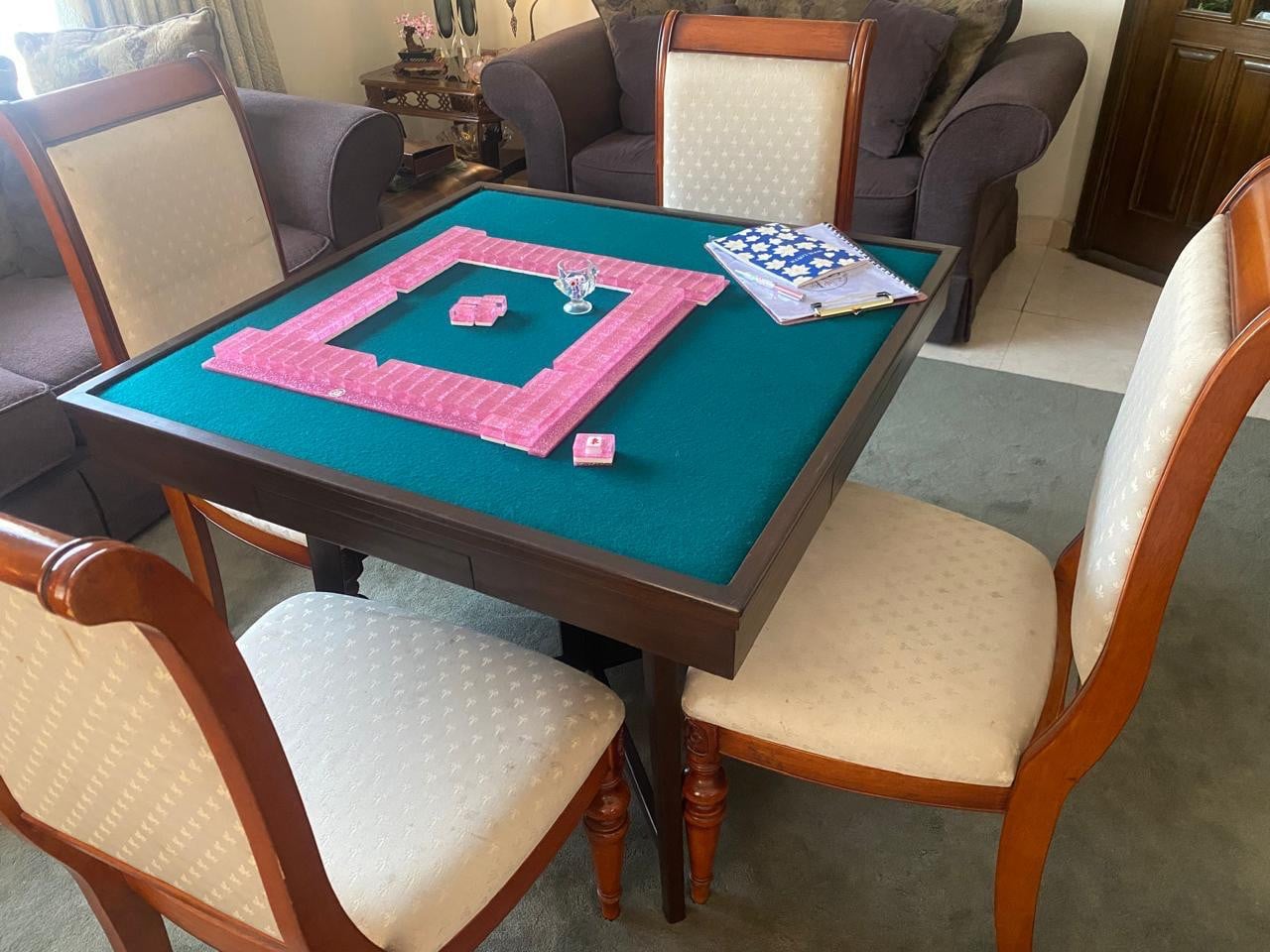
Unlike casual card games, mahjong demands tactical foresight, memory, and pattern recognition. Yet, unlike chess, it is not an agonisingly solitary calculation. The rhythm of the game naturally builds in pauses. Between rounds, as players wash the tiles—shuffling them face down across a felt-lined table—the mechanical task creates a natural breather. In those moments, intense competition pauses, giving way to casual conversation, tea drinking, and shared laughter.
For players like Anum Kamran, who took up the game recently, the physical ceremony of mahjong is a central part of its draw. “It’s such a departure from anything I’ve ever played or tried before, and the thought of concentrating on something for a few hours that wasn’t a screen was very tempting. I also loved the social element to it.”
While digital adaptations of mahjong exist on mobile apps, players insist that a screen cannot replicate the sensory experience of a live table. There is a distinct satisfaction in feeling the weight of the heavy resin tiles, the smooth cool surface under one's fingertips, and the crisp, resonant clatter as the pieces collide during the shuffle.
Beyond the sensory appeal, learning the game involves immersing oneself in a subtle cultural language. Players pick up foundational Mandarin terminology and cultural rituals—learning to recognise suit characters (Wan, Biao, Tiao), understanding tile arrangements, and mastering traditional calls like Chow (forming a sequence), Pung (forming a triplet), and Kong (a four-of-a-kind). Rituals governing table etiquette, such as seating positions relative to wind directions and tile distribution, add an element of ancient ceremony to the afternoon.
“I love the ceremony and tactile part that come with the game,” Anum notes. “There are some rituals that pertain to Chinese culture, and things like who joined the table last affect where you sit and what tiles you get. It’s also nice to feel the tiles as opposed to playing on an app.”
When asked if the game lives up to its intimidating reputation, Anum clarified: “The objective of the game is simple. It takes a little while to learn to read the rules and know the nuances and scoring.”
In the urban centres where organic opportunities to meet new people outside of school or work are increasingly rare, the four-player table layout became the cause for an accidental social bridge. As individuals signed up solo to learn the game, Madiha acted as a matchmaker, assembling complete four-person tables from individual registrants.
“I didn't realise I was also going to bring people together who might otherwise have never met,” Madiha reflects. “They came together simply because they all wanted to learn Mahjong. Some of those groups have gone on to become genuinely good friends. It's honestly so heart-warming to see the special bond they've created with each other.”
For the love of mahjong her students showed, Madiha began organising mixers at home where they could continue playing after they had graduated from her course.
“When I started hosting the mixers at home, it was mainly for practice purposes and to help guide my students to make them better at their game. I actually loved the idea of keeping them small and giving people that warm, homely feeling.” These gatherings quickly took on a domestic warmth. “My mom would make tea and snacks for everyone and I would just be there in the background watching people play with so much excitement,” Madiha recalls. “I created a special bond with everyone who came to my mixers. The classes were where I taught Mahjong but the mixers were where I really got to watch the community come alive.”
For the women participating, these weekly games have evolved into essential therapeutic spaces. “Learning and playing mahjong has been such a healing experience,” says Anum. “I learnt with a friend of mine and got introduced to two fabulous ladies. Now we play every Sunday and rotate hosting. It’s the best way to spend an afternoon without phones. We giggle, play, lightly roast each other, share our distresses within the safe comforting corners of the mahjong table. It’s the highlight of my week.”
Anum points out a poetic detail within the scoring terminology of the game itself. “As part of the scoring in mahjong, there are ‘brother’ and ‘sister’ sets,” she notes, referring to paired sequence tiles. “It’s a nice parallel, because through this experience I really found sisterhood.”
Through mahjong what is happening across drawing rooms and emerging clubs is less about importing an exotic trend and more about reclaiming an old habit. Pakistani urban life has long suffered from a shortage of spaces outside of home and work where people can gather without the pressure of commercial dining or the distraction of entertainment venues. In clicking resin tiles together over tea, players are reconstructing that missing social gap. Mahjong has simply provided the modern blueprint: a game intricate enough to keep the mind sharp, structured enough to hold focus, and tactile enough to keep our hands off our phones—if only for a few hours on a Sunday afternoon.
Original Source
https://tribune.com.pk/story/2632910/the-new-social-game