The saffron of sacrifice: Why Jauhar can't be understood without Chittor's Saka
The 13th-century heroic ballad Alha-Khand puts it with brutal simplicity: a dog may live twelve years, a jackal thirteen; an eighteen-year-old Kshatriya has lived long enough — to live beyond that without honour is a disgrace.
Such was the world of the old warrior ballads: life was not measured merely in years, but in what a Rajput man was willing to stake upon his honour. Death was not the opposite of courage. Sometimes, it was the price of it.
And nowhere does that terrible ideal burn more fiercely than at Chittor.
There are Holis remembered for colour. Chittor remembers one for blood.
On the night before Holi in 1568, while much of Hindustan prepared to welcome spring with fire, colour and celebration, the great fortress of Mewar prepared for death. The cannons had thundered against its walls for months; hunger had hollowed out its defenders; the mines beneath the fortifications had begun to tear open the ancient stone. Chittor was still standing, but everyone within its walls knew that the end had come.
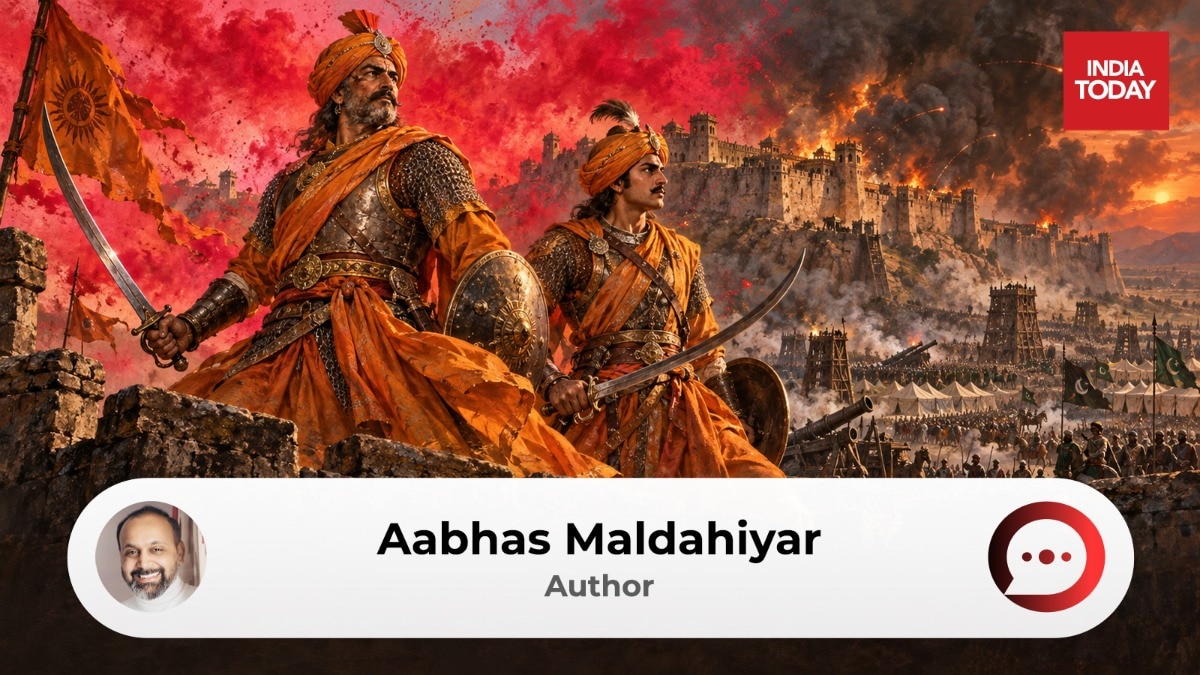
This was Saka: the final act of a Rajput fortress when defeat had become inevitable — Jauhar by the women, followed by the kesariya sortie of the men. After the women entered the flames, the warriors would take the ashes of their dead as tilak, place tulsi leaves in their mouths, don saffron and walk out through the gates for the final battle, knowing they would not return. The fire within the fortress and the sword beyond its gates were therefore not separate acts. Together they formed the last stand.
And Chittor was about to walk that road once again.
For months, the fortress had endured the army of the Timurid emperor Akbar. Cannon had battered its walls; mines had been driven beneath their foundations; assault after assault had crashed against the defenders. Hunger and exhaustion were doing what artillery could not. The walls remained, but the circle around them had tightened like a noose.
Then came the blow that told Chittor its final hour had arrived.
Jaimal Rathore, the commander who had become the backbone of the defence, was struck by a musket shot. Timurid accounts attributed the shot to Akbar himself, although the precise circumstances can no longer be established with certainty. For those inside Chittor, however, the question of who fired it mattered less than what followed.
The man who had held the defence together was gone, and with him went the last hope that the fortress might somehow survive.
That night, the women gathered around the fire. The men prepared their saffron.
History often reduces what followed to one word: Jauhar. But Jauhar did not stand alone. The women knew what dawn would bring. The men knew what was happening behind those walls before they rode through the gates. One would enter battle through Agni; the other would enter battle with a sword. One would disappear into the flames; the other would ride towards the sword.
And the calendar made that night almost unbearably cruel.
On the night when Holika was meant to be burnt, the women entered the flames before dawn. And when dawn broke, the men rode out to play with blood rather than gulal.THREE SIEGES THAT SET CHITTOR ABLAZE
But Chittor had walked this road before. The first great catastrophe came in 1303, when Alauddin Khalji of Delhi besieged Chittor. The Guhila ruler, Ratnasimha, resisted, but after prolonged resistance, the fortress fell.
From that siege emerged the name that would become inseparable from Chittor: Rani Padmini, or Padmavati.
Yet here, history and literature must be separated.
The most famous version of Padmini's story comes from Malik Muhammad Jayasi’s Padmavat, composed around 1540, more than two centuries after Alauddin's siege. Jayasi created a magnificent literary world: the princess of Sinhala, the talking parrot Hiraman, the Sultan's obsession, the mirror episode, Gora and Badal and the final Jauhar.
It is a great poem, but it is not a contemporary chronicle.
Amir Khusrau, Alauddin's court poet who accompanied the campaign, described the siege and capture of Chittor without mentioning Padmini. Later Rajasthani traditions preserved different memories of her, including traditions that place her in Pugal rather than the Sinhala of Jayasi's poem. Whether Jayasi transformed an older Rajasthani tradition into the geography and allegory of his epic cannot be established with certainty.
Yet, the hard historical core remains. Alauddin Khalji besieged Chittor in 1303 and Ratnasimha defended it. Yet the fortress fell and a powerful tradition of Saka became attached to its memory.
Chittor burned again in 1535. This time the enemy was Bahadur Shah of Gujarat.
Mewar had been weakened after the death of Rana Sanga, and Rani Karnavati governed as regent for her young sons. As Bahadur Shah's forces tightened around the fortress, the defenders once again faced the terrible meaning of defeat.
The women prepared for Jauhar and the warriors prepared for their final sortie (Kesari). The pattern had returned: when the walls could no longer guarantee protection, the women chose the fire and the men chose the sword.
But the third catastrophe would be the greatest with which this piece began.
By 1567, the power gathered outside Chittor was greater than anything the fortress had yet confronted.
Akbar had spent years extending the reach of his Timurid empire across northern India. Many Rajput rulers had accepted his authority, entered alliances with him or accommodated themselves to his expanding power.
Mewar under the Sisodias did not. Chittor had ceased to be merely a fortress and had become a statement of Swarajya.
So Akbar came for it.AKBAR'S LONG SIEGE TIGHTENS AROUND CHITTOR
Mewar's ruler, Maharana Udai Singh II, withdrew with the royal household, entrusting Chittor's defence to Jaimal Rathore, the Rathore chief of Merta, and Patta Sisodia, the young chieftain of Kelwa. For months, they held. But, artillery tore into the walls. Mines were driven beneath them. Breaches were repaired almost as quickly as they appeared. Assaults were repelled. Hunger gnawed at the defenders, exhaustion hollowed them out, yet the gates remained shut.
According to Timurid accounts, Akbar himself fired the shot.
Abu'l-Fazl records that fires appeared at several places within the fortress. To the besieging army, their meaning was unmistakable.
Abu'l-Fazl gives a figure of roughly 300 women, while later traditions remember queens, princesses, members of aristocratic households and children among those who rode the glory through fire. The precise numbers remain uncertain.
But numbers cannot tell us what that night meant.
These were mothers, daughters, wives and children who had spent months listening to cannon fire shake the stone around them. They had watched the men they loved leave for the walls each day, uncertain whether they would return. They knew that if Chittor fell, the walls that had protected them could become the walls of their prison.
And so they walked towards the fire.
Centuries later, we may argue over what Jauhar meant, debate its morality, or bend it to our politics, but no argument can soften the truth of what happened that night: women took their children into the flames, knowing they were walking to their deaths.
It was a choice born from a world in which defeat could mean captivity, enslavement, sexual violence, forced displacement or death. We must not pretend that the people inside that fortress possessed the choices available to us today.
They lived within the logic and violence of their own age, trapped behind walls while an invading Islamic army waited outside.FROM JAUHAR'S FLAMES TO THE KESARIYA SORTIE
Before dawn in Chittor, the women entered Agni.
Then the sun rose and the gates opened.
The men of Chittor were not prepared to lose everything they had been fighting to preserve. Their families were gone, their fortress was doomed, there was no retreat waiting beyond the gates and no future to purchase through surrender.
The ashes of their dead were taken upon their foreheads as tilak. Tulsi leaves were placed in their mouths, a sacred preparation for the journey they knew would end in death. Then they wrapped themselves in kesariya.
It was a declaration that they were going to attain Veeragati. Thousands of defenders came out for the final battle, with historical accounts placing the number of fighting men at around 8,000. Among them was Patta Sisodia.
They all knew that the surrender had ceased to be an acceptable future in their understanding of that moment.
Chittor had become a funeral pyre of stone, and the warriors were its final flames.
When the Timurid army finally entered the fortress, it did not enter the city that had existed before the siege. Those who remained were exposed to the violence of conquest. The figure traditionally associated with the slaughter is approximately 30,000.
But behind those gates there was no triumphant court waiting for the conqueror, no defeated king kneeling before him, no celebration worthy of victory.HOW HOLI CAME TO CARRY CHITTOR'S GRIEF
There was silence. Perhaps nowhere is the memory of Chittor more haunting than in its relationship with Holi.
The season that should have arrived with colour became entangled with memory. Traditions associated with Chittor include Rang Teras, observed thirteen days after Holi and locally connected with the memory of the third Saka.
A festival of joy and colour inherits blood and grief. Chittor's history became a chronology of three great catastrophes:1303: Alauddin Khalji, the first great fall, later surrounded by the enduring tradition of Padmini.1535: Bahadur Shah of Gujarat, Rani Karnavati and the second Jauhar.1568: Akbar, Jaimal, Patta, the final Jauhar and the final Saka.
Three sieges. Three fires. Three last stands. Three times Chittor was pushed towards annihilation.
And then there was Jaisalmer, to where the phrase Dhai Saka belongs.
The Bhati tradition remembers two complete Sakas and a third episode described as an ardha-Saka, or half-Saka. The third episode is traditionally placed around 1550, during the reign of Rawal Lunakaran, following the betrayal and attack of Amir Ali of Kandahar, whom Lunakaran had sheltered.
Lunakaran and his men fought, but unlike the complete Jauhar-Saka pattern, the women did not perform the customary Jauhar and the defenders ultimately survived.WHAT TODAY'S JAUHAR DEBATE OFTEN LEAVES OUT
Perhaps the easiest thing about Jauhar is to condemn it eight centuries later, from the safety of a democratic society, preferably with a freshly brewed coffee in hand.
Fire-consuming women and children was not a beautiful sight. A mother taking her child into the flames was not beautiful. A husband knowing his wife had entered the fire before he rode out to certain death was not beautiful.
The society that produced such a choice can — and should — be questioned. But judging people trapped inside a besieged fortress by the freedoms and protections of the twenty-first century is less moral courage than historical luxury.
They did not face an uncomfortable political transition. They faced captivity, enslavement, sexual violence, forced displacement and death.
So before you question Jauhar, question the world that made it conceivable.
And before passing judgement from the comfort of the present, ask the harder question: What kind of world leaves a woman choosing between the flames, and what waits beyond the gates?
That is the tragedy of Jauhar — not that history failed to give us an easy moral verdict, but that it gave those people no easy choices.
Perhaps this is also why the language of the goddess became so natural to the memory of Chittor.
The Rajput imagination did not conceive of Shakti merely as a gentle maternal force. She could be Durga, sword raised against the demon; Kali, standing beyond the fear of death; Chandi, ferocious and unyielding when destruction itself had to be confronted.
The woman facing the enemy through the fire; the warrior facing the enemy through steel. One final act within the walls, the other beyond them. In the imagination of generations that followed, the two became one memory: Durga in courage, Kali in death, Bhairava in the warrior who walked towards the battlefield without turning back.WHAT SURVIVES WHEN EVERYTHING BURNS?
Perhaps that is the question Chittor leaves behind — not whether Jauhar should be called glorious or condemned in a sentence, but what human beings do when war strips away every ordinary choice and leaves only terrible ones.
The women carried their families into the darkness of Agni; the men carried their memories through the gates. One entered the fire, the other the battlefield, and when the smoke cleared, Chittor stood broken, bloodied and conquered — but not forgotten.
That is why the story refuses to fade away.
Death is not beautiful. But there is something fierce in those who, when everything has been taken from them, refuse to surrender the last decision: how they will meet their end.
On the night of 22 February 1568, the women entered the flames. At dawn, the men took the ashes of their dead as tilak, placed tulsi leaves in their mouths, wrapped themselves in kesariya and rode towards certain death. They knew they would not return; their world had already ended behind them. Yet the final choice remained theirs.
That was the thunderous heart of Saka — not victory or survival, but defiance when both had become impossible.
And when the sun rose over Chittor that Holi morning, spring arrived as it always does. Flowers opened, colours flew, and the world moved on. But for Mewar, that spring carried a colour that Holi could never wash away.
The colour of fire. The colour of blood. The colour of sacrifice. Kesariya.
Chittor's walls fell. Its people were shattered. Its conqueror entered through its gates. But memory survived the ruin. Stones can be conquered; kingdoms can be erased. Memory builds fortresses of its own — and Chittor built what one no army could storm.
The fire became memory. The ashes became inheritance. The blood became colour. And kesariya became the colour of sacrifice.
(To read other articles by Aabhas Maldahiyar, click here)- Ends(Aabhas Maldahiyar is the author of Babur: The Quest for Hindustan. Views expressed in the piece are those of the author)Published By: Sushim MukulPublished On: Sep 14, 2026 08:30 IST