
The Takaichi Fallout: Tax cuts meet Japan's fiscal reality
By continuing to browse our site you agree to our use of cookies, revised Privacy Policy and Terms of Use. You can change your cookie settings through your browser.
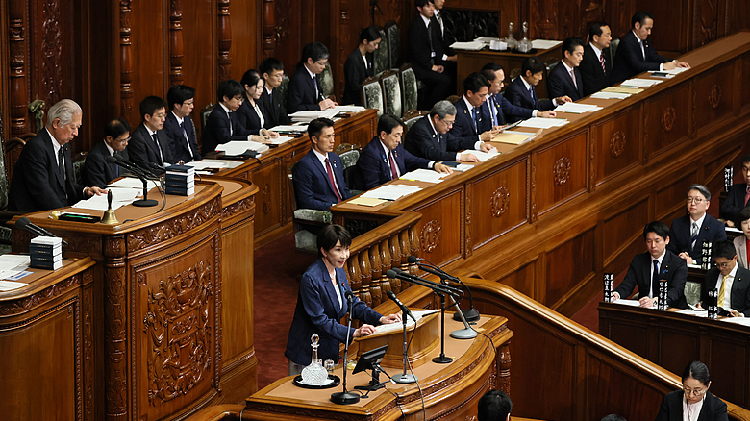
Japanese Prime Minister Sanae Takaichi delivers a policy speech in Tokyo, Japan, October 5, 2026. /VCG
Japanese Prime Minister Sanae Takaichi used her policy speech at the opening of the 222nd extraordinary Diet session on October 5 to press lawmakers to back her flagship bill to cut the consumption tax on food from 8% to 1% for two years, starting in April 2027. She framed the measure as relief for low- and middle-income households squeezed by rising prices.
The measure is expected to create a revenue gap of roughly 10 trillion yen ($63 billion) over the two years. While Takaichi insisted that she would not issue deficit-covering bonds to fund the cut and pledged to pursue a "responsible and proactive fiscal policy" that keeps annual bond issuance in check, she offered no convincing explanation of where the money would come from.
Zhang Yulai, deputy director of the Institute of Japanese Studies at Nankai University, called the tax cut a textbook case of populism. In Japanese politics, he argued, raising taxes costs votes, while cutting them boosts approval ratings. He said the bill was designed to shore up Takaichi's sagging support rather than genuinely ease the burden on households.
The public will ultimately have to pay for the fiscal shortfall, Zhang noted. The consumption tax is the most stable source of funding for Japan's pension and healthcare systems, and a two-year cut would create a hole in social security financing at a time when funds are already stretched thin. The temporary nature of the cut also risks causing chaos in retail settlement systems, while restoring the rate after two years would be a formidable political challenge. Short-term electoral dividends could therefore translate into long-term economic costs.
The contradictions in Takaichi's fiscal stance are stark. Her government approved a 21.3-trillion-yen ($135 billion) stimulus package last November—Japan's largest in five years—and, according to the Financial Times, is pursuing a 14-year public-private investment plan worth 370 trillion yen ($2.3 trillion) across 17 priority sectors, including semiconductors, artificial intelligence and quantum computing.
Meanwhile, the "Takaichi cost" is emerging against an already precarious fiscal backdrop: Japan's government debt has ballooned from 63% of GDP in 1991 to more than 220% today, while debt-servicing costs in the 2026 fiscal budget have surpassed 31 trillion yen ($197 billion)—more than a quarter of total spending.
Markets have repeatedly signaled their unease, with yields on super-long government bonds spiking to record levels earlier this year amid fiscal concerns. Investors are now watching the draft fiscal 2027 budget—due by year-end—for any funding gap that could force additional bond issuance, pushing long-term yields higher and the yen lower. Takaichi's promise of tax cuts without new debt sits uneasily alongside one of the most expansionary spending agendas in Japan’s postwar history—a contradiction that campaign-style sweeteners may obscure but cannot be erased.


