The tragedy of a runner: reclaiming public spaces from fear - IOL
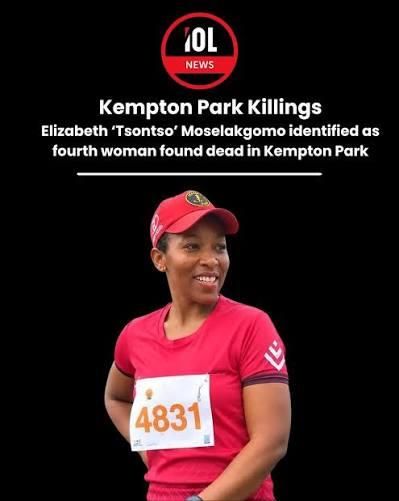
The tragic loss of a runner forces us to confront unsettling truths about public safety in South Africa. As fears infiltrate our routine runs, we must ask: Is safety merely an individual responsibility or a societal obligation?
There is something deeply unsettling about hearing that a top runner has been killed while doing something as ordinary, innocent, and profoundly human as going for a run.
Behind the headline and the inevitable expressions of shock and grief is a person who, only moments earlier, was doing something millions of people do without imagining that putting on a pair of running shoes and stepping onto a public road could become a final act.
For those of us who run, the story lands differently, because we understand what running can represent. We understand the familiarity of a route, the rhythm of breathing and footsteps, the gradual quieting of the mind, and that strange freedom that comes from being alone with your thoughts while your body simply moves forward. We understand that a run is often not just exercise, but therapy, discipline, solitude, community and, sometimes, the one part of the day in which the noise of everything else temporarily disappears.
And then, when a top runner loses her life, you begin to think about yourself.
I know that feeling. I remember having my running shoes with me and, whenever there was a break, deciding almost instinctively that I would use the time to run, because there was something beautifully uncomplicated about being able to put on your shoes and go, without first conducting a security assessment of the route, calculating the possibility of being attacked, or wondering whether the very thing that gave you freedom could make you vulnerable.
I was struck by a line that came into my mind while reflecting on the death of another runner: "I stop trusting my own voice, just to keep peace, let me question what I feel."
Perhaps that is what fear does to us. It does not always arrive dramatically; sometimes it enters quietly, changing the conversation inside our own heads until things we once did naturally begin to require negotiation.
Maybe I should not run today. Maybe that route is too isolated. Maybe I should wait for someone else. Maybe I should leave my phone behind. Maybe I should not wear my running watch. Maybe I should drive somewhere safer. Maybe I should just use a treadmill.
And slowly, almost imperceptibly, something that once belonged to us begins to belong to fear.
That is what troubles me most. In South Africa, the road increasingly carries another meaning — it can be a place where a reckless driver changes a life in seconds, where a criminal sees opportunity rather than a human being, or where a runner carrying a phone or wearing an expensive watch becomes a target.
Whenever another tragedy occurs, we hear the same advice: be vigilant, run in groups, avoid isolated areas, do not run with headphones, leave valuables at home, share your location, and choose safer routes. All of this is sensible. But there is a question we rarely ask.
Vigilant until when? Avoid certain roads, but until when? Run only in groups, but until when? Change your behaviour, but until when?
At what point does personal vigilance stop being a reasonable precaution and become society's quiet acceptance that public spaces are no longer safe?
That is the question we should be asking, because the runner cannot solve violent crime by changing the time of day she exercises, the cyclist cannot solve reckless driving by disappearing from the road, the pedestrian cannot solve criminality by never walking alone, and the woman who wants to run cannot reasonably be expected to surrender her freedom of movement because someone else has decided that public space belongs to them.
This matters because we have become remarkably good at individualising public safety. When something goes wrong, we immediately ask what the individual could have done differently.
Why were they running there? Why were they alone? Why did they have a phone? Why were they wearing that watch? Why did they choose that route?
These questions may sound practical, but they can quietly shift responsibility from the person who committed the crime toward the person who was simply exercising their right to exist in public.
Personal responsibility matters. Vigilance matters. Good judgement matters. But personal responsibility cannot become a substitute for institutional accountability. A society cannot claim that its public spaces are safe simply because some citizens have become sufficiently skilled at avoiding the unsafe ones.
Those who can afford it can join gyms, move into gated estates, hire private security, drive instead of walk, and exercise in controlled environments. But private adaptation is not public safety. Safety should not become a luxury product.
The young runner training for a first 10km, the mother running before work, the pensioner walking through the neighbourhood, and the professional athlete preparing for a major race all have the same fundamental claim to public space. They should not have to purchase that right.
This is where the death of a top runner becomes bigger than the individual tragedy, because it forces us to ask what kind of society we are constructing, and whether we are gradually normalising a condition in which ordinary citizens are expected to organise their lives around the possibility of violence.
Who owns the road? Who owns the pavement? Who owns the park? Who has the right to move through a neighbourhood without constantly calculating the possibility of violence? And, most importantly, who carries the responsibility for making those spaces safe?
Safe public space is not created by police vehicles alone. It is created through functioning institutions, credible law enforcement, properly maintained and adequately lit streets, effective traffic enforcement, consequences for reckless behaviour, responsive municipalities, and communities that refuse to surrender their public spaces.
When citizens withdraw because they are afraid, something larger than individual freedom is lost, because the road becomes quieter, the park becomes emptier, communities become less visible, and those who create fear gain greater control over the spaces from which ordinary citizens retreat.
That is why the death of a top runner should not disappear into the familiar cycle of outrage, condolences and silence. Condolences are necessary, but condolences are not public policy. Vigilance is necessary, but vigilance is not a policing strategy. Personal responsibility is necessary, but personal responsibility is not institutional accountability.
Perhaps we are becoming too good at adapting to failure. We change our running routes, share our locations, avoid certain streets, wait for daylight, run in groups, and learn which places are dangerous, and then congratulate ourselves for becoming better at managing risk, when perhaps the more uncomfortable question is why surviving public space requires so much private preparation in the first place.
Crime does not only take possessions and lives; it takes spontaneity, certainty and the ordinary confidence with which people once moved through their communities — changing the psychological geography of a city until a road that represented freedom becomes a route requiring calculation, and a morning run that represented peace becomes an exercise in risk assessment.
We should resist the idea that this is simply the price of living in South Africa. It may be a reality, but reality is not the same as inevitability. The fact that something has become common does not make it acceptable, and the fact that citizens have learned how to survive does not mean institutions have succeeded in keeping them safe.
So where do runners go? Do we move permanently indoors, run only on treadmills, stop exploring our own neighbourhoods, and teach another generation that the road is dangerous and that freedom must always be negotiated? Or do we insist that something has gone fundamentally wrong when ordinary citizens cannot safely do ordinary things?
I do not have an easy answer. But I know what I do not want. I do not want another generation of runners to inherit fear as part of the running kit. Shoes. Water. Watch. Phone. And fear.
I keep returning to that line: "I stop trusting my own voice, just to keep peace, let me question what I feel." Perhaps the question is not whether we should stop trusting our instincts, but why our instincts have become so fearful in the first place.
There was a time when putting on your running shoes meant one thing. You were going for a run. It should still mean that.
Not because South Africa is risk-free, and not because vigilance is unnecessary, but because freedom should mean more than having the legal right to do something. It should mean having a reasonable expectation that you can exercise that right without fear becoming the price of admission.
That is the freedom we should be fighting to recover. Not the freedom to run without thinking. The freedom to run without being afraid.
Nyaniso Qwesha (MBA) is a governance, risk and business professional, author and public commentator.