
The True Story Behind 'Unabomber'
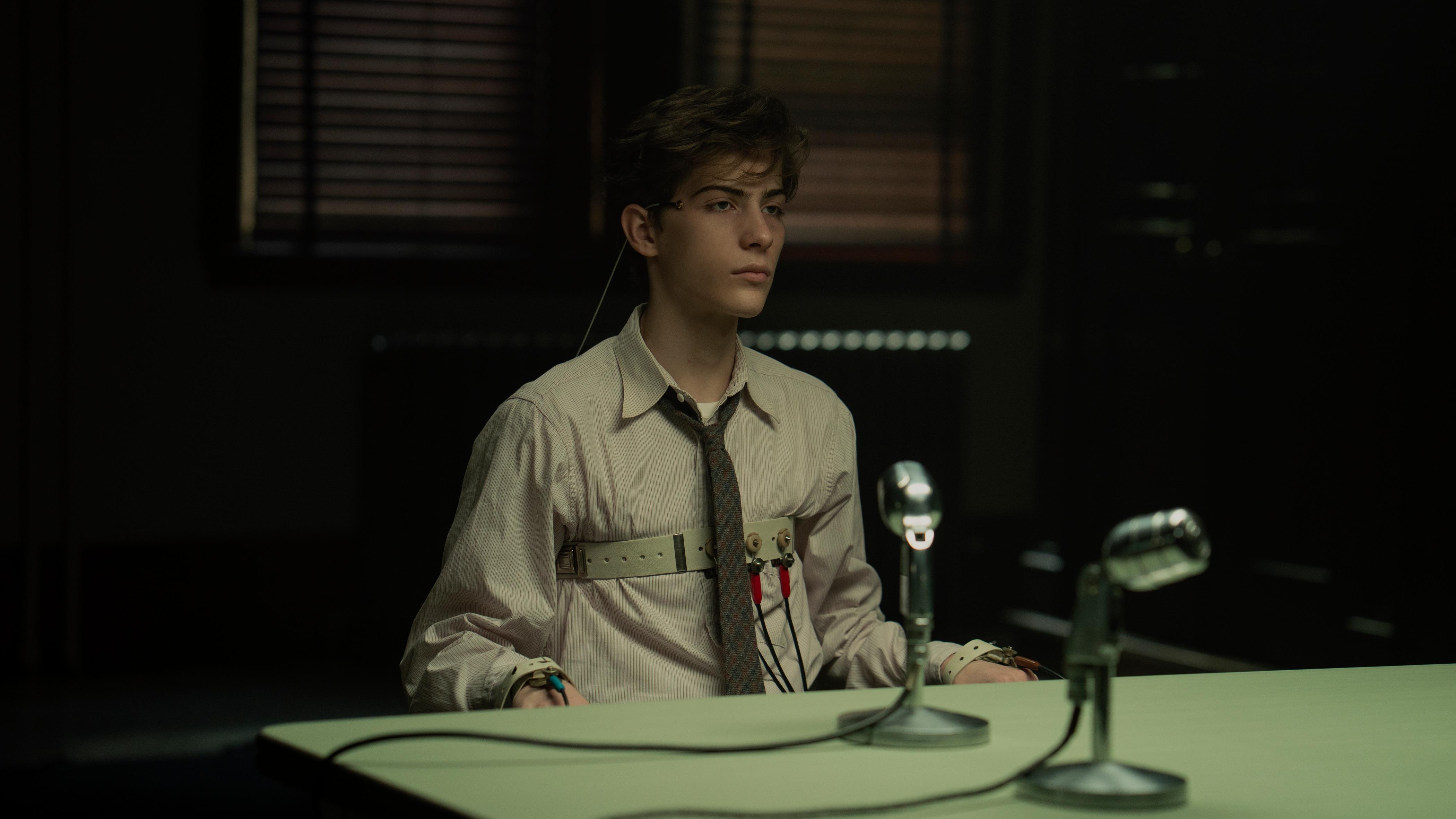
Ted Kaczynski was 16 when he entered Harvard University as a mathematics prodigy. Years later, he would become known as the Unabomber, after carrying out a bombing campaign that killed three people and injured 23 others between 1978 and 1995.
Netflix’s Unabomber directed by Janus Metz, explores Kaczynski’s life before and during the events that led to his capture. Jacob Tremblay plays the younger Kaczynski, while Russell Crowe portrays Harvard professor Henry Murray, Shailene Woodley plays FBI agent Joanne Miller and Annabelle Wallis portrays Christiana Morgan, Murray’s academic collaborator.
“We decided to explore Ted Kaczynski's time at Harvard, as it stood out as a formative and fragile period in his life,” Metz tells TIME. “We wanted to understand who this young man was up until he began his descent into a darker and deadlier path.”
Born in Chicago in 1942, Kaczynski demonstrated exceptional mathematical ability from an early age. He entered Harvard at 16 before continuing his studies at the University of Michigan, where he earned a master’s degree and a doctorate in mathematics.
At 25, he became a professor at the University of California, Berkeley. But he left the university in 1969 and eventually moved to a remote cabin near Lincoln, Mont., where he lived without electricity or running water.
Kaczynski became increasingly isolated from society. He spent much of his time reading, hunting and growing plants, while developing increasingly strong opposition to modern technology and industrial society.
In 1978, Kaczynski began the bombing campaign that would eventually span nearly two decades. His first known attack involved a homemade device mailed to a professor at Northwestern University. It exploded when opened by a campus security officer, causing minor injuries. In November 1979, Kaczynski placed a device aboard an American Airlines flight, causing smoke inhalation injuries and forcing the plane to make an emergency landing.
Over the years, his targets included universities, airlines and people he associated with technology and the modern industrial system.
The FBI used the case identifier UNABOM, short for “University and Airline Bombing,” before Kaczynski’s identity was known. The media later used it to name him the “Unabomber.” Between 1978 and 1995, 16 attacks were linked to the case, killing Hugh Scrutton, Thomas Mosser and Gilbert Murray and injuring 23 people.
Kaczynski’s identity remained a mystery for years. That changed in 1995, when he sent a lengthy manifesto titled “Industrial Society and Its Future” to The Washington Post and The New York Times and demanded that it be published. The approximately 35,000-word text laid out his opposition to modern technological society and explored ideas about human freedom, autonomy, and the effects of industrialization.
The FBI supported the decision to publish the manifesto in the hope that someone familiar with Kaczynski’s writing would recognize it. That person turned out to be his brother David’s wife, Linda Patrik.
After reading the manifesto, Patrik noticed similarities between its ideas and the writing she had previously seen from Kaczynski. She brought her concerns to David, who initially struggled to believe that his brother could be responsible for the attacks.
David eventually examined the manifesto alongside an essay Kaczynski had written years earlier. The similarities in their language and ideas were striking enough for him to contact the FBI.
The material gave investigators a crucial lead. After years of attacks and an extensive investigation, Kaczynski was now directly connected to the manifesto and the writings that could help identify him as the person behind the Unabomber case.
On April 3, 1996, nearly two decades after the first attack, federal agents surrounded Kaczynski’s remote cabin near Lincoln, Mont., and arrested him.
The search of the property gave investigators a trove of evidence. Inside, they found bomb-making materials, a typewriter, coded diary entries and approximately 40,000 pages of handwritten notes, along with a completed bomb.
Kaczynski later pleaded guilty and was sentenced to life in prison without parole. He remained incarcerated until his death in 2023 at age 81.
While in prison, Kaczynski was diagnosed with paranoid schizophrenia by a psychiatrist who interviewed him. He rejected the idea that he was mentally incapable of understanding his actions. In a 1999 interview with TIME, he said he was certain he was sane.
While at Harvard, Kaczynski took part in psychological experiments overseen by professor Henry Murray. Murray worked with Christiana Morgan at the Harvard Psychological Clinic, where they developed the Thematic Apperception Test, or TAT.
“Christiana was the co-creator of the Harvard school of psychology where the tests on Ted Kaczynski took place,” says Wallis, who plays Morgan in the movie. “Murray and Morgan were collaborators at the time and together devised the highly controversial stress tests used on Harvard students. I was fascinated to learn about the extent of her involvement.”
The experiments involved students writing about their beliefs before undergoing intense psychological sessions. They later became an important part of discussions about Kaczynski’s life, although their precise impact on him remains uncertain.
The full Harvard file on Kaczynski remains classified, making it impossible to know exactly what Murray concluded from the experiments.
“I don't think the Murray experiments in themselves turned Ted Kaczynski into the Unabomber,” says Metz. “There are many factors in Ted Kaczynski's life that contributed to his evolution.”
However, Metz says the experiments were designed to break down participants who knew very little about what they were being subjected to, and that the filmmakers wanted to show them as “likely a piece of the puzzle.”
Metz also points to Kaczynski’s own writings as another part of the story.
“We also know from Ted Kaczynski's own journals that he wanted revenge from feeling disrespected and rejected, which these experiments could have contributed to,” he says.
According to Metz, Kaczynski himself later claimed that the experiments had not had a significant effect on him.
For Tremblay, one of the challenges of playing Kaczynski was the lack of detailed information about his early life.
“While there is plenty of information to go off of from Ted's adult life, it was challenging to find material regarding his early life when I played him,” Tremblay says. “I was left with a rather blank canvas in terms of how much freedom I would have with the character.”
Tremblay listened to recordings of Kaczynski’s interrogation after his arrest to study his speech patterns and watched footage of him as an adult, noting his stiff posture. I then put my own youthful, nervous and softer spin on that,” Tremblay says.
The psychological experiment scenes presented a different challenge. Tremblay was strapped to a chair, limiting his movement and expressions. “I learned to utilize that unfamiliar and uncomfortable environment to my advantage,” Tremblay says. “Because Ted himself in that moment is also experiencing that discomfort and unfamiliarity at the same time.”
Unabomber is grounded in documented events from Kaczynski’s life, but the film also takes creative liberties with gaps in the historical record.
“But that was fun for the filmmakers and us actors as we got to create something unique from the story we pieced together and that excited me because it distinguishes our film from other tellings of the Unabomber's story,” Tremblay says.
For Metz, the film was also an opportunity to explore parts of Kaczynski’s story that are less familiar to audiences.
“In developing the film, we found that the psychological experiments conducted on Ted Kaczynski during his time at Harvard were unknown to most people, some were not even aware he attended Harvard,” Metz says. “While our film doesn't offer a complete biography, we chose to present a filmic take on his story and a narrative opening into the mind of Ted Kaczynski."
