They pass through human body without a trace: Discovery that won Physics Nobel
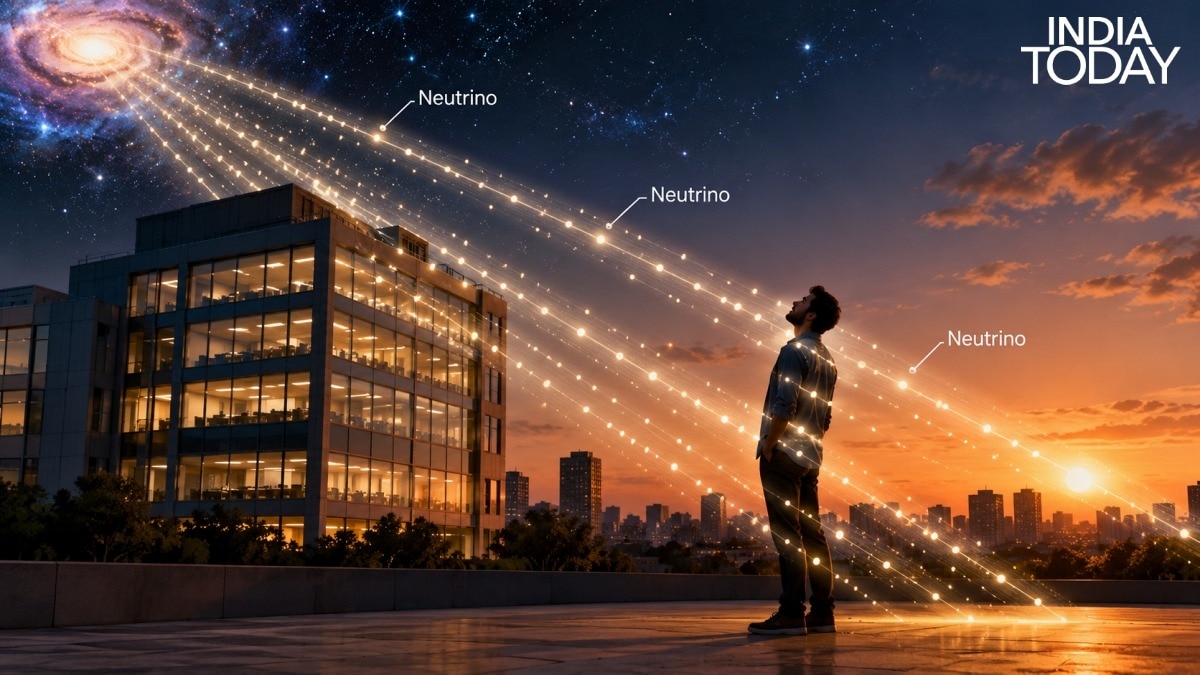
Imagine billions of particles passing through your body every second, and you don't feel a thing. They pass through buildings, mountains and even the entire Earth almost as if nothing is there.
These are neutrinos, and their ghost-like ability to travel through matter is exactly what makes them so valuable to scientists.
The 2026 Nobel Prize in Physics has been awarded to Francis Halzen of the University of Wisconsin–Madison for his decisive contributions to the IceCube Neutrino Observatory and the discovery of high-energy neutrinos originating from violent processes in the universe.BREAKING NEWS The Royal Swedish Academy of Sciences has decided to award the 2026 #NobelPrize in Physics to Francis Halzen “for decisive contributions to the IceCube Neutrino Observatory and the discovery of high-energy neutrinos of astrophysical origin.” https://t.co/UcPBWk0RiK— The Nobel Prize (@NobelPrize) October 6, 2026advertisement❮❯ Read Full StoryWHAT ARE NEUTRINOS?Neutrinos are tiny particles produced in some of the most powerful and violent events in the universe.
They are created by the Sun, exploding stars and other extremely energetic cosmic events. But unlike light, which can be blocked, scattered or absorbed, neutrinos can travel enormous distances almost untouched.
That makes them something like cosmic messengers.WHY ARE NEUTRINOS SO DIFFICULT TO CATCH?
Neutrinos rarely interact with ordinary matter. Imagine throwing a ball through a forest and having it pass between every tree without hitting anything. That is roughly how neutrinos behave when travelling through matter.
Billions pass through you every second, but almost all continue straight through without interacting with a single atom. Very occasionally, however, a neutrino crashes into an atom. When that happens, it can produce a tiny flash of light. Neutrinos come from the most violent events in the universe. Scientists can detect that flash, if they have a detector large enough.
And that is where Francis Halzen, the 2026 Nobel Prize in Physics awardee, comes in.A DETECTOR BURIED IN ANTARCTIC ICE
The 2026 Nobel Prize in Physics was awarded to Halzen for his decisive contributions to the IceCube Neutrino Observatory and the discovery of high-energy neutrinos from outside our Solar System.
Halzen had proposed an extraordinary idea: use the enormous amount of clear ice beneath the South Pole as a giant particle detector. A neutrino detector is being lowered beneath the Antarctic Ice. (Photo: IceCube/NSF)
Instead of building a huge machine above ground, scientists could place thousands of light sensors deep inside the Antarctic ice. If a high-energy neutrino happened to collide with an atom in the ice, the resulting flash could be picked up by the sensors.
IceCube eventually occupied about one cubic kilometre of Antarctic ice and was completed in 2011.WHY DOES THIS MATTER?
The universe contains objects capable of producing energies far beyond anything humans can create on Earth. But scientists still don't fully understand where these cosmic particle accelerators are or how they work.
High-energy neutrinos can provide clues. Teams inspecting a neutrino detector at the IceCube Observatory. (Photo: NSF)
Because they travel in almost straight lines, scientists can trace them back towards their cosmic sources. They can therefore reveal information about violent regions of the universe that may be difficult or impossible to study using ordinary light.
The first high-energy neutrinos detected by IceCube opened the door to a new form of astronomy: studying the universe through particles rather than light.
And this is why neutrinos matter. They may be almost invisible, but they can carry information from some of the most violent places in the cosmos, across billions of kilometres, through planets and galaxies, and eventually into a block of ice at the bottom of the world.- Ends
Sibu Tripathi heads the Science team at India Today Digital. A space geek, he writes on Science, Environment, and Health. He is a recipient of the prestigious Ramnath Goenka Excellence in Journalism award and a two-time winner of the WAN-IFRA Digital Media Awards. He has previously covered the Delhi government and written extensively on politics and city governance. Apart from travelling, he likes to cook when he has time and explore new genres of books and films.