This Ontario hospital locked Jake Gordon up alone for five years. It transferred him just after the Star told his story - Toronto Star
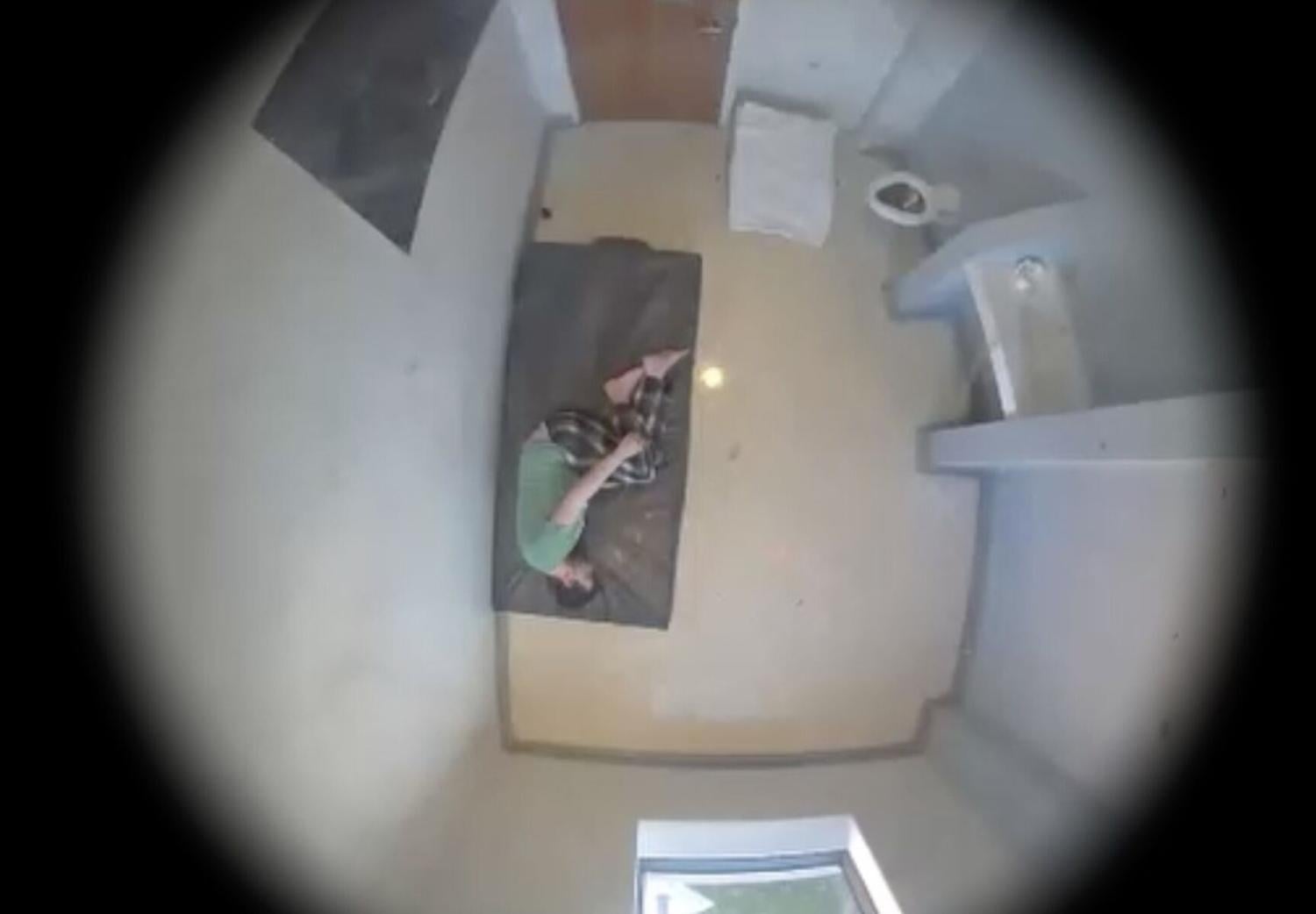
Jake Gordon has been transferred closer to family just weeks after the Star published footage of his life kept locked in isolation at Waypoint Centre.
This story is part of 20 Years in Isolation, the Star’s ongoing investigation into the use of psychiatric seclusion at Waypoint Centre for Mental Health Care. The Star’s reporting has been met with calls for an independent review of Ontario’s mental health system.
Diane Worden was happy but in shock when she got a call a few weeks ago from Waypoint Centre for Mental Health Care about her son, Jake Gordon.
After more than five years detained in Ontario’s only maximum-security psychiatric hospital in Penetanguishene — almost entirely spent locked in isolation in his room — the 31-year-old man with treatment-resistant schizophrenia was being transferred immediately to a less secure hospital just a 15-minute drive from the family home.
The move to Ontario Shores Centre for Mental Health Sciences in Whitby came just a month after a Star profile on Gordon’s case, featuring six-and-a-half hours of video surveillance footage provided by Worden showing her son pacing alone while in seclusion in his tiny room at Waypoint last year. Worden had requested the video from Waypoint in the hopes of finding out how her son was able to cause a serious injury to his eye, but the incident was not captured in the footage.
At the time of his transfer, Gordon had been out of seclusion for just over two months, having been released amid the Star’s ongoing investigation into Waypoint’s use of the practice.
“It’s shocking how fast they made this happen,” Worden said.
Jake with his mother, Diane Worden.
Seclusion is meant to be the option of last resort, to be used for as brief a time as possible, to deal with a patient who poses an imminent risk of bodily harm to themselves or others. The Star’s investigation has revealed that Waypoint has been keeping seriously mentally ill patients in seclusion for years, and in the case of Camelott Hamblett, 20 years and counting. An independent assessment concluded in August that Waypoint is holding patients in conditions the United Nations has “deemed to constitute torture” in similar settings.
Medication alone had failed to improve her son’s condition, Worden noted, as he had a poor response to many different drugs. But on the heels of the Star’s coverage this spring, Worden said her son started spending an increasing amount of time out of seclusion and out of restraints; he was being taken to the canteen and into the courtyard; he was seen by a dentist and an optometrist; he was being given access to music more often; and he was showering again.
He then improved to the point that he was released from seclusion in August, and is now well enough that he can be managed in a less secure facility.
She said Gordon — who had trouble walking and talking and would drool when Worden visited him at Waypoint — is doing significantly better. On a recent visit to Ontario Shores, Worden noted that he’s communicative and “very happy” to be there.
“He talked about the hope of getting out one day, getting a job, a nice place to live and seeing his family more often now that he is closer to home,” she said.
Everything that has happened for her son in such a short period of time is no coincidence, Worden said. She attributed the increased focus on her son's care this year to the Star’s investigation, the multiple experts who have come forward with their concerns, and the work of Gordon’s new lawyer, Anita Szigeti, who specializes in mental health law and represents a number of other men in seclusion at Waypoint.
“It’s 100 per cent because of the public scrutiny,” Worden said. “You don’t go from five-and-a-half years in seclusion to all of a sudden you’re out and making cupcakes and two months later you’re being transferred to Ontario Shores.”
For years, Worden made the drive to Waypoint — about five hours round trip — to visit her son as much as she could, when he would be permitted to briefly leave his room. While she did have her concerns about his care and would voice them to the hospital, she said she ultimately trusted that they were doing the right thing for Gordon.
The exterior of Waypoint Centre for Mental Health Care.
Worden, who also serves as her son’s substitute decision-maker, worries about the damage that five years in isolation will have caused. She also continues to question whether seclusion for such a lengthy period of time was even necessary, pointing to Gordon’s voluminous medical records, which she said do not indicate risk or aggression from Gordon on a daily basis that would warrant him remaining locked up.
“They always told me it was because he was a harm to himself or to others,” she said. “Well, where is the harm?”
It was only when she came across the initial stories from the Star’s investigation in the spring, profiling the cases of Hamblett and other patients who’ve been kept in locked seclusion at Waypoint, that she became alarmed.
“Obviously that trust was misguided,” she said.
Unlike most of the other men in long-term seclusion at Waypoint, Gordon was not a forensic patient, meaning he hadn’t committed any crime. Rather, he was a civil patient, involuntarily detained under the Mental Health Act because he’s been found to pose a serious risk of bodily harm to himself and others.
Worden is under no illusions: she does believe her son should remain in a hospital. But his case calls into question the independent oversight of the detention of civil patients, and whether there was a missed opportunity to get Gordon out of seclusion sooner.
The Consent and Capacity Board (CCB) — whose three-member panels are made up of a medical professional, lawyer and layperson — is required to hold a review of a civil patient’s case after six months, and then every year afterward, to determine whether their involuntary status should be upheld; the patient can also ask for orders such as a transfer to another facility.
It’s unknown whether the board was ever presented with any evidence about Gordon’s seclusion status and whether any panel members expressed concern. That’s because while the board must provide its decision within a day of the hearing, it isn’t required under Ontario law to produce written reasons for that decision unless one of the parties — Gordon, his psychiatrist and the hospital — asks for them within 30 days of the hearing. No one ever did.
That’s in stark contrast to the Ontario Review Board, the independent body with oversight of forensic patients, which is required to produce written reasons after every hearing.
The chair of the CCB, Philip Squire, said in an email the board’s practices accord with the legislation: “The CCB is unable to comment on the practices of other administrative tribunals or their governing legislation.”
Gordon was represented by five different lawyers at six CCB hearings; it’s unclear how they came on board, though one possibility is they were arranged by legal aid after an order from the board.
When Szigeti was contacted by Gordon’s family and recently retained to be his lawyer, she found it “shocking and really disconcerting” that there were no records she could access to determine if his seclusion had been reviewed by the CCB. Notwithstanding what the law says, Szigeti has long been raising the need for the CCB to adopt a policy requiring the board to always produce written reasons for the mandatory hearings reviewing an individual’s involuntary status.
“There has to be some documentation somewhere as to what is happening with someone who is locked in a facility, and in this case locked in seclusion for more than five years,” Szigeti said.
“What is the purpose of having an oversight body tasked with mandatory hearings when there’s no record of what they did and why?”
Worden never went to her son’s hearings, which are held on Zoom, because she says his Waypoint social workers told her it was just to decide whether his involuntary status should be upheld — something she wasn’t looking to challenge anyway. She had no idea that the board would have had the power to transfer her son out of Waypoint.
She can’t help but think of other families who still don’t know.
“There are all these patients like Jake who are locked in there, and nobody can do anything about it because we don’t know the system,” Worden said. “They lock us out.”
The campus of the Ontario Shores Centre for Mental Health Sciences in Whitby.
Now that Gordon is back at Ontario Shores, his mother will be able to visit him daily. When he was at Waypoint, months would pass by before she could see him because she wasn’t comfortable driving the long distance in winter weather.
And for the first time in over five years, Gordon will be able to see his father, who has multiple sclerosis and is mostly bedridden. Given the proximity of Ontario Shores, Worden plans to find a way to transport her husband there to see their son.
“The hardest part of having him at Waypoint was either his dad would pass away or something bad would happen to Jake, and he would never be able to see his dad again,” Worden said. “Jake is always worried about him. The first thing he always says is: ‘How is Dad?’”
While seclusion is used for various lengths of time in practically all hospitals, including Ontario Shores, none have been known to keep patients locked up for years like Waypoint. At Ontario Shores, Gordon’s room has a big window with a view of Lake Ontario, as well as a bed with a pillow and blankets; at Waypoint, as seen on the surveillance footage, he only had a mat on the floor.
Overall, Worden is still taken aback by just how much progress has been made since her son was released from isolation, and she hopes to see that progress continue.
“He’s lost weight, he’s talkative, he’s smiling,” she said. “He’s just the old Jake that was there before he went to Waypoint.”
Jacques Gallant is a Toronto-based reporter covering courts, justice and legal affairs for the Star. Reach him by email at jgallant@thestar.ca or follow him on Twitter: @JacquesGallant