This Toronto directing duo’s wickedly funny TIFF short recalls the Safdie brothers’ work - Toronto Star
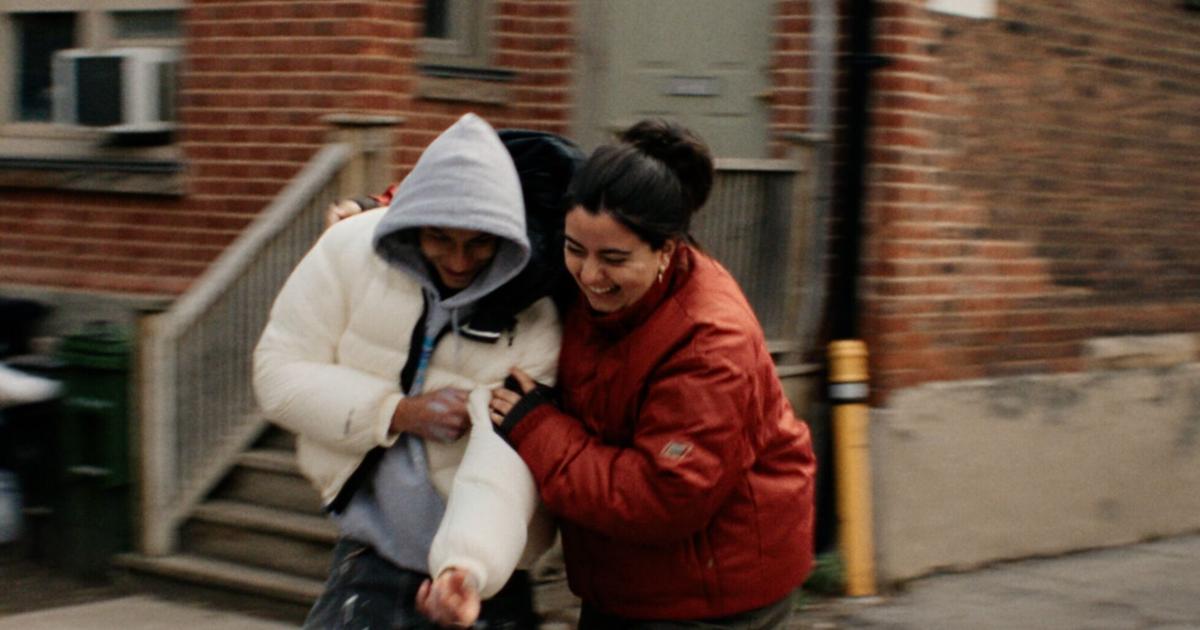
Mick Robertson and Margaret Rose's percussively paced 'BID16' unfolds as a vivid illustration of Murphy’s law.
“BID16,” starring Christopher Rivera and Annie Lujá, screens in the TIFF Short Cuts program.
Mick Robertson and Margaret Rose’s new short film, “BID16,” which premieres Sept. 13 at the Toronto International Film Festival, begins with a scene straight out of a thriller: two would-be thieves try to power-saw their way into a storage unit. They aren’t exactly professionals, as evidenced by the YouTube explainer video on lock-cutting that’s streaming on their phones. They’re also not exactly thieves, given that the contents already belong to them.
“I can’t lose all my stuff,” pleads Carmen (Annie Luján), who’s several months delinquent on the rental fee and who has enlisted her younger brother Anthony (Christopher Rivera) as a partner in what she believes to be a victimless crime. Carmen’s attempt to reclaim her belongings before they’re put up for auction is reckless, desperate and ill-fated, and catalyzes a swift downward spiral.
TIFF’s Short Cuts program has historically been an incubator for exciting young Canadian filmmakers, and Robertson and Rose’s percussively paced 11-minute film unfolds as a vivid illustration of Murphy’s law that combines empathy for its put-upon protagonist with a wicked sense of humour.
“It began with the idea of a delinquent storage locker and evolved, through collective creation, into a story about an anti-hero whose world view is shaped by living outside conventional ideas of success,” Robertson told the Star. “We became very interested in the idea of irreverence as a coping mechanism for societal and systemic pressure.”
“We developed (Carmen) with Annie Luján,” Rose added. “Her training is in theatre (as is ours) and as a clown, so we were certainly inspired by the physicality and humour Annie brings to the work. She would always challenge us to find the ‘game’ of the scene, to elaborate and discover the fun in any and all ideas.”
That playfulness accounts for “BID16”’s unexpected — and wonderfully effective — slapstick digressions, including a bit of business involving a ballpoint pen that explodes (literally) into a kind of existential sight gag. It’s a fine line between cruelty and empathy, and the filmmakers navigate the tightrope with aplomb.
“We were playing around with the comedic arc of a person feeling emboldened by anger, followed by genuine and thorough humiliation,” Rose added. “There is particular humour and sadness in the negotiation of these feelings, which appeals to us.”
By juxtaposing hard-edged, hard-luck realism against an expressionistic soundscape, “BID16” can’t help but evoke the work of the Safdie brothers, minus the self-conscious shock value. It’s less a story of self-destruction than of helplessness.
“Carmen finds many of society’s rules and norms absurd and, feeling that they work against her rather than for her, rebels against them,” Robertson said. “This rebellion masks a deeper frustration about the lack of ownership she feels in her own life … The storage locker becomes a contained dramatic space in which to explore those ideas of precarity, agency and futility.
“BID16” is Rose and Robertson’s second short film, following 2024’s similarly accomplished “Every Other Weekend,” about a single mother preparing for a date. Its seamless fusion of character study and social commentary suggests a fortunate and formidable meeting of directorial talents.
“Neither of us have any formal training in filmmaking,” Rose explained. “I went to theatre school to study acting, which was really my main focus. I was always quite intrigued by directing, but just never really pursued it in school. Writing was always something I was intimidated by.”
Mick Robertson and Margaret Rose directed “BID16,” their second short film.
Like Rose, Robertson came to filmmaking through acting. “I was never set on becoming a director; one thing led to another organically,” she said. “In my late teens and early 20s my focus was acting and playwriting. In my last year at university, I was given the opportunity to make a silent short film by TIFF Next Wave, and through that experience realized that film is the medium I am most drawn to.”
That student production was what brought the pair together, and they’ve been artistically inseparable ever since. “In the film world, duos of any kind are heavily scrutinized unless they share a last name,” said Robertson, who met her co-director in university and asked her to act in a short film before they became collaborators. “A shared last name reinforces the idea of a lone genius. Through co-directing, we hope to challenge traditional notions of authorship by emphasizing collective input. This is more truthful than the idea of the auteur.”
Rose and Robertson are currently developing their first feature. “We’re in the very early stage — the hundreds-of-index-cards stage,” said Rose. “I think that in many ways we’ll continue our approach. Our work is propulsive, and I think that it will be a fun challenge to bring that energy to a feature-length narrative.”
Adam Nayman is a Toronto-based critic, lecturer and author. He is a freelance contributor for the Star. Follow him on Twitter: @brofromanother.