Three win Nobel Prize in Medicine for research into brain activity - The Indian Express
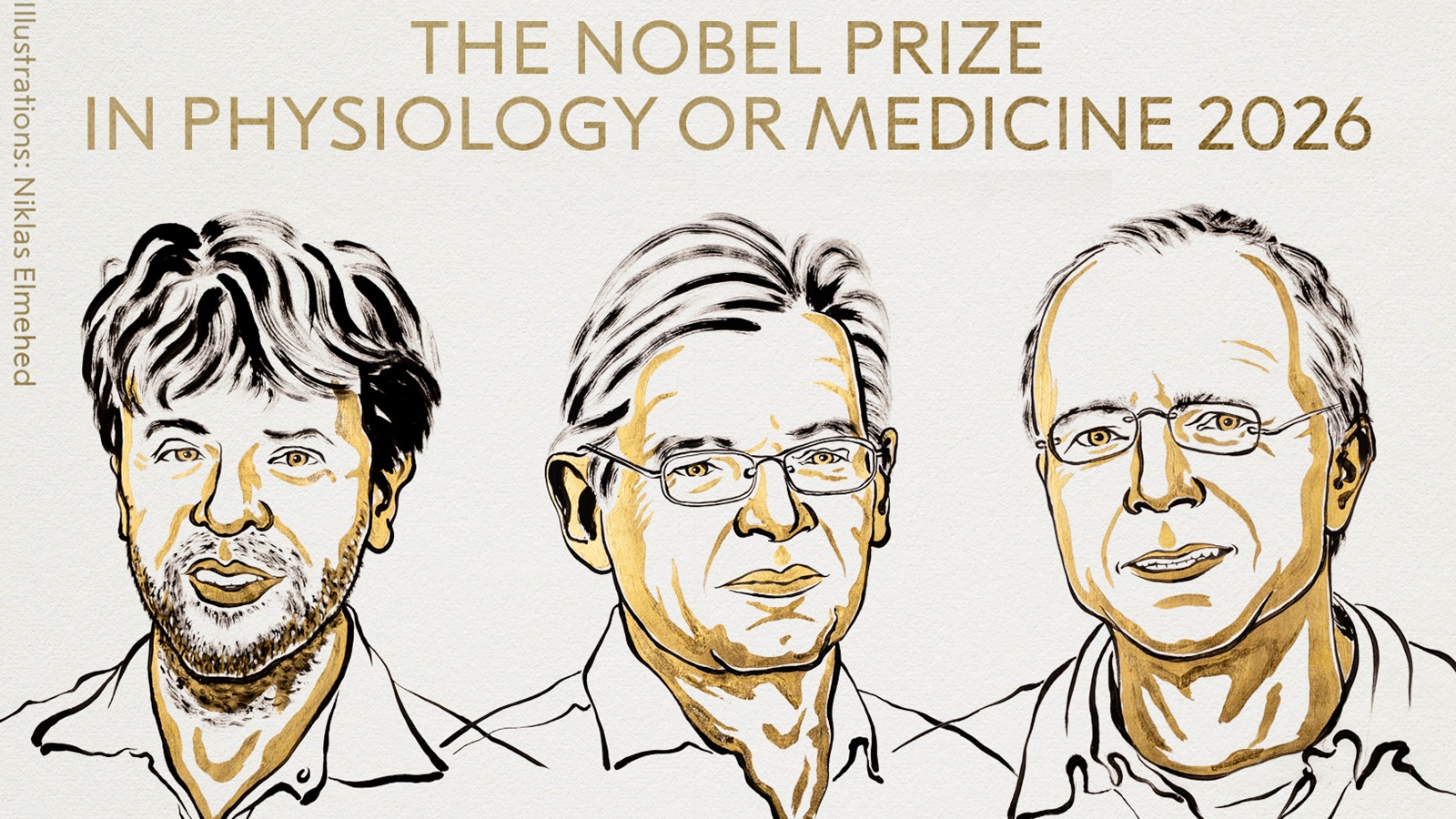
The 2026 Nobel Prize in Physiology or Medicine has been awarded jointly to Karl Deisseroth, Peter Hegemann, and Georg Nagel for their ground-breaking discovery of channelrhodopsin (algae protein) and the development of optogenetics, a revolutionary technique that uses light to precisely control living neurons. This pioneering work, which successfully bridges biology and engineering to map complex neural circuits, earned the laureates a shared prize of 12 million Swedish kronor (approximately $1.2 million USD).
In simple terms, they found a way to control cells with light. Imagine that the brain is a vast electrical network containing billions of tiny cells called neurons. These neurons communicate by sending electrical signals, allowing us to move, see, remember, feel pain and experience emotions. Karl Deisseroth, Peter Hegemann and Georg Nagel helped scientists develop a remarkable way of controlling these electrical signals: using light. Their research led to the discovery and development of light-sensitive proteins, called opsins, that can be placed in specific cells. When light is shone on those cells, the proteins act like tiny switches, turning the cells’ activity on or off. This technology is known as optogenetics — essentially, using light to control genetically modified cells.
BREAKING NEWS The 2026 #NobelPrize in Physiology or Medicine has been awarded to Karl Deisseroth, Peter Hegemann and Georg Nagel “for their discoveries concerning light-gated ion channels and optogenetics.” https://t.co/pkDDEBWtkz
Until optogenetics, scientists had relatively crude ways of figuring out what individual groups of neurons actually do. For example, electrical stimulation might activate many neighbouring neurons at once, making it difficult to know which cells were responsible for an effect. Researchers can now change that. They can make a particular group of neurons light-sensitive and then activate or silence those cells with extraordinary precision. It is a little like moving from switching off the electricity to an entire building to being able to control one particular light bulb.
Scientists can use optogenetics to ask questions that were previously extremely difficult to answer: Which neurons cause a seizure? Which brain circuits are involved in addiction? Which cells are responsible for forming a memory? Which circuits contribute to depression or chronic pain? By switching particular cells on and off and observing what happens, researchers can establish much stronger cause-and-effect relationships between brain activity and behaviour.
This is where the research could have a major medical impact. Diseases such as Parkinson’s disease, epilepsy, depression and chronic pain involve abnormal activity in particular neural circuits. If scientists can identify exactly which cells or circuits are malfunctioning, they may eventually be able to target those circuits much more precisely than conventional treatments can.
So the technology can function as both a research tool and a roadmap for developing future therapies.
Optogenetics has also opened a completely new approach to treating certain forms of blindness. In some inherited retinal diseases, the photoreceptor cells that normally detect light are destroyed. Researchers have explored introducing light-sensitive proteins into other surviving retinal cells, effectively giving those cells a new ability to respond to light.Human studies have provided early proof that this approach can produce some visual perception in people with severe retinal degeneration. It is not yet a general cure for blindness but demonstrates how scientists can potentially use the principles of optogenetics to build a new light-detection system inside a damaged nervous system.
Researchers are investigating light-controlled biological systems involving immune cells, cellular signalling and drug delivery. In the longer term, such approaches could potentially allow medicines or biological processes to be switched on only at a particular location or at a particular time.That could be particularly valuable in medicine, where one of the biggest challenges is often doing something to the diseased cells without affecting healthy cells.
The significance of Deisseroth, Hegemann and Nagel’s work goes beyond a single treatment or device.They helped give scientists something that biology had largely lacked: a precise control switch for individual cells. Instead of simply watching neurons fire, researchers can manipulate them and ask what happens. The immediate payoff has been a revolution in basic neuroscience; the longer-term promise is a new generation of highly targeted treatments for disorders of the brain, nervous system and potentially other organs.