Too many air quality indicators may complicate public messaging for haze: Grace Fu - The Straits Times
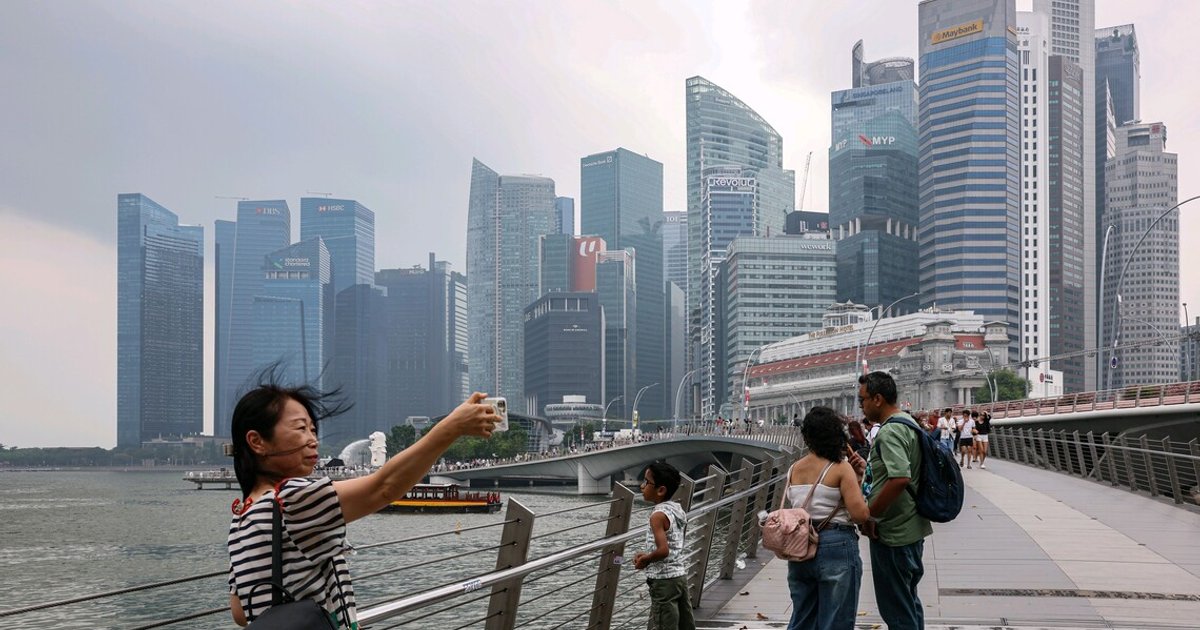
The NEA currently provides two indicators of air quality: a PSI forecast for the next 24 hours, and an hourly PM2.5 reading.
SINGAPORE – Having too many air quality indicators may complicate the government’s messages for the public during haze episodes, said the Minister for Sustainability and the Environment Grace Fu on Nov 3.
The use of forecast 24-hour Pollutant Standards Index (PSI) for planning and hourly PM2.5 for taking decisions has worked well, Fu told Parliament.
“We don’t think there is a need to include 12-hour, 24-hour or 48-hour PM2.5 forecasts as having too many indicators may complicate our public messages,” she added.
She was responding to a question from WP’s Fadli Fawzi (Aljunied GRC), who had asked if the National Environment Agency (NEA) under her ministry can provide PM2.5 forecasts to help Singaporeans plan their daily activities during haze.
“I’m very minded that… our forecast and advisory are clean, succinct, (allowing) people to (easily) manage activities,” she said.
PM2.5 are small particles that are the dominant pollutant during transboundary haze episodes.
The NEA currently provides two indicators of air quality to help people plan their activities: a PSI forecast for the next 24 hours, and an hourly PM2.5 reading.
The 24-hour PSI forecast indicates what the air quality is expected to be in the next 24 hours and can be used to plan activities ahead of time.
The forecast takes into account the prevailing air quality, local and regional weather conditions, and the regional hotspot and haze situation assessed through satellite imagery, said Fu.
Meanwhile, PM2.5 readings refer to concentrations of the dominant pollutant particle during haze episodes. It provides a more reflective indicator of current air quality.
It is based on the readings from its 23 air quality monitoring stations installed across the country.
People should refer to the PM2.5 values for planning their immediate activities, and to the PSI forecast if they are planning an outdoor activity the next day.
The National Environment Agency (NEA) will continue to review how its forecasting and public information services can be enhanced to provide more useful guidance, said Fu, adding that providing timely and reliable information is an important part of its ministry’s public health response.
Fu also said that NEA releases fortnightly forecasts but noted that the forecast is less accurate as the horizon of the forecast increases.
The 1-hour PM2.5 readings provide the shortest possible forecast and is the “most accurate” in giving the public a sense of the air quality before conducting an activity, she said.
During the sitting, Fu also fielded questions on the Government’s response to the haze situation – the worst experienced in Singapore in over a decade since the 2015 crisis.
On masks, for instance, she said that the priority for the two distribution exercises had been Singaporeans who are more vulnerable to the health effects of haze, or who may have limited means in collecting free haze masks.
This includes seniors, pregnant women, children, individuals with specified medical conditions, holders of Community Health Assist Scheme Orange and Blue card, those with Medical Fee Exemption Card, and those who are on ComCare.
“This ensures that assistance reaches those who need more support,” she said.
N95 or equivalent masks are generally not required when a person is indoors or outdoors for short periods, such as commuting.
In the case of haze, there is no risk of people-to people transmission which would have required all Singaporeans to be masked up as soon as possible, said Fu.
During the latest haze episode, two mask distribution exercises were conducted.
The criteria of those eligible to collect the masks was expanded in the second round that started on Oct 23, with all Singaporeans aged 60 and above allowed to pick up the face coverings. In the first round, only seniors aged 67 and above were eligible.
Close to one-third of Singaporeans are eligible under the expanded criteria, she said, adding that close to 30% of them had collected their masks as at Oct 29.
“We will continue to review the scale and eligibility of distribution as conditions evolve, and are prepared to expand support if necessary,” she added.
Nadia Ahmad Samdin (Ang Mo Kio GRC) also raised questions on whether the ministry has assessed the impact of prolonged haze on agricultural productivity locally and in Singapore’s food import sources, and if there are risks to the food supply resilience and affordability here.
Fu said that the recent haze has not affected Singapore’s food supply.
“Singapore imports food from more than 180 countries and regions. Sourcing broadly helps to reduce concentration risks and enables industry to switch to alternative sources when needed,” she added.
While wholesalers have feedbacked that prolonged haze may impact vegetable growth, Fu said that for local farms, the overall impact has generally been “minimal” with operations returning to normal following recent improvement in air quality.
The Singapore Food Agency (SFA) will continue to monitor the impact on food supply and implement measures to address concerns as necessary, she said.
Fu also noted that while the haze has affected footfall at hawker centres and markets, it is also compensated by increase in take-away orders.
She added that NEA will continue to monitor the impact on hawkers, although there is currently no plan to introduce additional haze-specific financial assistance.
Chin Hui Shan is a journalist covering the environment beat at The Straits Times.