
Top global government ministers discuss goals, strategies at astronautical/space congress in Türkiye - Anadolu Ajansı
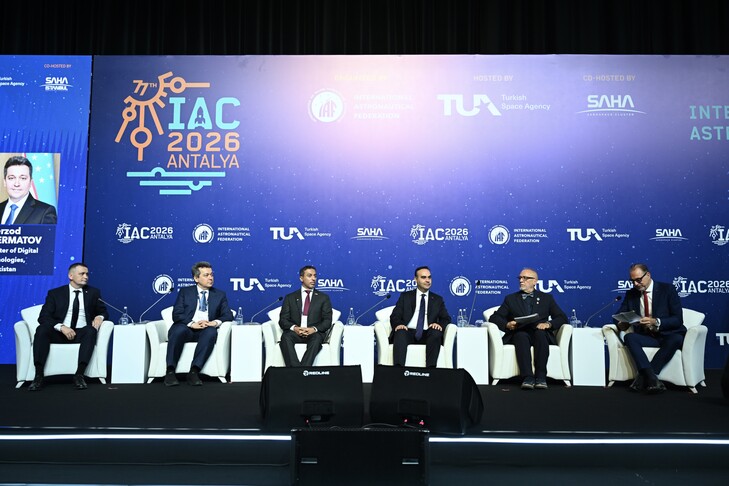
Top international government ministers and senior officials gathered Monday in the southern Turkish city of Antalya for the 77th International Astronautical Congress (IAC 2026) to discuss national space strategies and address the commercialization of the Earth’s orbit.
Mehmet Fatih Kacir, Türkiye’s industry and technology minister, said at the gathering that space science investments are key to producing high-value-added technologies and maintaining a competitive edge.
“Space is the backbone of value-added goods and services production, and Türkiye has made investments in recent years, including launching our homegrown satellites,” he said, telling how Ankara initially launched high-resolution imaging satellite Imece in 2023, and since the launch of the Turksat 6A communications satellite, Türkiye joined the ranks of just a dozen countries worldwide that can design and make their own communications satellites.
Kacir said one of Türkiye’s top priorities is to land on the lunar surface, while efforts are underway to construct a technopark in the capital Ankara and a spaceport in the African nation of Somalia, one of Türkiye’s allies, to secure independent access to space.
Ahmad Belhoul Al Falasi, the Emirati sports minister and chair of the United Arab Emirates Space Agency, said the UAE’s national space strategy for 2031 is focused on doubling the revenue growth of their space sector and ranking among the top 10 space economies worldwide.
“We’ve come to realize that it’s not necessarily funding — they (startups) need access to markets with our bilateral trade agreements, and they need access to space infrastructure, such as fire testing, launch sites, clean rooms,” he said.
“Thirdly, access to talent — we’ve been lucky in the UAE we’ve been able to attract the smartest talent within the region and locally.”
“In summary, the first decade was building the basics, but now in the second decade, we want to get the private sector involved to develop a vibrant and interconnected ecosystem that strikes a balance between the public and private,” he added.
Michal Jaros, Poland’s economic development and technology secretary, said next year’s International Astronautical Congress will be hosted by Poland, in the western city of Poznan.
Space has great importance for both security and the economy, he said, adding that satellite technologies grew to support many areas, such as navigation, transportation, communications, agriculture, and crisis management.
Since Poland hosted the congress 60 years ago, in 1964, the country has undergone a complete transformation, he said.
“We moved from isolation and cooperation, and this is the direction we all need to take when we think about space — if we want space to remain safe, sustainable, and available for peaceful activities, and for the future generations, we need more cooperation,” he said. “See you in Poznan next year.”
Sherzad Shermatov, Uzbekistan’s digital technologies minister, said space has been one of his nation’s priorities for six centuries, back from “when the ruler of Samarkand built the (word’s) biggest observatory.”
“Our aim is to bring this national priority back under the leadership of our president,” he said, adding that one of the nation’s goals is to reignite the youth’s interest in science and technologies, and that the country is preparing to host the International Astronautical Congress in 2028 alongside other efforts to launch their satellite and send young Uzbek space travelers into orbit.
Juan Cruz Cigudosa, Spain’s science, innovation, and universities secretary, said the Spanish space sector grew exponentially in 2022-2025, as Spanish space firms boosted their revenues by 40% to €1.5 billion ($1.68 billion) per year, while employment in the sector surged 52%.
“At the latest ministerial meeting of the ESA (European Space Agency) in November 2025, Spain became for the first time the fourth-largest contributor to ESA — we will contribute €1.55 billion between 2026 and 2030,” he said. “This represents a threefold increase in our annual contributions from 10 years ago.”
Cigudosa added that Spain is a candidate to host the 80th International Astronautical Congress in Barcelona in 2029 to discuss sustainability, climate resilience, and water issues.


/https://i.s3.glbimg.com/v1/AUTH_63b422c2caee4269b8b34177e8876b93/internal_photos/bs/2026/q/R/owiim8SGKSNKpfVtuoDQ/foto28pol-101-betsreune-a10.jpg)