Toronto mayoral debate: Here are key takeaways from last night’s clash between Chow, Bradford and Alexander - Toronto Star
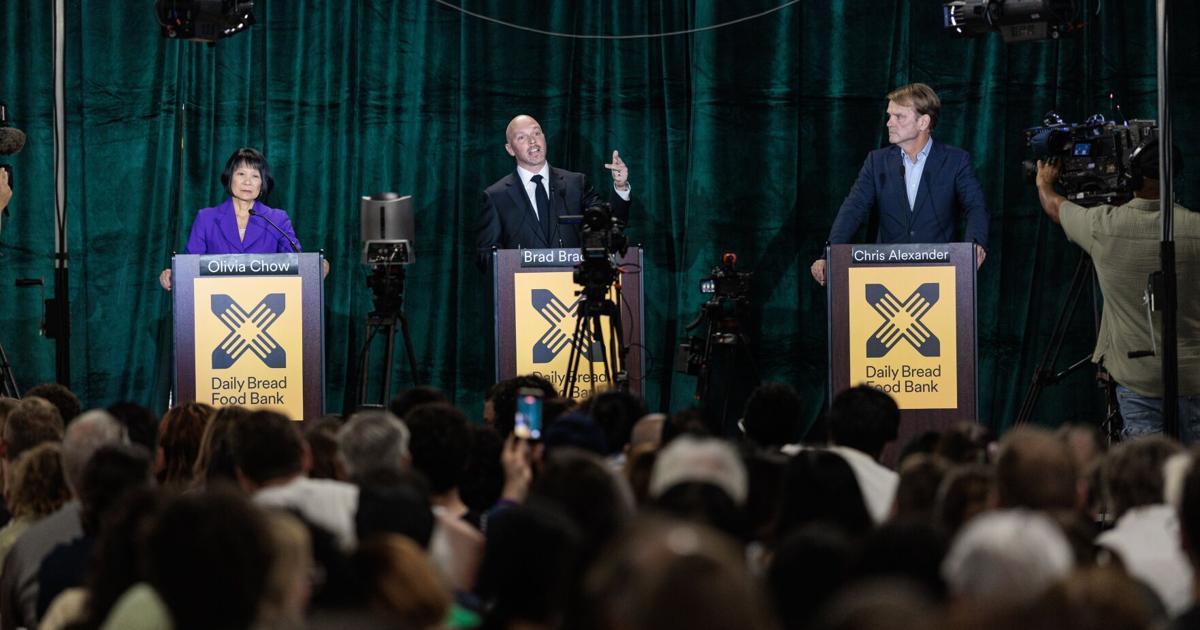
The three leading candidates for Toronto mayor squared off against one another for the first time Monday evening.
Olivia Chow, Brad Bradford and Chris Alexander, the three frontrunners in Toronto’s mayoral race, take part in the first debate of the election cycle at The Daily Bread Food Bank in Etoboicoke.
Olivia Chow defended her record on affordability issues but faced strong attacks from her opponents, as the three leading candidates for Toronto mayor squared off against one another for the first time Monday evening.
The race officially started in May, but it’s expected to intensify as the candidates ramp up their campaigns and attend more events in the six weeks between now and the Oct. 26 voting day.
The event hosted Monday by the Daily Bread Food Bank at its South Etobicoke headquarters was the earliest opportunity Chow, Brad Bradford and Chris Alexander had to land a direct blow against each other. They fielded questions about poverty, transit, housing, and food insecurity, which organizers said were among the most pressing issues facing whichever candidate wins this fall, as the high cost of living in Canada’s largest city continues to push more families to use the Daily Bread’s services.
The evening’s themes may have been expected to play to the strengths of Chow, the incumbent, who has focused on policies she says will help ease families’ financial burden as she seeks a second term.
But while at points her remarks drew enthusiastic applause, she also endured some boos from the Etobicoke crowd. And throughout the debate’s 90 minutes she had to weather salvos from her two main rivals, who charged that she has made life in the city less affordable while failing to deliver on basic services or address Toronto’s most urgent problems.
There are certain to be more twists in the election, with more debates to come and a total of 53 candidates on the ballot. Here are the highlights of Monday’s event:
The candidates flash yes-or-no answers with their paddles during a rapid-fire portion at the debate.
As expected, Chow did her best to highlight what she said was her record of tackling affordability issues. That included her expansion of the city’s student nutrition strategy, a $32 million program that this fall is being extended to all 325,000 of Toronto’s public school children. She also touted her administration’s three straight years of TTC fare freezes, and progress toward building more affordable housing.
Bradford, who is councillor for Beaches—East York, countered by arguing Chow’s property tax increases, including a record 9.5 per cent in her first budget, have made life in Toronto more costly. Compounded, the tax hikes represent an increase of almost 20 per cent, and have added hundreds of dollars to homeowners’ annual tax bills. He also took aim at her record on affordable housing, saying that while she has promised to approve 65,000 rent-controlled homes, so far only about 1,500 have been built.
The councillor said “families can’t afford” Chow’s policies and blamed them for driving more people to food banks.
Alexander, a former Conservative MP for Ajax-Pickering, said he decided to run for mayor because under Chow he saw a city mired in problems, with high taxes, rising food insecurity and perennial budget problems. He said his campaign has “the most credible plan to get Toronto back on track.”
Bradford took aim at Chow over what may be a sore point among some of the former NDP MP’s supporters by asserting that she hasn’t done enough to push back against Conservative Premier Doug Ford.
Whether it be on Ford’s moves to close the Ontario Science Centre or overhaul Ontario Place, or expand the island airport, “I can’t think of a single file where you’ve actually effectively been able to push back against the premier from doing exactly what he wanted to do,” Bradford told Chow. Toronto needs a leader “who’s actually going to stand up for Toronto,” he said.
Chow, who has taken credit for helping stop Ford’s airport proposal for now, defended her record of forging positive relationships with higher levels of government that she said had yielded billions of dollars in federal and provincial support for the city including funding for new subway cars and housing assistance. “There is so much more we can do because we have the confidence of Prime Minister (Mark) Carney and the premier of Ontario,” she said.
A young man delivers his verdict as Olivia Chow speaks. Some of her messages were applauded.
One of the most heated moments came when Bradford pressed Chow over her decision not to exercise her right to sit on the police board. The board provides oversight of the force, and while it doesn’t have the ability to make day-to-day operational decisions, Bradford has argued that Chow is shirking her responsibility by not taking her seat as previous mayors have done.
Bradford asked her to explain to “Torontonians who don’t feel safe” why she had chosen not to take a more direct role in policing.
Chow responded by talking about the promises she had made to victims’ families to make the city safer, and citing stats showing major crimes like homicides and shootings have declined. She also noted 911 wait times have improved under her administration, but initially didn’t directly provide her reasoning for not sitting on the board. As some in the crowd heckled, she ultimately explained that the police board was already “doing a very good job.”
The mayor acknowledged concerns about crime and said residents deserve to feel safe. She told the audience that Bradford “wants you to be scared.” The councillor has campaigned on crime issues and made promises such as hiring 1,000 more police officers, an expensive proposal he has said he will release funding plans for later in the campaign.
There may have been three people on stage, but Bradford often gave the impression he was alone up there with Chow.
The councillor has been intent on framing the election as a two-way fight between himself and the current mayor despite Alexander’s surprise entry to the race in late July. That’s because while Alexander is polling a distant third, the former Conservative cabinet minister has the potential to take votes from Bradford, as both are fighting to win over residents unhappy with Chow.
Bradford is eager to make up ground on the mayor, who according to one recent poll by Liaison Strategies has the support of about 50 per cent of leaning and decided voters, compared to about 39 per cent who back Bradford.
Throughout the night the councillor focused his rhetoric on Chow and passed up the chance to attack Alexander. He said voters have a choice between “two distinct and different directions for the future of Toronto” — meaning his and the mayor’s — and called for “real change.”
For one segment, moderator and Daily Bread CEO Neil Hetherington asked the candidates to respond to a series of yes-or-no questions using paddles with “yes” written on one side, and “no” on the other.
He started with some softballs — “have you ever found a raccoon in your green bin?” — but the more substantive questions did yield some notable, if not nuanced, replies.
The trio agreed on some important policies, such as allowing six-unit multiplexes citywide. They also agreed to keep property tax increases “at or below” the rate of inflation. (Chow has previously said she would cap them “at or around” inflation).
Both Alexander and Bradford signalled they would use strong mayor powers that would allow them to overrule a majority of council on some policies, while Chow stuck to a pledge to not use them.
Chow was also the only one who said she would support city-run grocery stores.
When asked about the hot-button topic of allowing new data centres in the city, Alexander and Bradford signalled they would permit them, but despite the moderator’s instructions to give a single answer, Chow waved her paddle back and forth. She said the city is currently studying the issue.
Ben Spurr is the Star's city hall bureau chief, based in Toronto. Reach him by email at bspurr@thestar.ca or follow him on Twitter: @BenSpurr.