Toronto mayoral race tightens as Olivia Chow’s lead over Brad Bradford shrinks in a new poll - Toronto Star
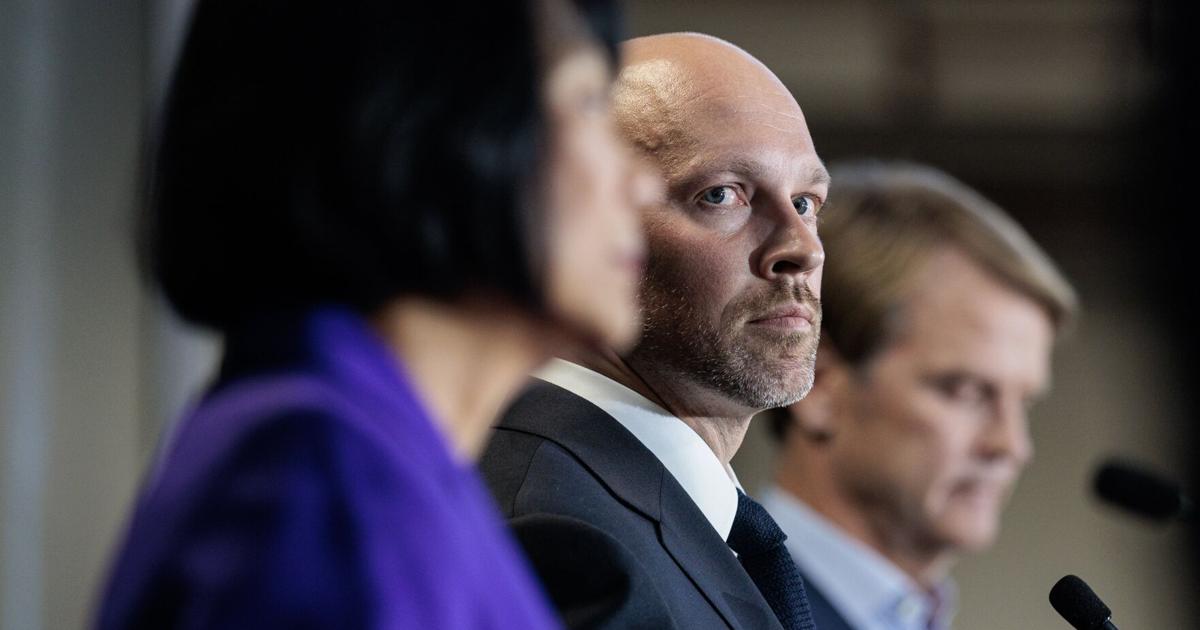
A new poll by Liaison Strategies found Olivia Chow was seven points ahead of Brad Bradford, down from 11 points two weeks ago.
A new poll suggests mayoral candidate Brad Bradford is gaining ground on incumbent Olivia Chow in the municipal election. Rival Chris Alexander is in third place with 10 per cent.
Mayoral hopeful Brad Bradford has made up ground on incumbent Olivia Chow in this fall’s Toronto election, according to a new poll.
With just under five weeks to go until the Oct. 26 voting day, the public opinion survey by Liaison Strategies shows that 47 per cent of decided and leaning voters intend to cast a ballot for Chow, compared to 40 per cent who back Bradford. That gives Chow a seven-point lead over Bradford, the councillor for Beaches—East York, down from 11 points two weeks ago.
The survey, which was conducted in co-operation with the Star, has candidate Chris Alexander, the former federal cabinet minister and MP for Pickering-Ajax, in third with 10 per cent.
The findings broadly matches the results of a Mainstreet Research poll published last week.
“I think the race is tightening,” said David Valentin, principal at Liaison. But he noted that with almost one-fifth of respondents undecided there is “a lot still to be determined.”
Valentin attributed Chow’s shrinking lead in part to growing media coverage of the race. Following the first debate with all three main candidates on Sept. 14, there has been growing attention on the election and Torontonians are making up their minds.
But as Bradford inches closer to being within touching distance of Chow, Valentin cautioned that the numbers aren’t all good news for the councillor. As more voters are becoming familiar with Bradford, the portion of respondents who say they have an unfavourable impression of him is growing faster than those who have a favourable one. Thirty-seven per cent says they have a negative view of Bradford, compared to 33 per cent who view him favourably.
“There’s positive change for him, but the question is, is it sustainable change?” Valentin said.
Liaison also asked questions about which issue was the most important to respondents when deciding which candidate to support. Nearly a quarter, or 23 per cent, said cost of living. That was followed by housing affordability at 19 per cent, and crime and public safety at 17 per cent.
Chow, a former NDP MP and veteran progressive, has focused much of her campaign on affordability issues, promising to put a weekly cap on TTC fares and touting what she says is her record advancing social housing, protecting tenants and expanding child nutrition programs.
Bradford has tended to focus more on crime and public safety, advocating mandatory treatment for drug addicts, pledging to hire more front-line police officers, and criticizing Chow for not taking a seat on the police board.
Valentin said that given how much residents prioritize affordability issues, which are being exacerbated by geopolitical events like the U.S.-Iran war, he was surprised Bradford’s team hasn’t put more emphasis on policies that would lower Torontonians’ cost of living.
“I find it so fascinating that the Bradford campaign has not put big affordability measures in front of people,” he said.
The Mainstreet poll conducted between Sept. 14 and 17 found that among decided and leaning voters, Chow had about 46 per cent support, followed by Bradford at roughly 38 per cent and Alexander at just under 10 per cent.
It found crime and safety to be a major concern for respondents, with just over half saying the issue would be extremely or very important in how they voted. Mainstreet president and CEO Quito Maggi predicted the effect of the issue on the outcome of the election “cannot be overstated.”
The Liaison Poll was conducted Sept. 19 and 20 using a random sample of Toronto residents, with interactive voice recording technology. For the total sample, the margin of error is 3.1 percentage points, 19 times out of 20.
The Mainstreet poll also had a sample size of 1,000 Torontonians, and was conducted using interactive voice response. The results are considered accurate within plus or minus 3.1 per cent, at a 95 per cent confidence level, according to the company.
Ben Spurr is the Star's city hall bureau chief, based in Toronto. Reach him by email at bspurr@thestar.ca or follow him on Twitter: @BenSpurr.